

BLOOM
roots
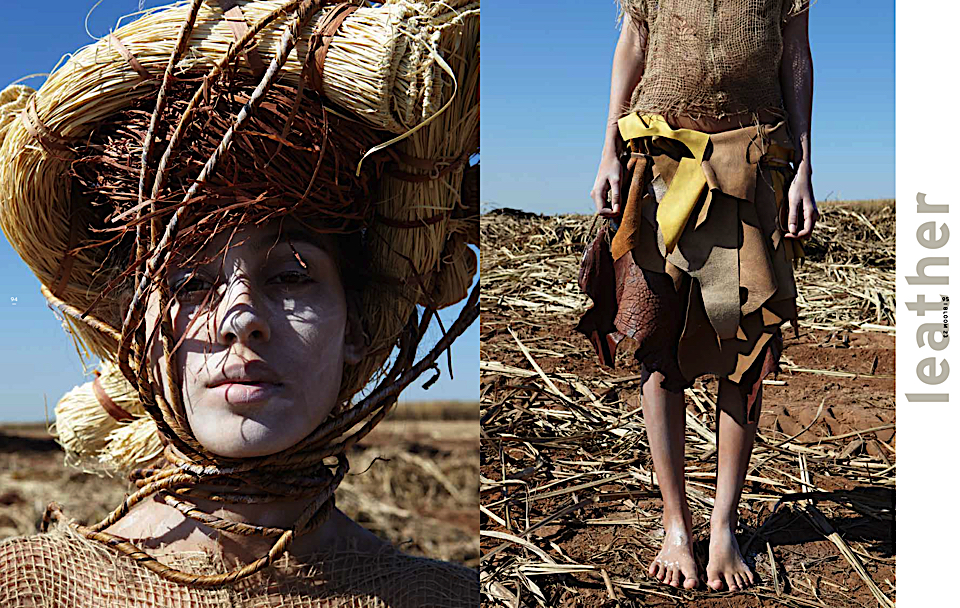
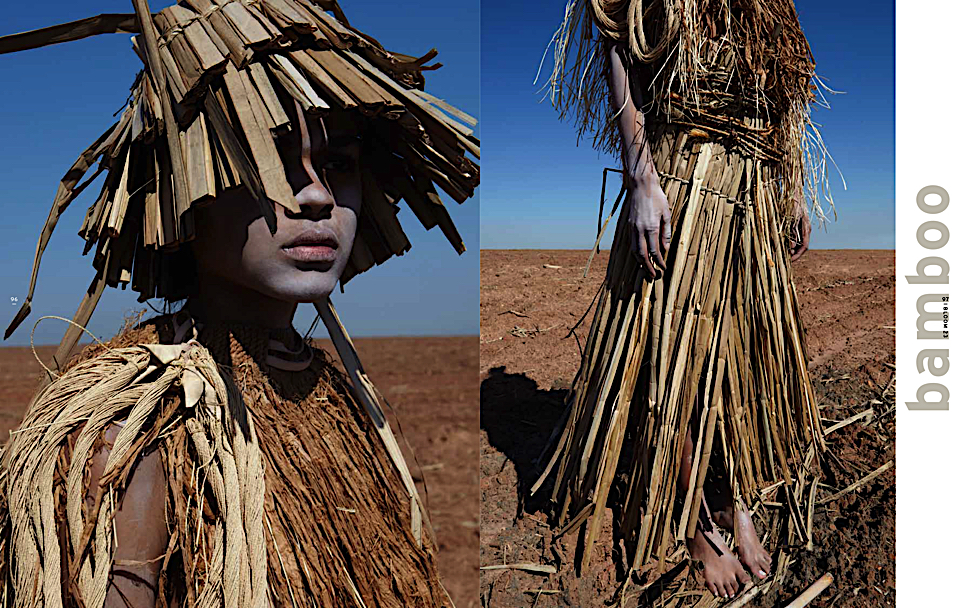
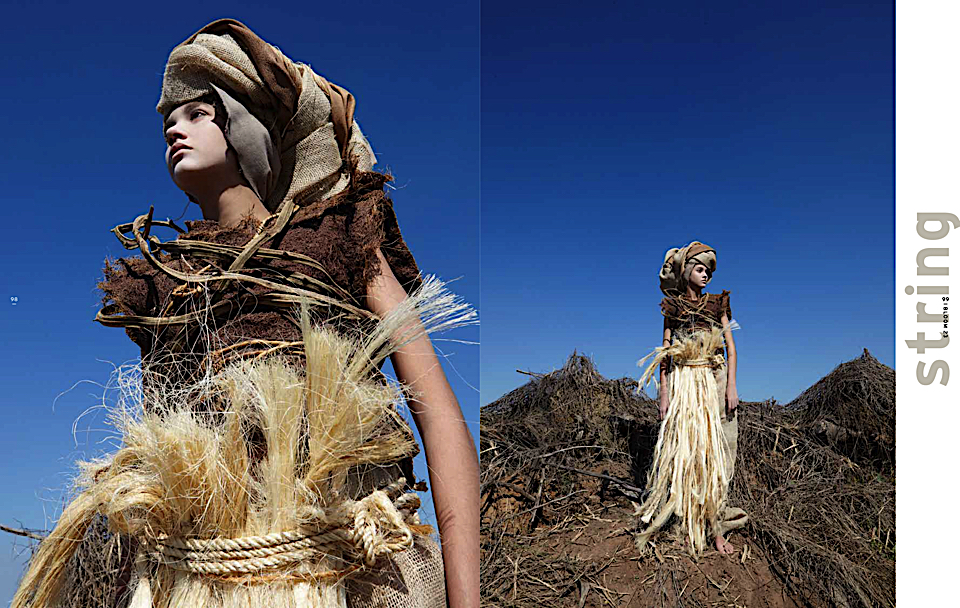
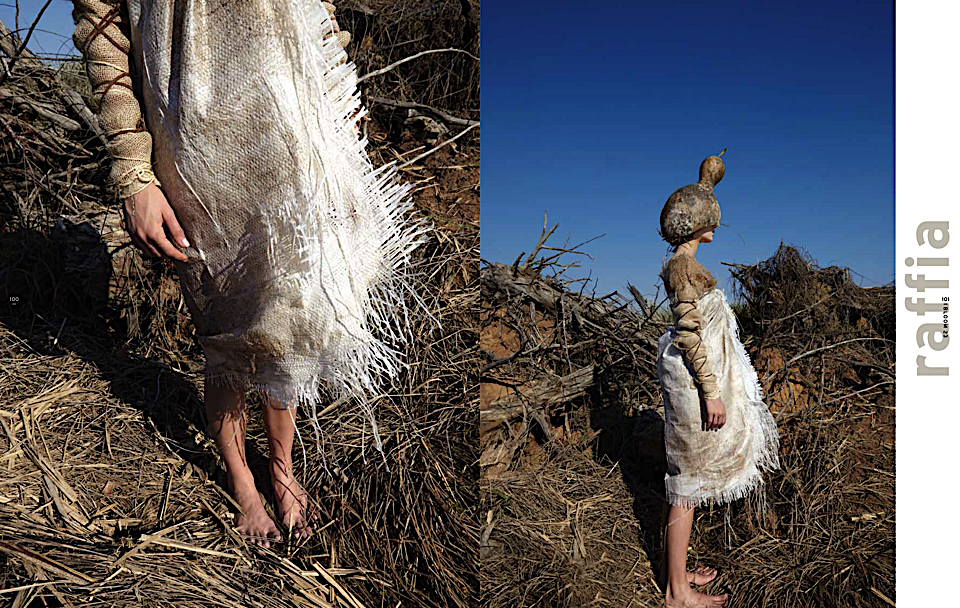
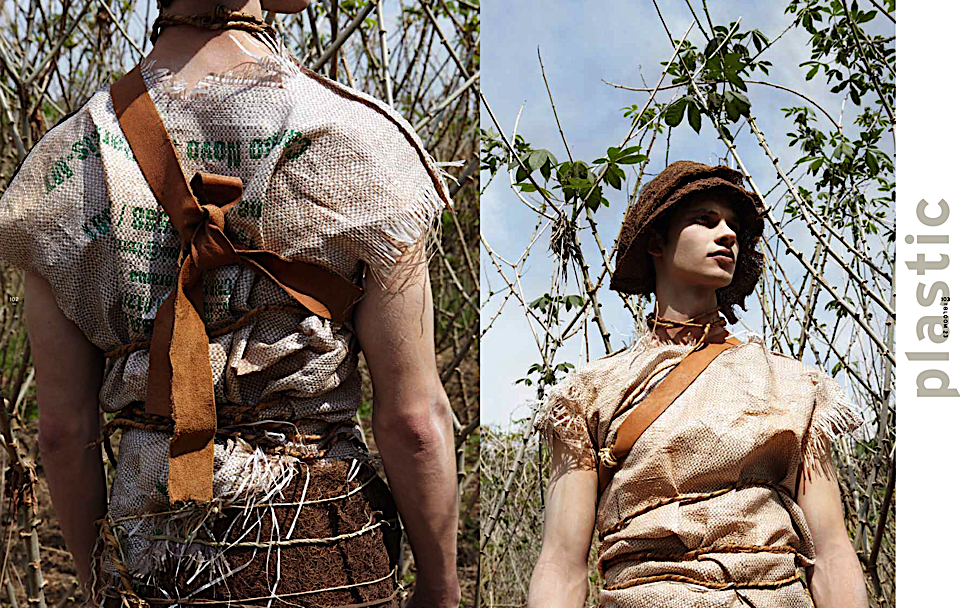
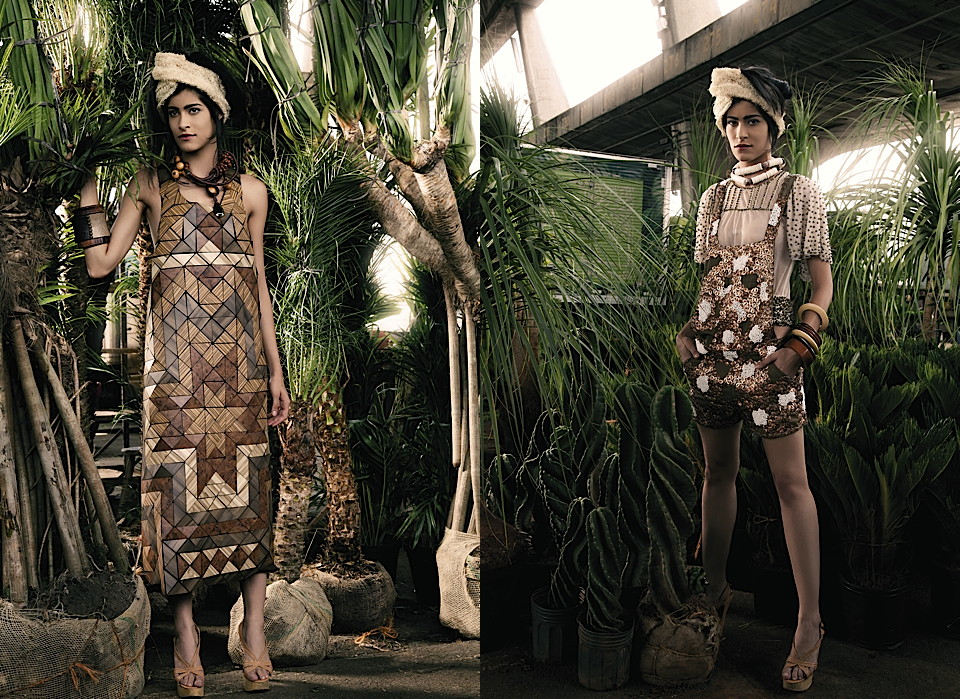
The sugarcane field is calling with its hot and humid environment, inhospitable, challenging, mesmerizing. The eye can see beyond the horizon, the ear can hear the echo of the faraway river, the skin can feel the cindering heat. The plane seems to vibrate and moves up and down in a ritual dance. The drum of the shaman reverberates from its dry stretched skin. Life is a matter of endurance. A creative survival mode made with a make-do aesthetic. The grasses are waving and give the illusion of air, although the stifling heat is numbing the mind, reducing humans to primitive beings. Just thinking of water, dreaming of air. Contemplating the arid beauty of it all. These grasses become products of culture with baskets, roofs and habitats, plant fodder for miraculous indigenous fiber. Fibrous textiles are coming to the fore with waving grass skirts and grassroots design, making a primitive and archaic impression, steering fashion to an animistic core. The grasses are multiple and represent an ecosphere that hosts many endemic eagles, macaws and toucans adding their strident song to the bewitching rhythms. Ants, termites and butterflies are busy building their habitats; a whole world concerned with the creation of life. As the creation of style it requests a sense of urgency, a fight for survival, a quest for derision. A holistic ecosystem that brings out the best in the human imagination and steers it to new heights, conceiving unknown territories of visual experiences. The plateau is on a high altitude and makes people short of breath, feeling euphoric as if the grasses could be consumed as hallucinogens. A weird experience that reflects the amazing costumes that are born from fiber, generated by grass, consumed with human waste as well. Thus the natural and the artificial blend and become one, diluting the idea that everything needs to be from nature, including human nature as a source of synthetic grasses, made to wrap and protect. Gathering fruits, fibers and firewood the nomadic ancestors would roam the grasslands living in survival mode, hunting monkeys, but hunted by jaguars and ocelots. Wading through the dense and dry grasses that have cutting edge properties, made to defend themselves, the loose hunting outfits are reflected in the gathered skins and protective armor made from dense textiles wrapped with rope. The head is covered for the punishing sun. The feet are wrapped in rope made from fat plants. Improvized as only Brazilian creation can achieve. Lidewij Edelkoort creative direction Sergio Machado styling Lucius Vilar photos Rogério Cavalcanti photo assistant Jorge Escudeiro hair and makeup Raul Melo image treatment Iung Studio macramé Gabriela Santili models Amira, Lais Botelho, Mika Max, Rene Maximo, Sabrina Vieira, Samira, Sostenes, Thaina Pires
All matter is used for functional purposes, all matter is seen as decorative as well. The grass is woven and braided, the cloth is layered and stitched, the skins are tanned and rustic, the grass roots of Brazilian creation is in the abundance of its raw materials, its generosity of growing matter, its aesthetic.
going for gold

Surfing is a sport that requires determination, balance, strength and endurance. At one with the elements, surfers have an almost spiritual connection with the sea, in sync with its rhythms, trusting it, placing their lives in nature’s hands. To be a surfer, one has to have a lot of faith: in the current, in timing, in intuition, and so why not in more daring fashion?
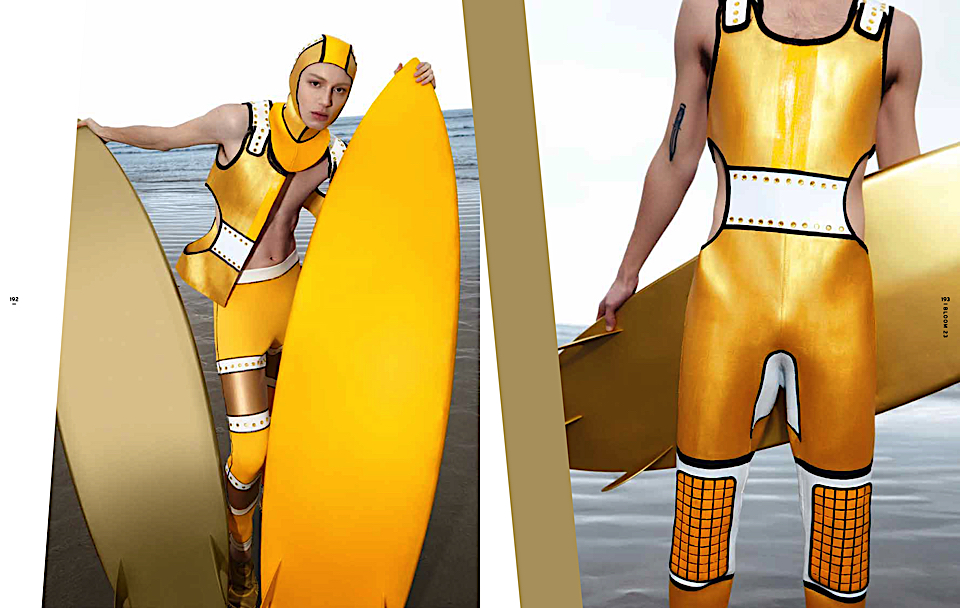
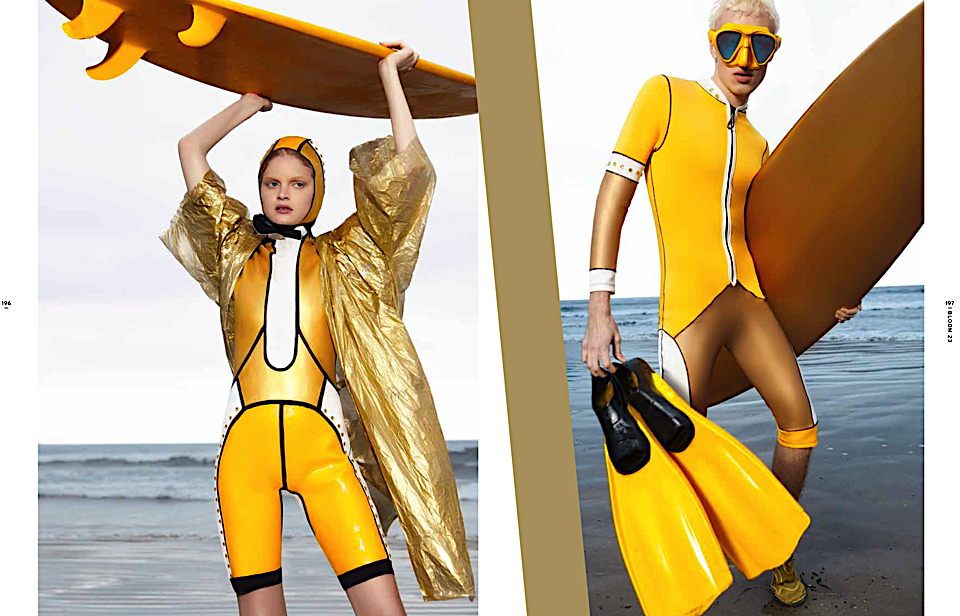
Inspired by activewear principles, items like bodysuits, vests and jackets could become a new style hybrid for surfing; seeing trends like hoods, neoprene, perforation and colour-blocking all turn aquatic.The muscular articulations of the legs and body can be followed, further emphasizing the movements and flexibility that surfing requires.
A new futurism announces a changing tide, with girls and boys hitting the beach like a troop of otherworldly aliens landing on the shore. Yellow will be uplifted by the use of gold, from wetsuits and swimmers to light-sheath rain coats as accessories. Matte metallic finishes that are a new way of standing out in the water and making a splash with spectators. And now that surfing has been approved as an Olympic sport at the 2020 Tokyo Games, there’s no reason why pro surfers everywhere won’t want to go for gold!

fafa
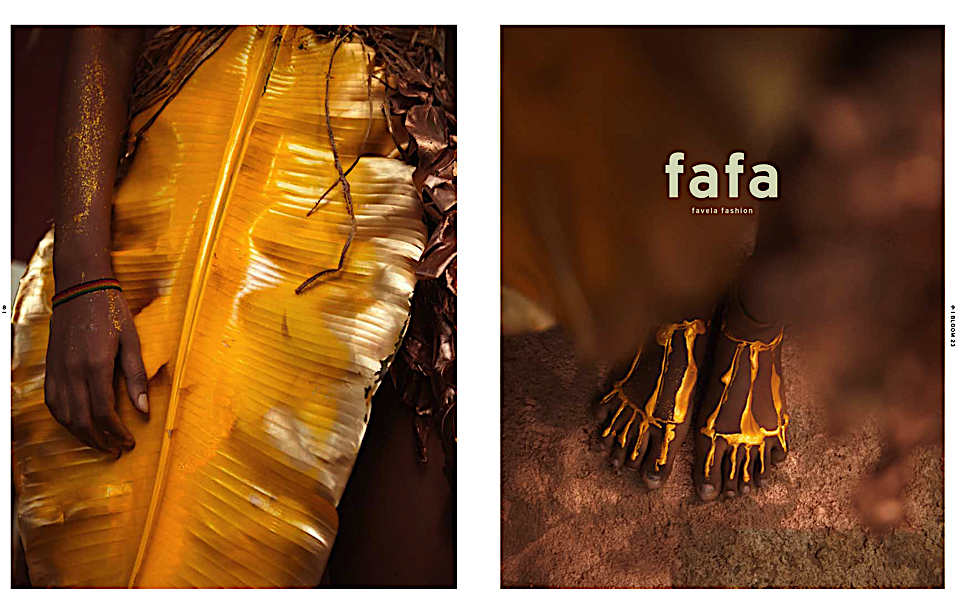
The favela is nestled between two luxurious neighborhoods, a sexy and dangerous place bustling with life, screaming with art, lamenting with songs and buzzing with its people. People of all colours and all genders live there, which is making it a dark place with rampant racism and threatening homophobia. The quartier of Vidigal is the navel of the gigantic Rio de Janeiro, and the meandering intestines of the place read like the brains of society, the bowel movements of its youth premonituous of another more creative and entrepreneurial future. Moving up and down over its hills is a patchwork of houses made of discarded materials and make-do design where people live and dance in the narrow alleys, creating a close-knit society of indiscernible inventiveness and power to adapt to new situations, to adopt new ideas, to improvise. No wonder therefore that fashion is born in this favela. Fashion design educated by a woman from France, a powerhouse. With courage and vision, she steers her students away from trauma towards a future of independence. She gives her life to her kids and guides them in all matters of life, including creation. Their education is free and open to all young Brazilians. Only twenty talents are selected from eighteen hundred portfolios. Each year, once a week the handpicked students learn how to conceptualize and design, also once a week how to make patterns and clothes and a third day is spent learning about marketing and branding, how to create images, videos, installations. During the other days, the students can earn some pocket money.
At the end of the second semester, a collection of five pieces is developed and shown at São Paulo Fashion Week, in the presence of the press and professionals. Widening horizons. The school of Casa Geraçao Vidigal is the students’ home and castle, shielding them from the environment, presenting them with another existence, a possible future. In the second year, the young people (from 18 to 25 years old) are enrolled in the school’s creative agency; they are oriented on how to work with clients, how to process information and how to think commercially. Acting as an incubator, this year is used to boost morale and learn the business end of creating a start-up, how to make one’s own collection, how to find a placement in the industry.
The Moda Fusion association, which was created a decade ago by the formidable Nadine Gonzalez, has as vocation to identify, educate, promote and introduce the favela talents to the world. Thus, sweatshirts were painted by local women and sold by Colette in Paris, as well as decorative pareos conceptualized for the Bon Marche department store. A poly-sex perfume called “TRAME” was developed with the fragrance house Firmenich, and a street-wear trend book conceived for the Peclers agency. Winning the first prize for the decoration of a luxury hotel for the Accord Foundation gave the students the confidence to communicate with the creative industries.
The school has a modest annual budget of 150.000 euros. Unfortunately Brazilian brands are scared to be associated with the favela, and do not act as benefactors either, at least for now. Not even the school’s reduced budget is capable of stopping the passionate Nadine. She is working on a new building to house the institute, with one floor for the local women producing special collections, one floor for education and one floor for the agency and incubators.
Her next even wilder plan is to move this genius concept to her mother country and locate the school in the out-skirts of Paris, at the commune of Pantin, where art galleries 13 and ad agencies are seeking solace from gentrification. Another hot spot to consider. Furthermore, another challenge to address the huge social inequalities of France.
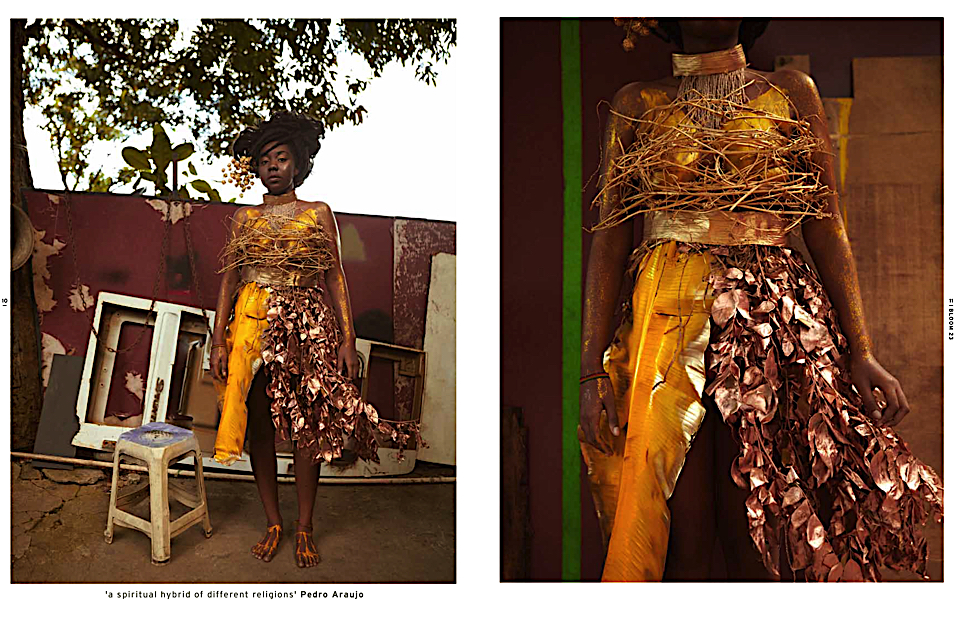
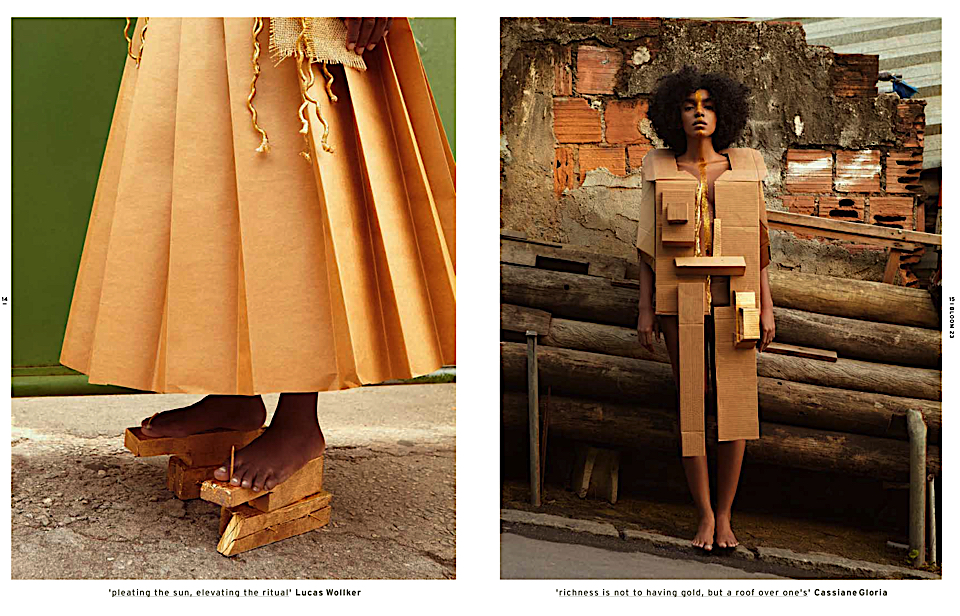
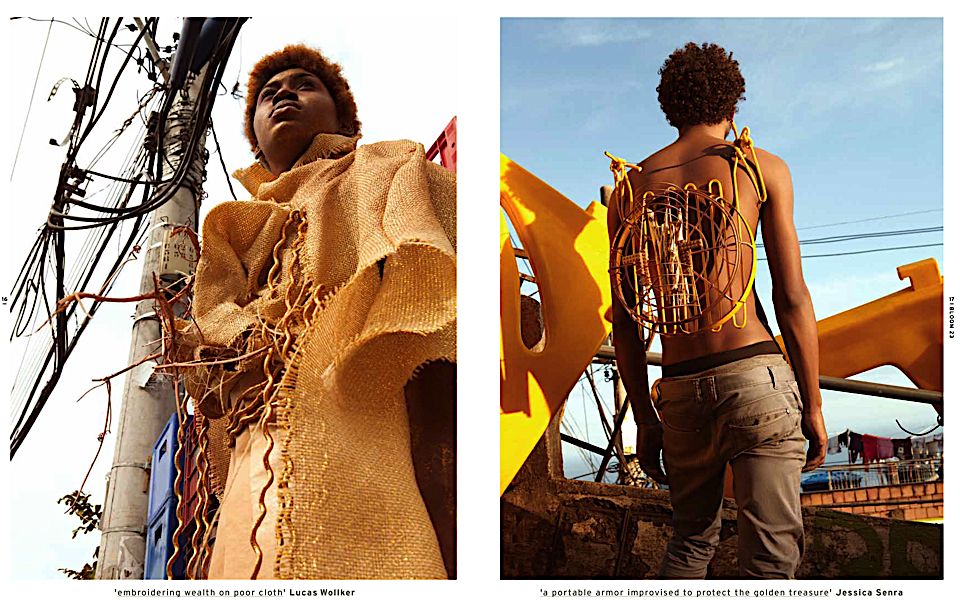
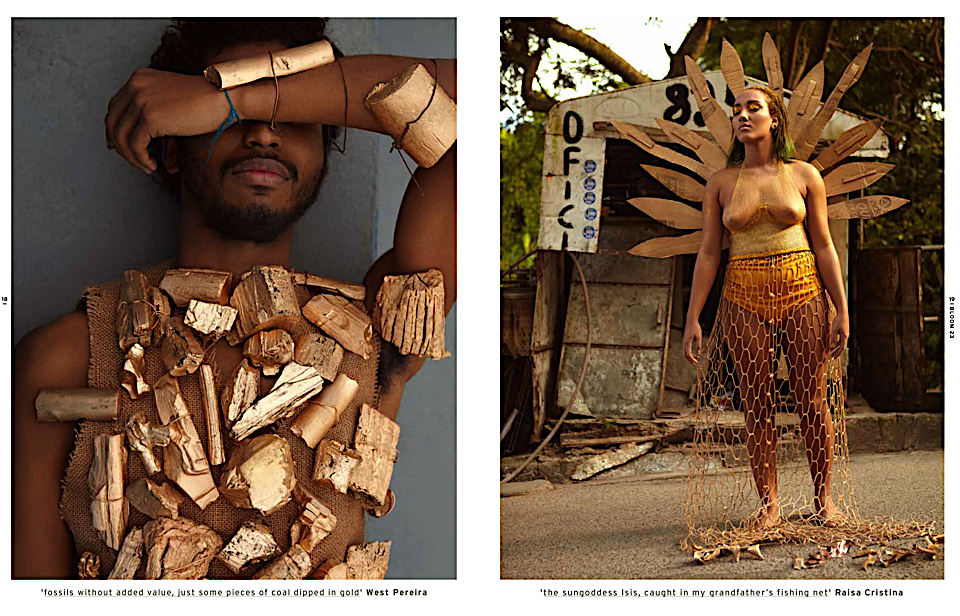
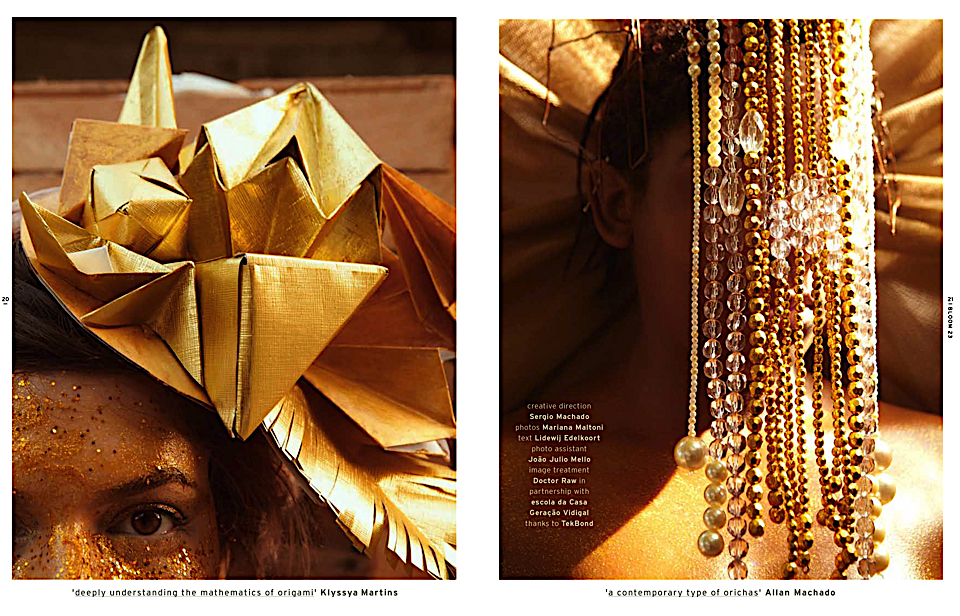
Under the gifted and inspired leadership of Sergio Machado and art directing the students with a tough hand in a tender glove, we created these pages together. In the beginning the students didn’t pay him much attention. After all, he is a white and, they think, wealthy man from São Paulo, living in Paris of all places! No respect was shown for fifteen long minutes of doubt (instead of fame!) and Sergio had to control his inner turmoil, not showing his disarray, stoically getting in touch with his inner self.Then the students turned to him and got involved, falling instantly in love. Soaking up his inspiration, relying on his intuition, learning from his prolific talents. In awe of their creative approach he gave the students the di cult task of imagining their vision for another, golden future. A dense and spiritual portfolio is the result, exulting the immense belief these young designers harness to move on from their beloved favela, to impress their wild style in a wider world. Some are minimalists; others are maximizing their inspirations to stand out in space. All are concentrated energy. With the Southern Hemisphere getting ready to take center stage, it is inspiring to have the privilege of looking into the minds of these young creative Brazilians. We wish them a golden future.
creative direction Sergio Machado photos Mariana Maltoni text Lidewij Edelkoort photo assistant João Julio Mello image treatment Doctor Raw in partnership with escola da Casa Geração Vidigal thanks to TekBond .
fruit woman
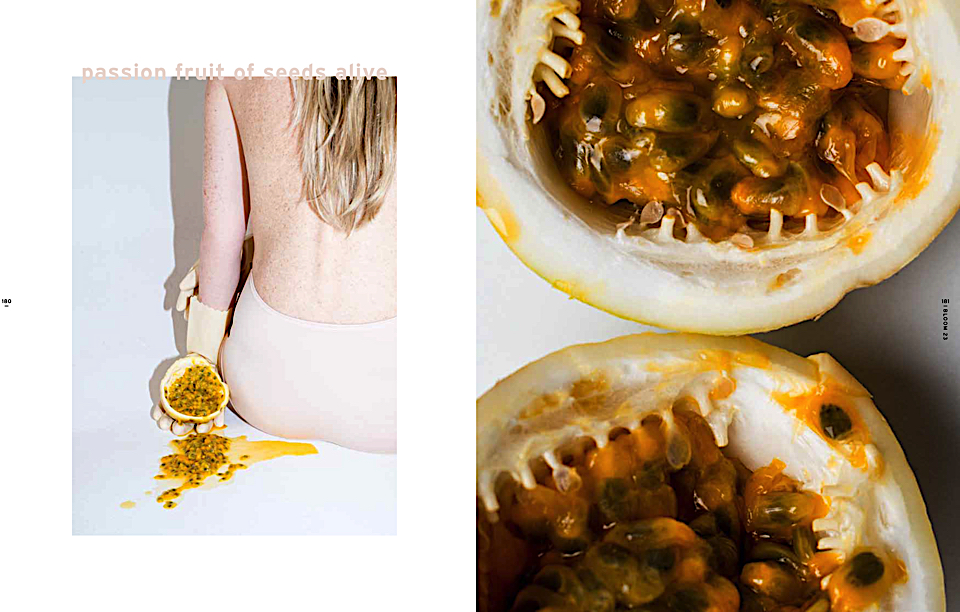
The pulp runs through the fingers, adhering, integrating, involving every type of feeling, including tactile, visceral and emotional ones. In a chromatic and kinesthetic meeting, the pigmentation and the perfume of peeled elements entangle in a web of intense vitality.
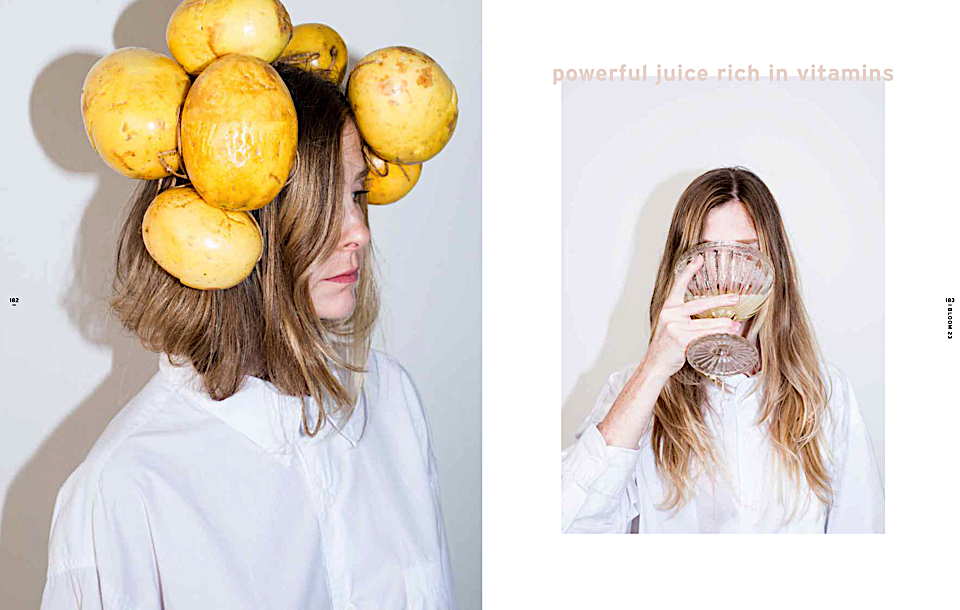
Succulent and savory fruit, in all shapes and sizes, grow here. Some harder and with firm and tense skins, and others, on the contrary, brighter and more viscous. When they shed the peel, the foliage and the layers, they acquire even more beauty and naturalness. It is possible to feel the loving call for an embrace. Palpate it or go further, slowly squeeze it to see the energy flow in a powerful juice, rich in vitamins and for the organism.
From honey to fibers, fruit can be manipulated to give new life to skin, mind and existence. Their fresh juices are widely consumed. They have a high antioxidant content and are a source of dietary fibers that clean the body and activate cellular regeneration, with diges- tive and stimulant properties. From them, essential oils are extracted, which are valuable to the cosmetic industry because they enthusiastically regenerate and produce enchanting aromatic notes.
Additionally, some wilder species have an ornamental use. They grow in the forest and also on city streets, feeding the passers-by.
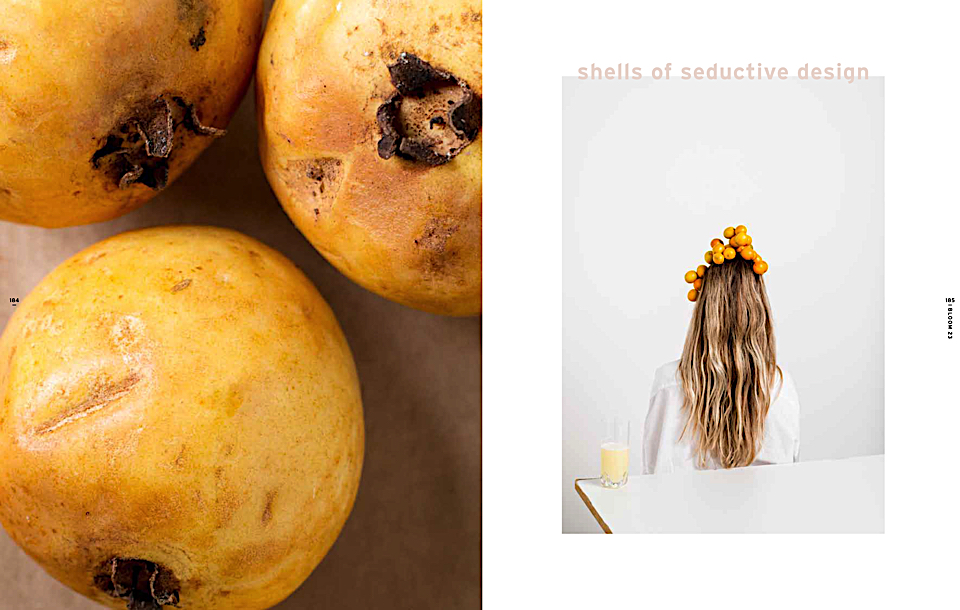
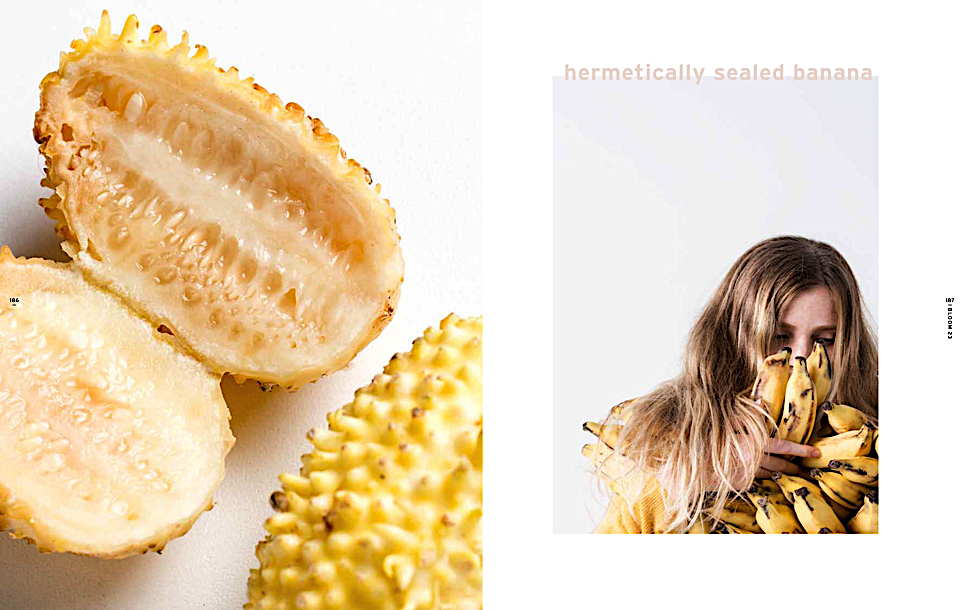
While they fruitfully spread, renovating the environment, they seem to enjoy overexposure and indulge in being decorative. In the hot and humid tropical zones germinate seeds of intriguing and seductive design, the pineapple, which majestically bears its green crown, the passion fruit, which keeps seeds alive in its dented shell, the hermetically sealed banana, which can be served at any time due to its well designed packaging.
During cultivation, a large part of the species grows like climbers, either clinging to vines or linked to shrubs and trunks, multiplying in bunches and clusters. They sometimes emerge from the earth, filled with determination and personality. The harvest ritual starts early, with the first sunrays, demanding delicacy and physical care of long hours in the orchards. Their very existence confirms a complete cycle of life, triumphal. Then, successively, come fecundation and recommencement. Insisting on freshness, on repeating the cycle, just heading towards the glorious moment of reaping, of harvesting, when, finally, the liquid of life is free to flow.
creative direction Bianca Nabuco / photos Demian Jacob / text Maria Rita Alonso / producer Manuela Padilla / model Mariana Antonini
armor of flowers
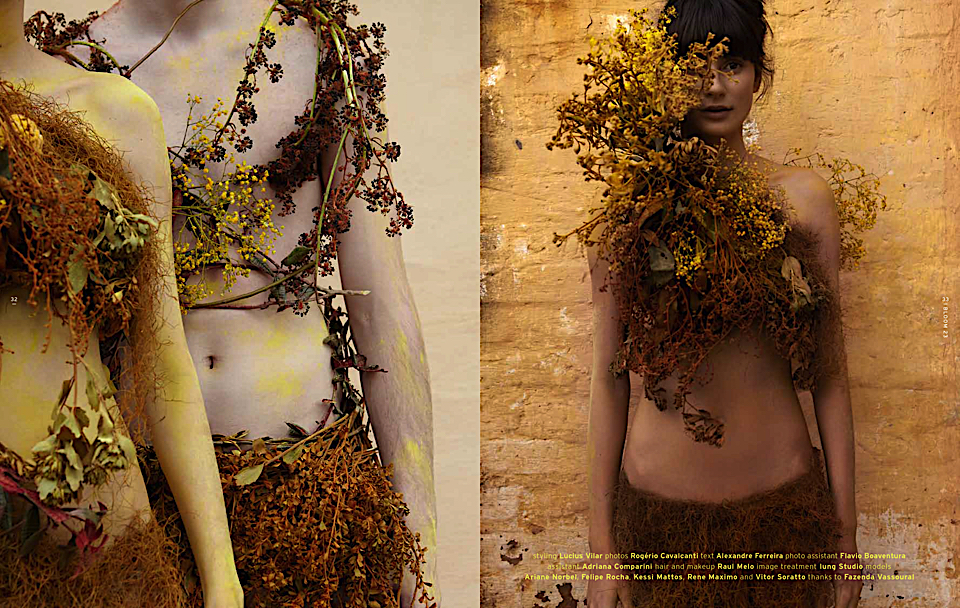
The garden in which I live was not a choice. It flowered with no consultation nor warning. From my own nature sprouted branches, flowers and fruit that, at first, covered me with fear. After all, how can one explain a garden growing and flowering on my body? In a world of beings with swords between their teeth, to be covered in life provokes astonishment and suspicion. An inevitable and transforming movement stirred in many people.
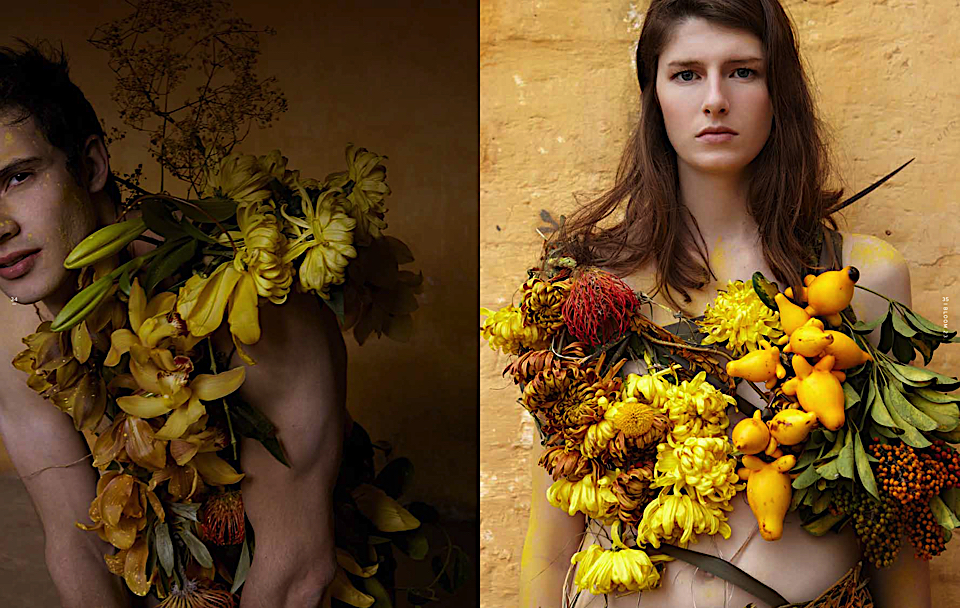
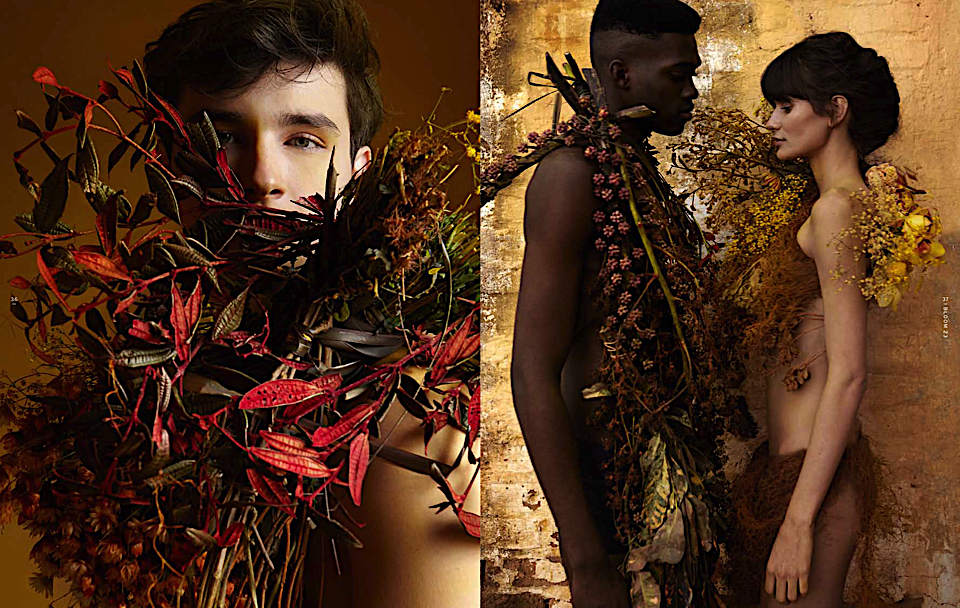
It did not depend on race, colour, gender, age or faith. It was not caused by fungus, viruses, bacteria. Not even the walls constructed around nations were capable of halting the dissemination of various species such as dahlias, chrysanthemums, cockscombs, goldenrods, pinocchios, lilies, orchids, croton, privet, cow’s udder, photinias, barberries. Flowers, shrubs and even trees germinate in a splendorous way, creating a new ecosystem on our skin. Species from the hot and humid planes, the dense backwoods and the coastal forest no longer surrendered to the soil and climate. A meeting, impossible for millennia, celebrating the beauty of diversity.
Yes, there is life. Not the one idealized by announcements of primitive drives to generate clicks and consumption, but the one with profound roots, which resists. Survives storms. Our bodies are fertile and full of metaphors, in need of light. From my pacific seed, I create my armor. From my self-knowledge, I make my shield. I harness my forces. I do not expect others to see the life that sprouts in me. But in my own way, I carry on seeing the beauty that exists in you.
And with it, I transform my world. Searching peace.
Styling Lucius Vilar photos Rogério Cavalcanti text Alexandre Ferreira photo assistant Flavio Boaventura assistant Adriana Comparini hair and makeup Raul Melo image treatment Iung Studio models Ariane Norbel, Felipe Rocha, Kessi Mattos, Rene Maximo and Vitor Soratto thanks to Fazenda Vassoural
Urban Jungle Bloggers
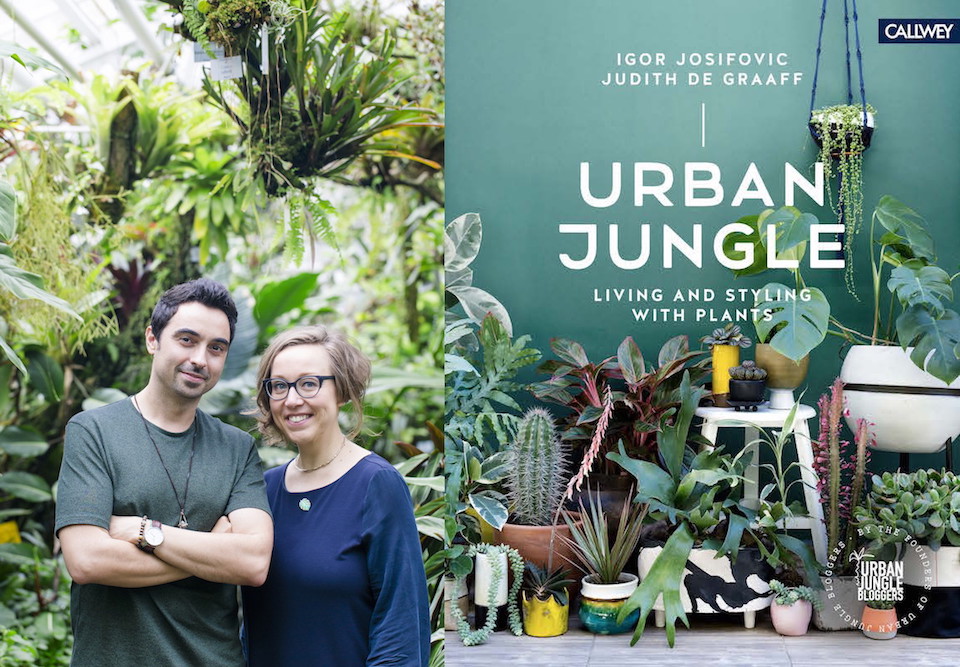
photos by © Lina Skukauske | Urban Jungle Bloggers
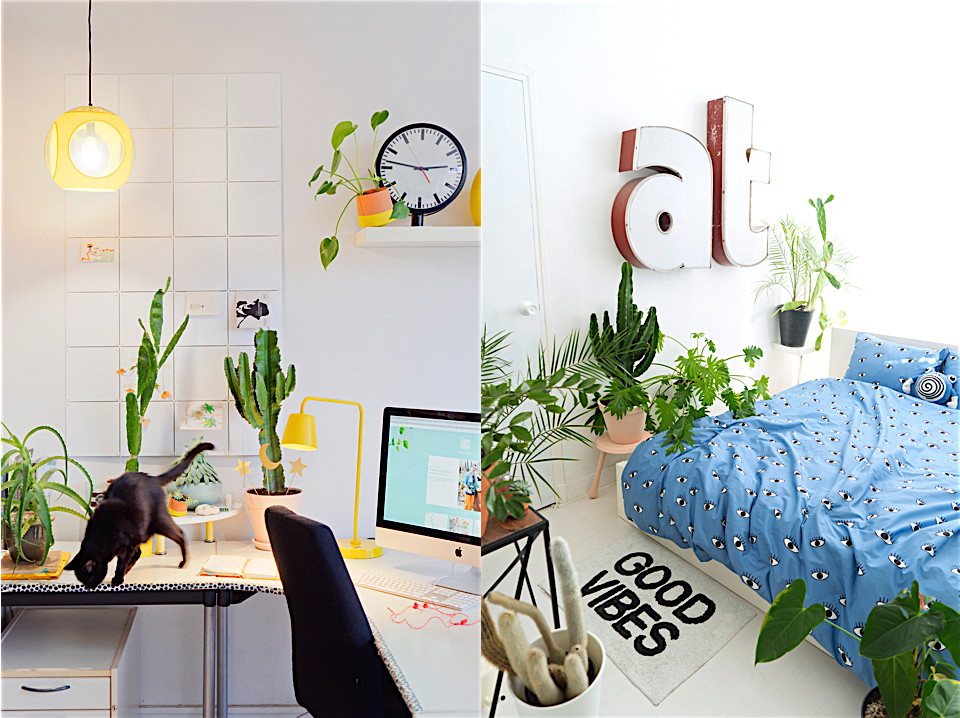
Today plants are an essential dimension in our urban lives. We need to reconnect ourselves with Nature and what better way than taking care of plants !
Urban Jungle Bloggers is all about living with plants – in your home, in other interiors, in public spaces. It’s a huge global community of plant lovers responding to a meaningful long term trend. Our editor Cecile Poignant met Judith one of the founder of this green family for you to know more about Urban Jungle Bloggers.
When and how did UJB - Urban Jungle Bloggers - start ?
Urban Jungle Bloggers started in 2013. My friend Igor (from Happy Interior Blog) and I (from JOELIX.com) had coffee in Paris and talked about the things we enjoyed in life and the things we loved blogging about. We realized we had a shared passion for houseplants and decided to start a monthly series on our own blogs, where we presented our plants, our urban jungles, to our readers. We called it Urban Jungle Bloggers. From the very beginning other bloggers wanted to join in and we continued with monthly topics that we sent to all participating bloggers. We then shared all these blogposts across all social media platforms so that more people could read them. What started as a fun blog project, grew into a thriving community of plant lovers from all around the world! Last year we published our first book: Urban Jungle, living and styling with plants.
How would you describe yourself ?
I’m an enthusiast and visual-minded creative with a passion for color, design, light and plants. And I cut my own hair.
What fascinates you about plants ?
Plants surprise me, by their shapes, colors and power to grow simply by giving it some water and enough light. Large plants can compete with true sculptures and add so much character to a space. They are ever changing, bending over, changing colors, growing new leaves, hibernating, suffering from bugs, recovering, and turning towards the light. They’re in constant movement, even though it’s not always visible on the outside. Plants teach me to be patient, they take their time to grow a new leaf or bloom, it’s not instant!
Do you have the feeling of thing created a huge green family - 405 000 followers on Instagram ?
Absolutely, Urban Jungle Bloggers feels like a big plant loving family. It’s wonderful to see how people keep their plants at home: a few in the window sill, or dozens of plants spread across the house… or even “worse”! Some people collect only one kind of plant, some are eclectic and love them all. We all share that love for growing greens and exchange our knowledge and creativity with each other.
Urban Jungle Bloggers’s community is really worldwide, how can you explain this global success ?
First of all, Igor and I live in different countries and have different audiences. But the community quickly grew beyond these people, attracting plant lovers from across the world. I believe that if you do something with passion, it shows, and people recognize that and want to be part of that. Plant lovers live in every corner of the world and blogs and social media allow us to share that interest with each other without physical boundaries. It’s so interesting to see that the availability of certain plants is more limited in some areas of the world, that some plants are considered weed in some regions whereas they are considered luxury goods somewhere else. We live in the right time to reconnect with nature and taking care of our plants, as more and more of us live in urban areas where the only bit of nature we see every day are the parks… and our houseplants!
Do you only love plants or are you also a flower lover ?
I do appreciate flowers and love their smells and beauty, but my heart beats faster for plants that stay fresh a little longer than a beautiful bouquet. It always makes me so proud though when my plants start blooming! I recently had a few blooming cactus plants with pink, yellow and orange blooms. But if you’re looking for some real flower girls, you should check out :
@madame_love and @stilzitat and @botanicart
these ladies know what to do with flowers!
Is this green love something specific to millennial ?
I don’t think so, I believe houseplants can bring joy to anyone, young and old. But on the other hand, so many millenials grow up glued to their smartphones with “instant everything” in a fast-paced, digitalized world that there is a bigger need for them to reconnect with nature. They feel the need to surround themselves with nature and want a connection to something so basic yet so essential, that will remind them of the “natural pace of life” beyond smartphones and social media. Also we believe that plants teach us more responsibility, patience, and mindfulness - they act as a sort of anchor to root us again. Especially after long and stressful days in the city. This love for green is becoming essential for urban dwellers!
How does your community work ?
There are several ways to join Urban Jungle Bloggers. You can join on Instagram by using the hashtag #urbanjunglebloggers for your plant-related photos. Twice a day we select the most inspiring images that we share with others on our @urbanjungleblog account. You can also sign up for our newsletter , in which we announce the new seasonal topic and more green tips and tricks. If you like the seasonal topic, you can use it to create a blogpost on your blog, that we will then share across our social media platforms and on our website. We are constantly inspired by the blog- and Instagram posts from our community.
What are your plans for the future ?
Right now, we are preparing the launch of our Urban Jungle book in French (on September 7th ) as well as a few workshops. We are keen to grow Urban Jungle Bloggers and keep it fun, interesting, informative, and creative. We also want to delve into more video content soon and who knows, maybe one day we will even take it offline and organize some Urban Jungle meet-ups. Stay tuned!
Cecile Poignant
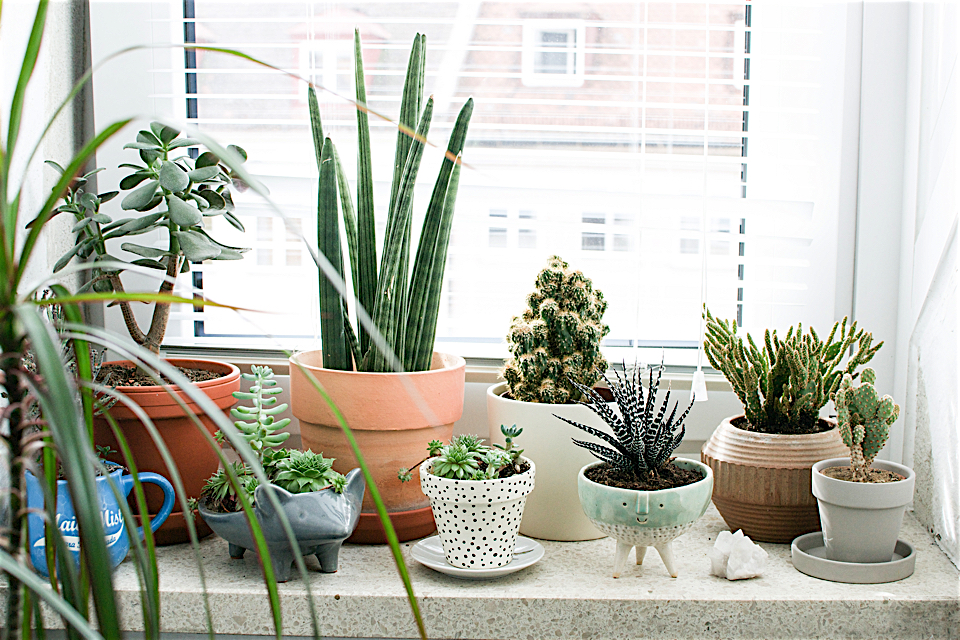
photo © Igor Josifovic | Happy Interior Blog
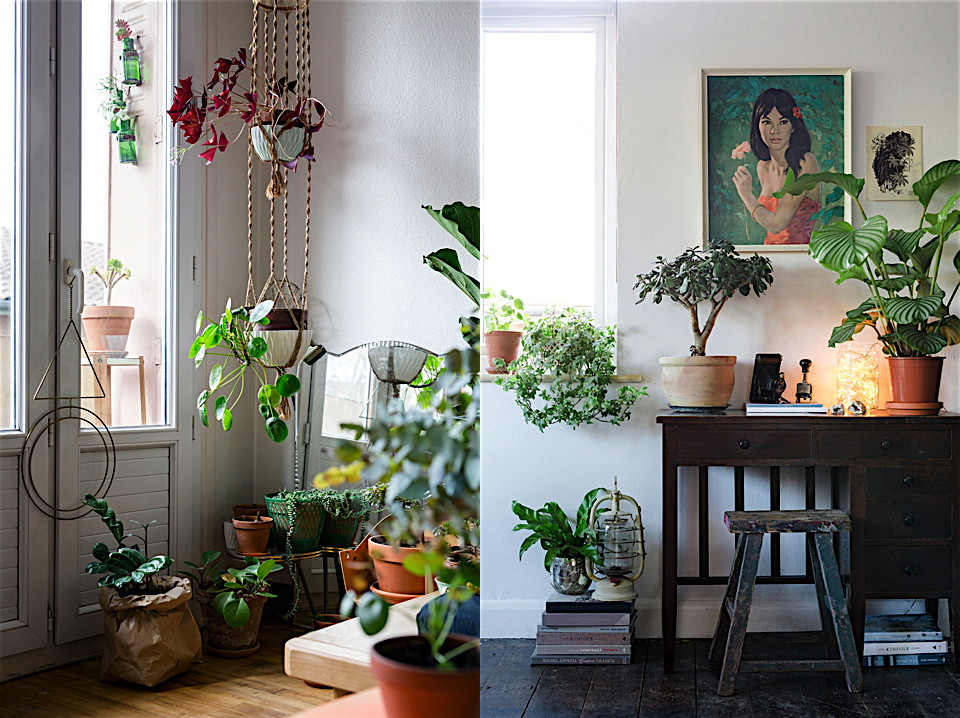
photos © Lina Skukauske | Urban Jungle Bloggers
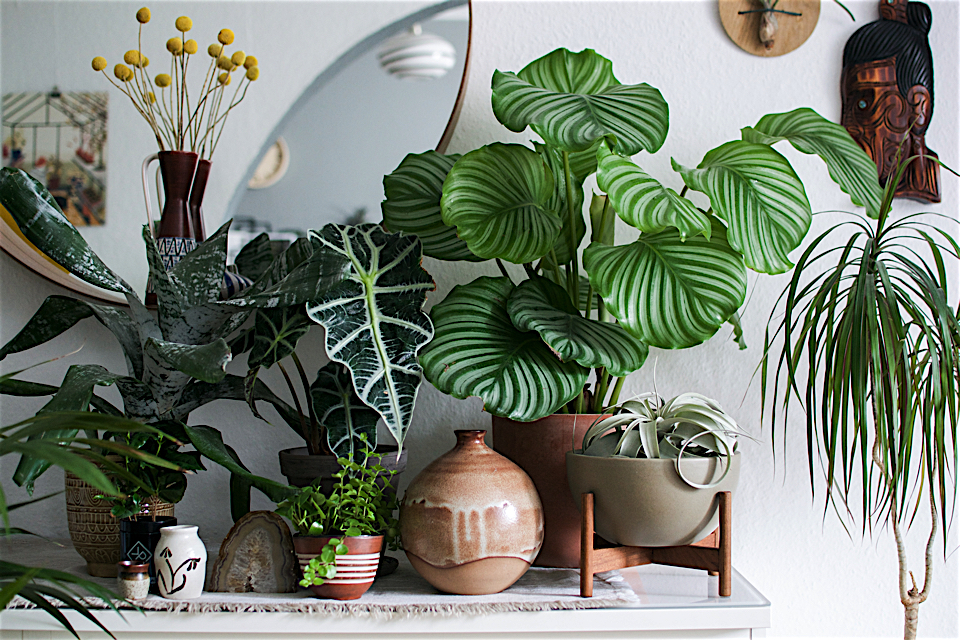
photo © Igor Josifovic | Happy Interior Blog"
photos © Judith de Graaff | JOELIX.com
ethnobotany
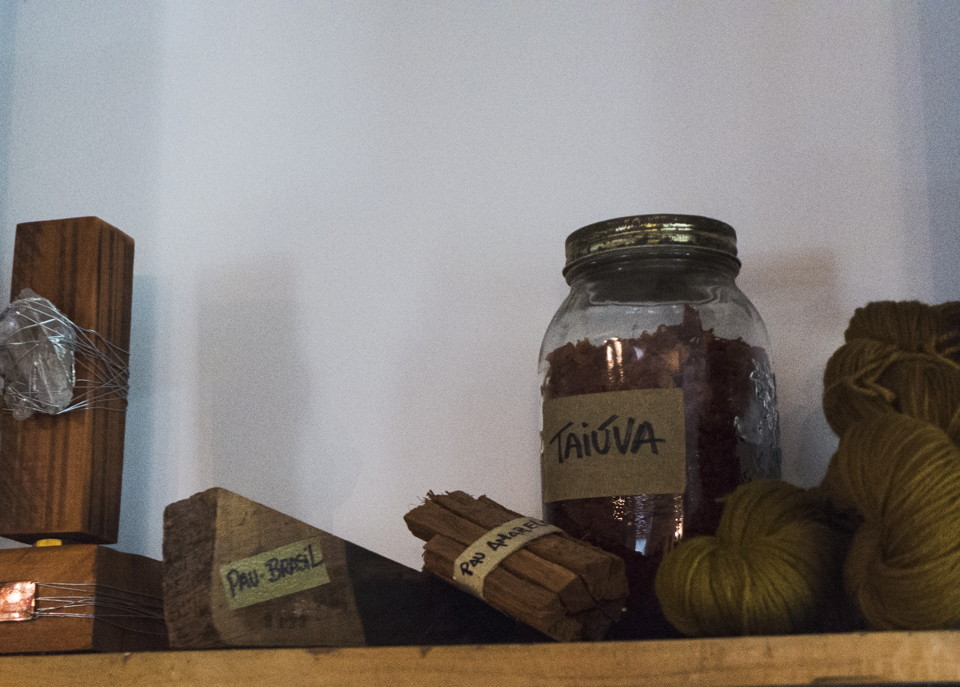
The term Ethnobotany refers to the study of the ecological, genetic, cultural and evolutionary interactions with plants. Each community therefore becomes a space of learning, in relation to how the community uses its natural botanical resources to solve its needs.
What makes this field of study so magnificent is the huge array of possibilities that are opened in several areas, which range from pharmacology to textiles, in an environmentally clean manner, and in such a way that we are able to reestablish lost bonds that have diluted with modern times. We see that older techniques have their own peculiarities to the regions of other cultures.
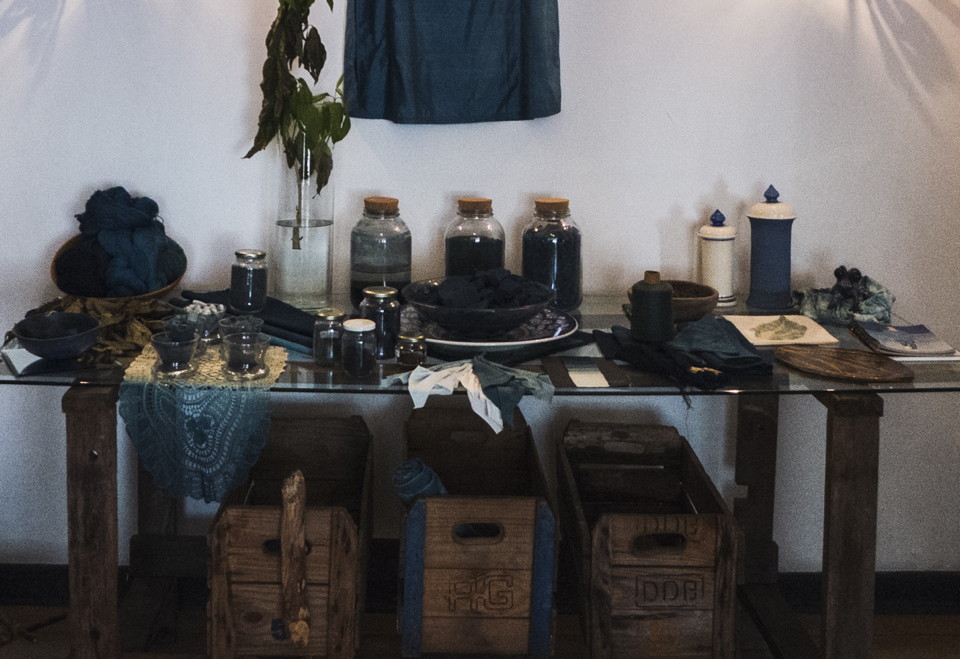
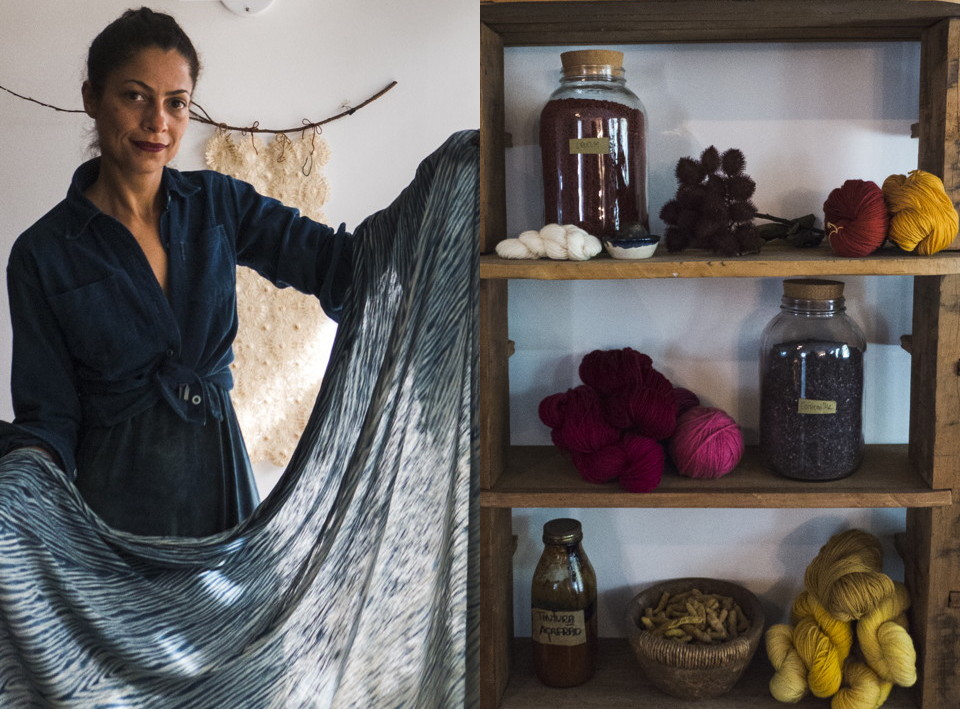
Humanity, the planet and history are thankful, while the world of fashion is just one of the many universes that are touched in such a beautiful way by several studies; for example with textile dyeing using vegetables that give us a palette of colors and fluidity in various styles of patterns. Dyeing with plants is directly related to the textile arts and they complement each other in such a way that any comparison with chemical and industrial processes is not even possible.
The dyeing process is not itself relatively simple, and its complexity resides in the fixation of the colors in the material too, which makes the process something much more artisanal in terms of the scale of production. That's why the technique gave rise to processes with synthetic dyes, which are denser and have a certain level of toxicity.
The use of natural dyes for textile, cosmetic and food dyeing is an economical alternative for rural communities that can be integrated to preserving the environment, adding cultural and economic value to the way we see and use colors in our daily lives. And this gives us the power to consciously choose pieces that are more sustainable from the moment of their inception.
Leka Oliveira do studio in blue Brazil – a reference in the natural dyeing area – believes that Ethnobotany is part of a lifestyle, where slow is the reference word. Not just in fashion, but as also in how we face the cycles of life, where the full awareness that each phase has its natural process is essential for our well-being and to make our part for the contribution of a better future aimed at our evolution.
Lu Valenzza
Lu Valenzza born in Amazonia and based in São Paulo is a future trends enthusiast and an anthropologic observer. She is offering creative research, communications support, and trend forecasting to provide actionable insights to help society and businesses move forward in the coming years, always in touch with tomorrow think scenarios for redesign a better world.
Lu Valenzza
vendors from above
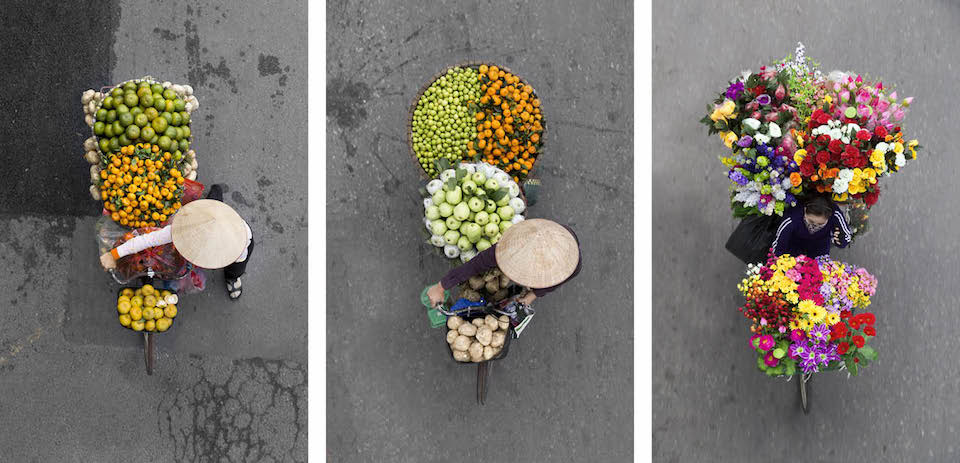
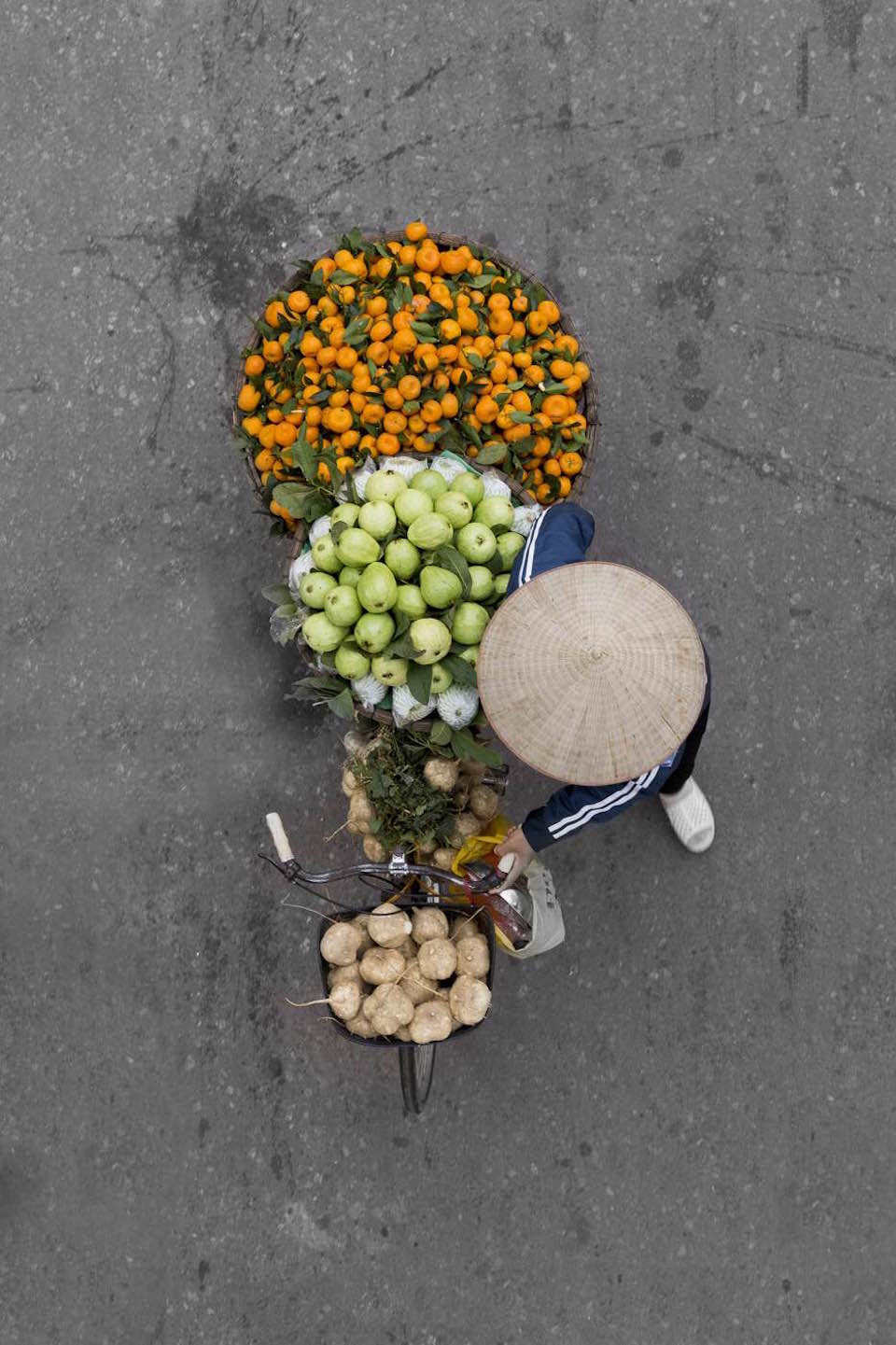
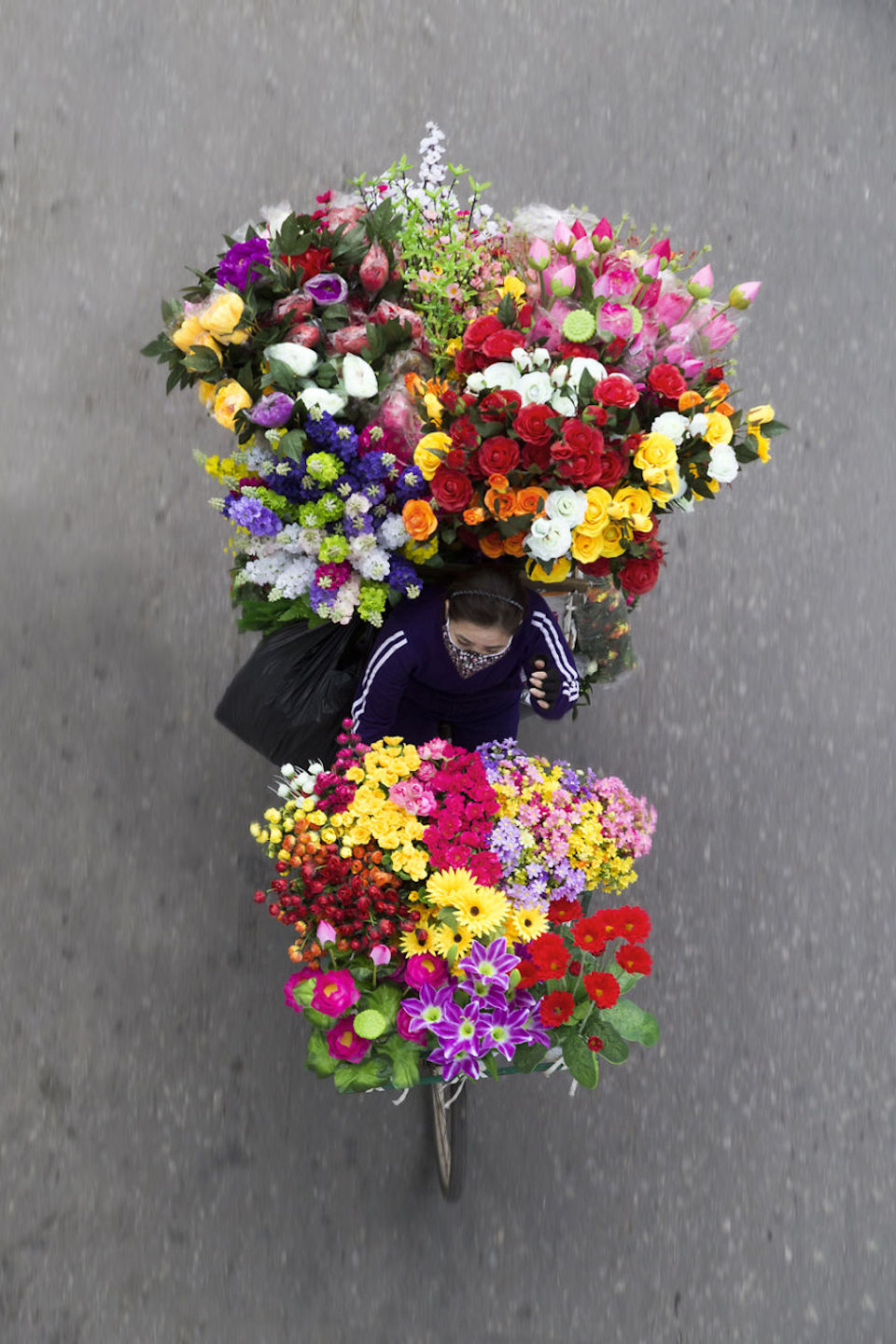
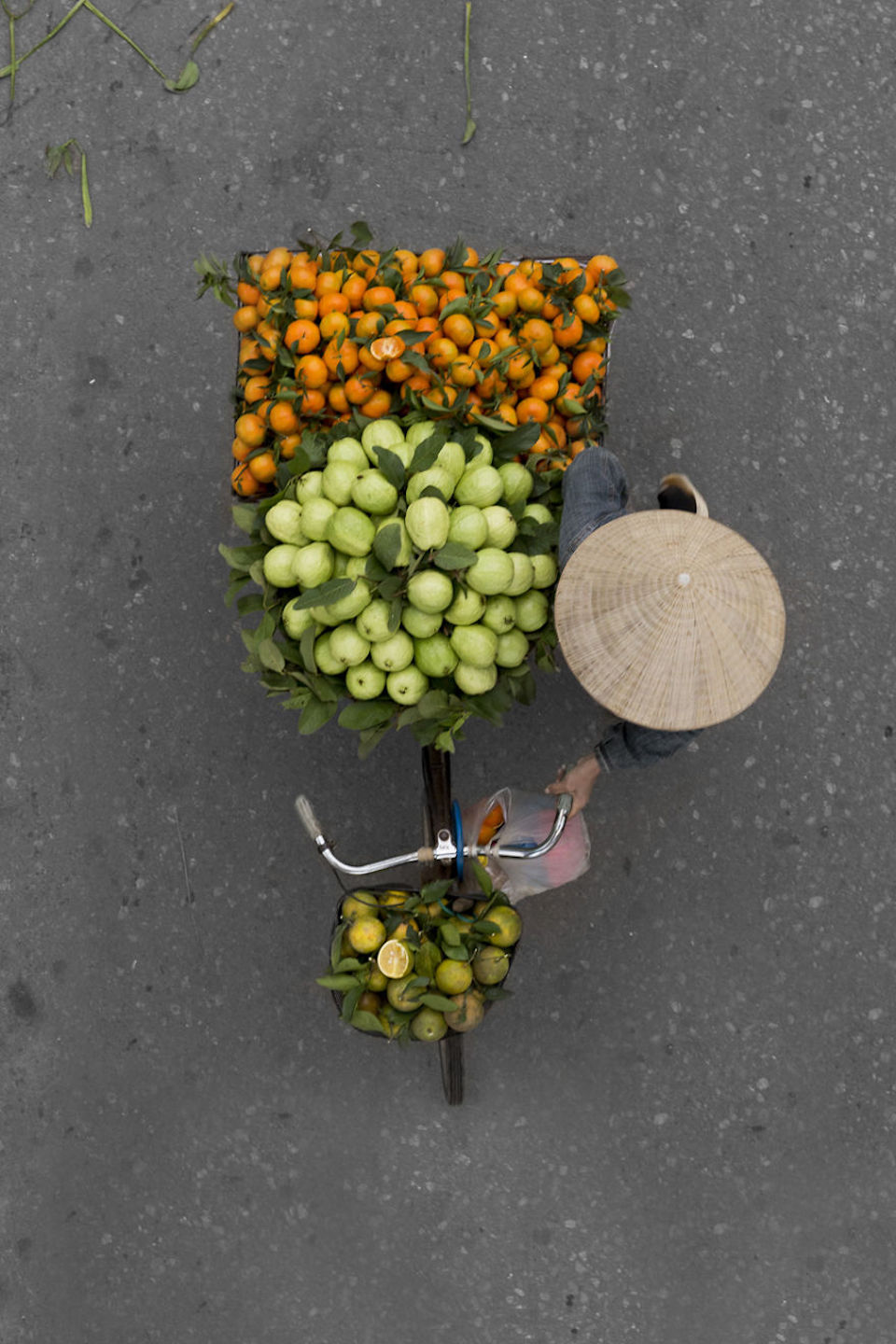
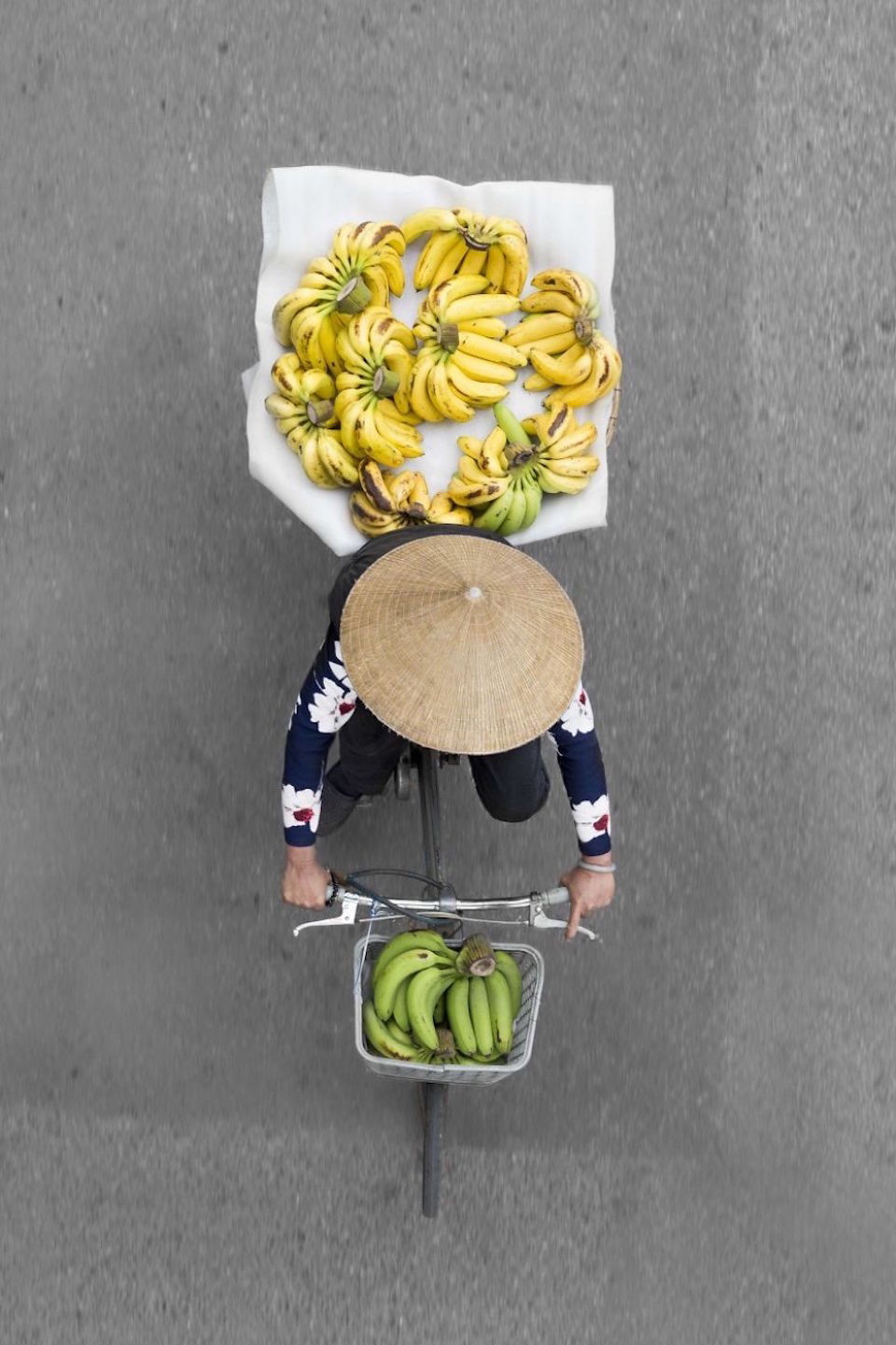
Young Dutch photographer Loes Heerink has lived in Hanoi for several years.
As she explained: “photographing the street vendors became a little project of mine. I would spend hours on top of a couple of locations in Hanoi waiting for vendors to walk underneath the bridge.
The street vendors in Hanoi are often female migrants that spend most of their days trying to make profits on selling fruit, vegetables, snacks and other small items.This project started with my fascination for the women carrying their goods. They have no clue how beautiful their bicycles are, no idea they create little pieces of art every day.“
For you to get to know her better we asked Heerink a few questions:
How would you describe yourself as an artist ?
I don’t see myself as an artist. Well I see myself more as an artist than as a photographer. I actually see myself as neither. I am just using photography to let my creativity out!
Is photography the most important media for you?
Yes. I also like videography! But I like photography more. I do both though.
Why are you so interested by Vietnam?
I have lived in Vietnam and I find the country very beautiful. It has a lot to offer!
What is your relation to nature ?
I love nature, I love to photograph nature most! I like to go to beautiful places or look for them. I like to go out and photograph the little things in nature, like leaves or flowers or little bugs. Things you would normally not notice.
How would you describe “Vendors from Above“ ?
“Vendors from Above“ is a result of my attraction to street vendors.
What would you like people to feel about your photos?
I want people to see the beauty I see!
Heerink wants to publish this work in a photo book. She's aiming to have about 100 images in the book, and to achieve this, she started a crowdfunding campaign on Kickstarter to go back to Vietnam to complete the shooting phase.
Cecile Poignant
Kickstarter Campaign
Instagram
faith issue #23
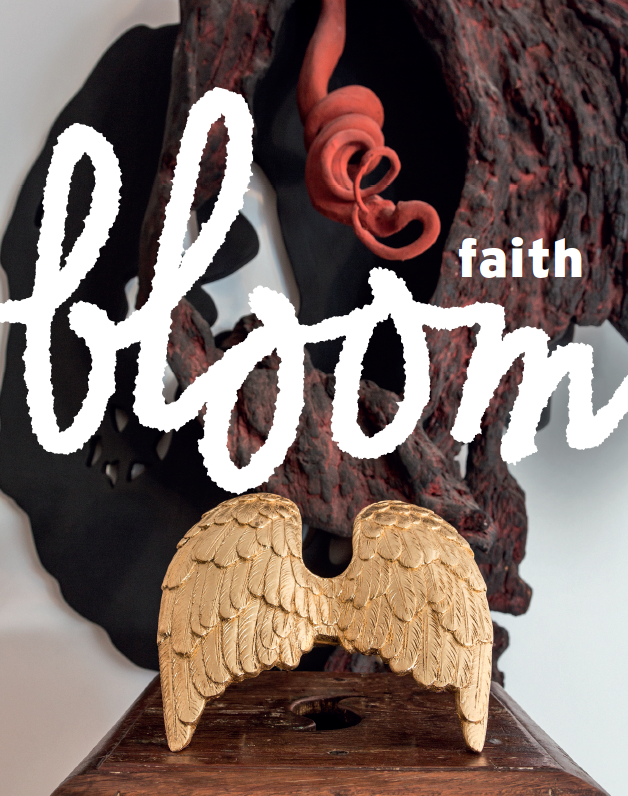
Confronted with the adversary of human designed disasters and manmade political scandals paralyzing our planet and countries, people’s only recourse becomes faith, an almost forgotten principle. To have faith in the spirit of survival, to have faith in creative forces able to rebuild society, an intrinsic need to believe in the human race, especially in moments of bewildering despair. We need to trust our instincts to build a better future, full with genuine love towards ourselves and others, even those at fault. Being able to forgive, to understand, to comprehend, to taste the fear in others. To pledge an awareness of altruism, script a gospel of compassion. Desire needs to be embedded in empathy.
Recognizing their inspirations and yielding to innate creative urges, artists and designers will build up the needed confidence to create new matter, landscape other horizons, design decorative objects, weave unusual fibers, draw non-existent flowers, created with the deep conviction that aesthetic expressions will resonate with others and are able to heal and care for people. Faith grows from future generations, professing their reliance on inner strength, convinced to reroute society the way they see it; convivial, cooperative, concerting, concerned, a society where truth remains an important quality and flexible forms of constancy help to compose the rhythm of existence.
Li Edelkoort
PRE-ORDER TODAY
Delivery late November, 2016. 85 € (plus shipping)
radical roots
BLOOM Luscious - Photo: Ruy Teixeira Photo assistant : Noel Thomas
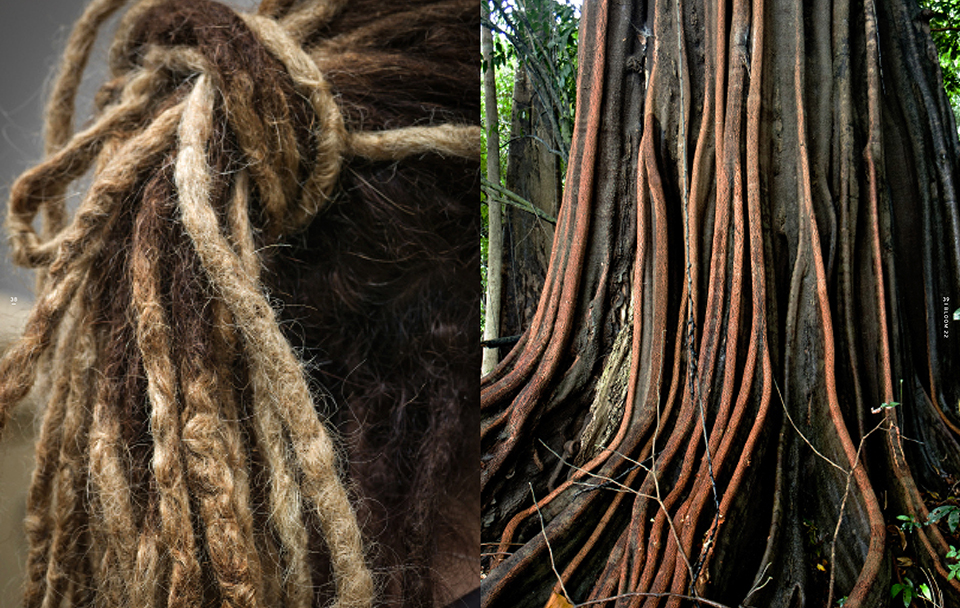
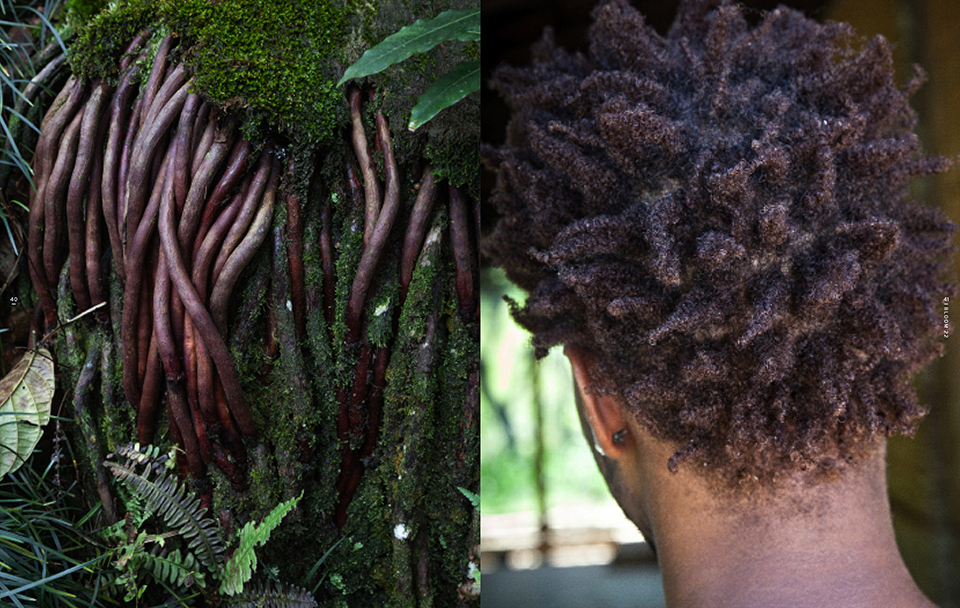
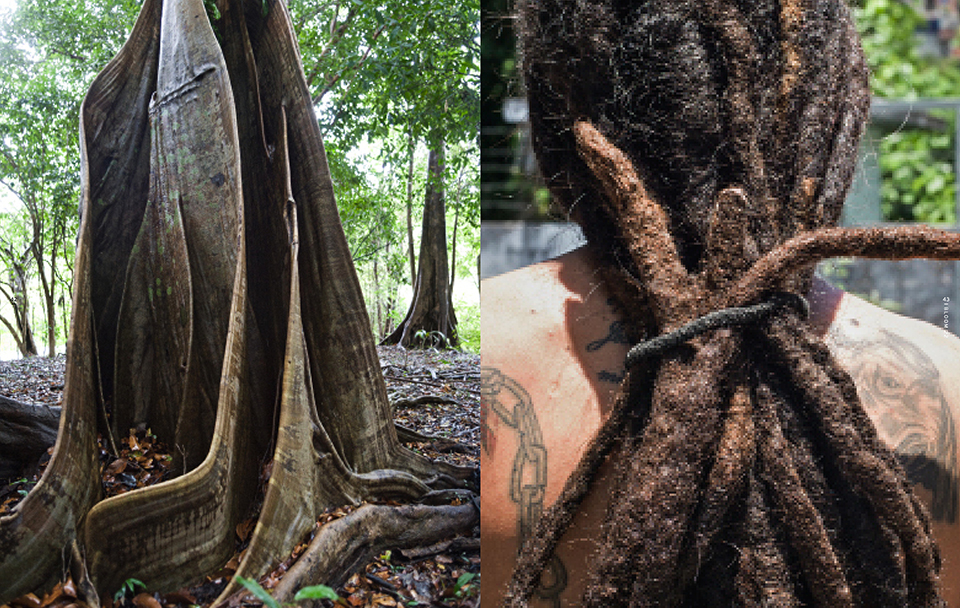
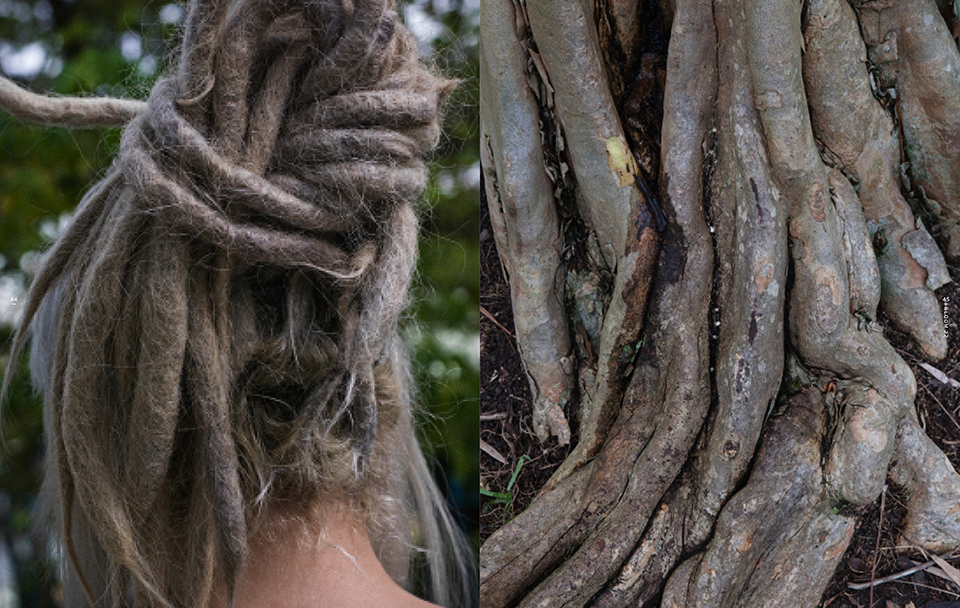
Roots are designed to anchor a towering tree’s body to the ground and as locks, they are grown to anchor onto the spiritual dimension of hair. Both are entangled in representing a powerful sense of belonging.
Trees are like the warriors of nature who fight to keep a foothold in extreme conditions. Martial roots conquer the ground, avidly drawing nutrients and providing a base for the rich canopy of green leaves that process energy from light – bringing together two dynamic systems, connecting earth and sky. Just as jata, as dreadlocks are also known, connect the brain to a higher mental order, entertaining special relations with the spirits like an immortal traveller between two worlds. Therefore the roots of skull and tree bewitch people and offer a sense of mystery, able to take on mystical powers at the centre of the world’s fascination.
Roots are intelligent and have a natural perception of their environment, including a haptic sense of light sources and physical obstacles. Whenever the environment of air, food and water are perfectly adept to meeting this organic architecture’s ultimate needs, roots will spontaneously start growing in all directions, further anchoring the trunk, further nourishing the tree. Roots are pretty powerful growing machines that can destroy foundations, snap water pipes and even lift sidewalks. Violently making their presence felt.
The tree can be seen as a witness of ritual happenings; to talk to and touch the trunk becomes
a powerful experience from which we can draw spiritual powers. We are unable to grasp the complexity of our feelings and therefore bow to the superiority of the roots and trees towering over us.
One of the most significant associations of trees is their links to society. Trees are used as village centres under which to solve tribal problems and as places of gathering for worship and rituals. Several ethnic groups revere trees and use them to make representations of their gods. As totems, they become visible representations of unseen forces carved in wood, often representing the trees themselves.
A sense of belonging is something many people strive to achieve. The tree, with its firm base, symbolises that concept of roots, an on-going relationship with our surroundings. The canopy drawing energy from its environment is symbolic of our need to absorb our cultural heritage and embrace our evolution from times past. The drive to find a Darwinist link with our present is instinctive and represents our quest to find a reason
for being on this earth.
Pagan religions worshiped the roots, associating them with longevity and fertility; this explains why some trees hold sacred positions, more as mythological deities rather than just as places to gather and celebrate. The compelling biblical tale of Samson and Delilah, in which a man’s potency is directly linked to the dreadlocks on his head, describes how Samson’s powerful strength vanished when Delilah had his seven locks cut. Thus the symbolic reading of roots and locks are similar, sharing beauty, texture and meaning.
Dreadlocks’ roots go back in time thousands of years, when the deity Shiva and his ardent followers promised to never again cut or groom their hair. Ever since, many belief systems have incorporated a disregard for physical beauty and vanity into their spiritual path. Such seekers cease to cut and comb their hair and this is how, left to their own devices, the fibres naturally knot and felt together, forming dense and anarchistic tubular mats.
In many cultures, these locks are sacred and considered to be a religious expression of disregard for the profane. In all the myths about flowing locks, there is an interplay between extreme asceticism and virile potency, which intimately links the elements of destruction and creation.
Most locks are internally formed and with different textures of hair, various methods are used to encourage their formation. Letting long hair flourish freely by not brushing will encourage it to tangle as it grows, leading to twisted and matted ropes of hair. Western and eastern traditions believe that mental and spiritual energies may leave the body behind through the top of the head. Therefore the tresses are knotted so the energies remain encapsulated within the system, keeping the mind strong and the body rooted.
Dreadlocks are often associated with the Rastafarian movement but many other groups have worn locks before, including the Hamitic people, Maasai warriors and Yoruba priests of Africa, the Semitic people of Asia, the Spartan warriors of Greece, the Sadhus of India, the Sufis of Turkey and the Fakirs of Pakistan. Aztec priests were described as wearing their hair untouched, allowing it to grow long and matted.
Named after the Dreads, an eclectic group from 1900’s Harlem that drew influences from the bible, tribal cultures and diverse Eastern religions and who “dreaded” the powers of God. Emulating the initial holy men, the Dreads grew matted locks of hair, which would become known to the world
as dreadlocks. Thus the jata have become more than a religion; they are a manifesto for a way of life, an existence on the outskirts of society. Today they signify spiritual intent and are also a statement of non-violence, embracing solidarity amongst the less fortunate and oppressed minorities.
Integrating and interweaving, roots and dreads lead to a strong correlation of meaning and symbolism, where both entities teach us to root ourselves too: to anchor our body to the earth,
paying homage to its nutrients, to elevate our mind to the sky, actively contributing to the world’s consciousness. Willing a better world. To search for our roots, which are themselves in upheaval in today’s seemingly careless global society. To root for each other also, organising society in circles and mental groupings that are able to nourish our hopes and visions for the future.
Lidewij Edelkoort
Photo: Ruy Teixeira
Photo assistant : Noel Thomas
BLOOM Luscious is available for purchase:
English
Portuguese
BLOOM Luscious - Photo: Ruy Teixeira Photo assistant : Noel Thomas
BLOOM Luscious - Photo: Ruy Teixeira Photo assistant : Noel Thomas
BLOOM Luscious - Photo: Ruy Teixeira Photo assistant : Noel Thomas
grafted
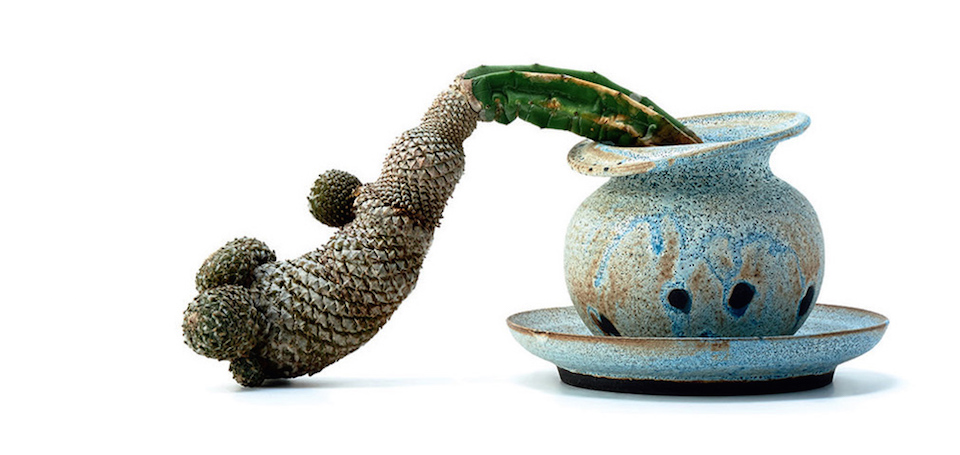
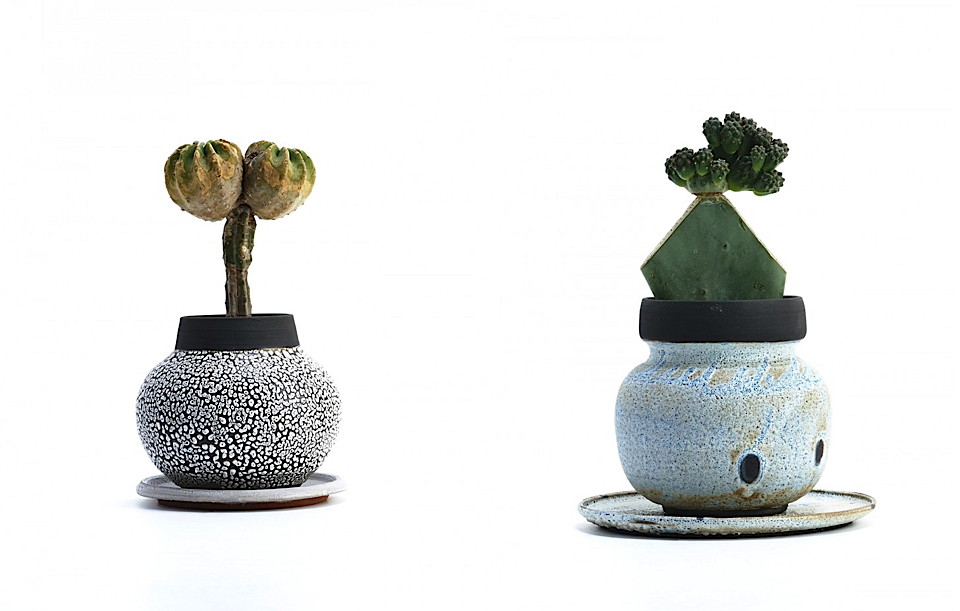
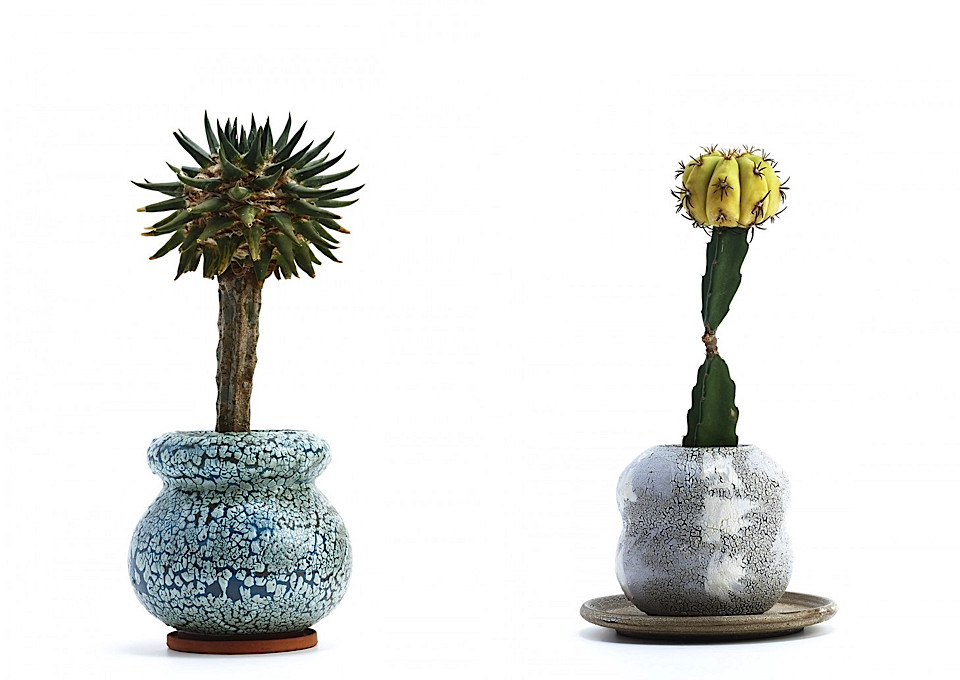
Since plants started to play one of the leading roles in our interiors they have come a long road from minimalist expositions to much wilder and more expressive configurations. Nowadays, we plant them anywhere and any ways using both traditional pots and less conventional objects like glass boxes and even teacups. And just when we think we know everything about this ongoing trend, a unique project pops up bringing a fresh view on plants and their display. These irregularly formed succulent hybrids planted in wildly textured pots are the outcome of the collaboration between Japanese plant whisperer Kohei Oda and American ceramicist Adam Silverman.
Kohei Oda is a well-known Japanese plant artist specializing in plant grafting. In his experiments he frequently uses damaged and unwanted plants, and connects their tissues together so they get a chance to grow as one compound plant. The results are stunning – new and unexpected forms are being born. It was Orina Reich and Ritsuko Yagi, the owners of a tiny shop in LA, who brought together Oda and Adam Silverman, LA based ceramist with passion for erratic forms. Silverman gathered a lot of experience travelling across many parts of Japan, working and taking lessons from local masters. There is no doubt it affected his work, but in contrary to the minimalist style his ceramics are much more sculptural and experimental. The result of the first collaboration between Oda and Silverman, “A Tale of Plant & Pot” exhibition, took place in this little shop in LA. The spectacular art pieces displayed were very expressive – giving a real personality to each cacti.
Their partnership took another step further – a second exhibition together took place in Kyoto. This initially skeptical idea of collaboration resulted again with little art pieces; multiple hybrid plants growing in uncommonly shaped pots. It is the idea of hybridization that makes it such a fresh concept. The plants grafted together are one of a kind and almost appear to be from another planet – they become desirable not only because it is nothing we have seen before but also because of the new life they represent. That effect would not be so expressive if not for the bizarrely textured vessels which underline the uniqueness of the plants. In the end the impression we get is a hybrid of magic and craftsmanship.
Even though Silverman himself did not believe that working with Oda would get him to the next level as an artist, the book released displaying their works called “Grafted” proves he was wrong. Throughout the 160 pages of this carefully edited book we get a new, wider view on these stunning plants and pots. Thanks to the photographs made by Shuji Yoshida and Joshua White we get a chance not only to admire the whole compositions as they are but also to take a closer look at the details from a new perspective. The whole publication was designed and edited by Tamotsu Yagi and published by August Editions, apart from numerous photographs it also contains an essay by Glenn Adamson. Bad news is that it is a limited edition of only 1,250 pieces. No time to think – go grab your own copy!
Kamila Garczyńska

fashionable fibres
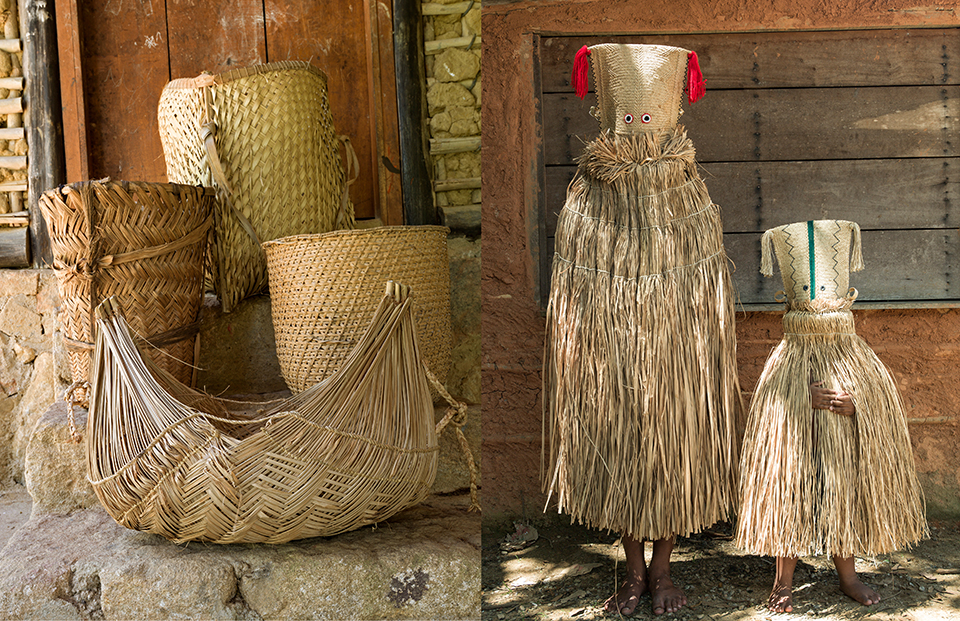
Left : basket (triangular), Suruí ethnic group, state of Pará; (left, braided) Cargueiro Basket, Kayapo ethnic group, state of Mato Grosso; (right) Basket, Yanomami ethnic group, states of Roraima and Amazonas, and basket, Xavante ethnic group, state of Mato Grosso all from Armazém Paraty - Right: within the Kaiapo ethnic group from Xingu, state of Mato Grosso, the men braid the baskets and make the weapons.The women produce the straw masks, bracelets, ribbons and ropes from Armazém Paraty
The burgeoning use of natural materials for garments and interiors is reflective of consumers with a discerning eye for sustainability and ethically made and traded products. Cottage industries and artisan crafts are abloom. Woven wicker, grass and other organic ingredients have awoken a taste for drier tactilities and coarser materials. At the same time, different species of grass are flourishing in newly landscaped gardens, a horticultural trend that brings the savannah to the city or to the contemporary public park.
Brazil’s fibre weaving heritage is engrained in its culture, tracing back to its indigenous roots. Since time immemorial, dried leaves, grasses and malleable reeds have been used to create functional baskets for fishing, hunting and gathering as well as decorative ritual costumes. Each group uses different materials that are native to their diverse local environments in a variety of techniques.
Deforestation for farming and other destructive expansion has endangered many fibre species as much as it has threatened the survival of the tribes. An sos for fibre, people and culture. In an effort to preserve woven crafts, some local governments protect the over harvesting and export of certain plants. Golden Grass (Syngonanthus nitens) is one such example, yielding a fine shiny fibre that resembles metallic thread. Native to Jalapão in the northern state of Tocantins, it was originally used by the Xerente people and is embraced today by craft artisans. Palm leaves from the Buriti (Mauritia flexuosa) produce a silk-like material that is used for basketry and textiles. It is endemic to Brazil’s Cerrado plains in Goiás and Minas Gerais and even lends its name to Brasília’s governmental headquarters, the Palácio do Buriti.
Brazil has recently established itself as a centre for sustainable progress, notably influenced by Osklen, the country’s first truly global fashion retailer. Founded by Oskar Metsavaht, since 2000 the company’s E-Institute has researched and developed ecologically-correct fabrics that are adept for mass-production, including a canvas woven from natural fibres as part of a collaboration with Alpargatas, Brazil’s largest footwear manufacturer. The institute has also developed sustainable fish leathers, Amazonian latex and silk, organic cottons and recycled PET yarns.
These newly-advanced natural materials make it an exciting time for creative products. Guinea Grass, banana fibre and carnauba are braided into enticing multi-dimensional forms. Coconut fibre is intertwined into beautiful bloom stems, often in oversized proportions as a more generous welcoming gesture. Sisal is woven into modern mats to bring an aesthetic organic presence direct from the looms to our living rooms. Be it hanging as an admired artwork or sweeping up as a humble broom, fashionable fibres are becoming sustainable elements fit for the future of craft and design. A movement to watch and to be continued.
art director: Sergio Machado
photography: Ruy Teixeira
text: Philip Fimmano
BLOOM Luscious is available for purchase:
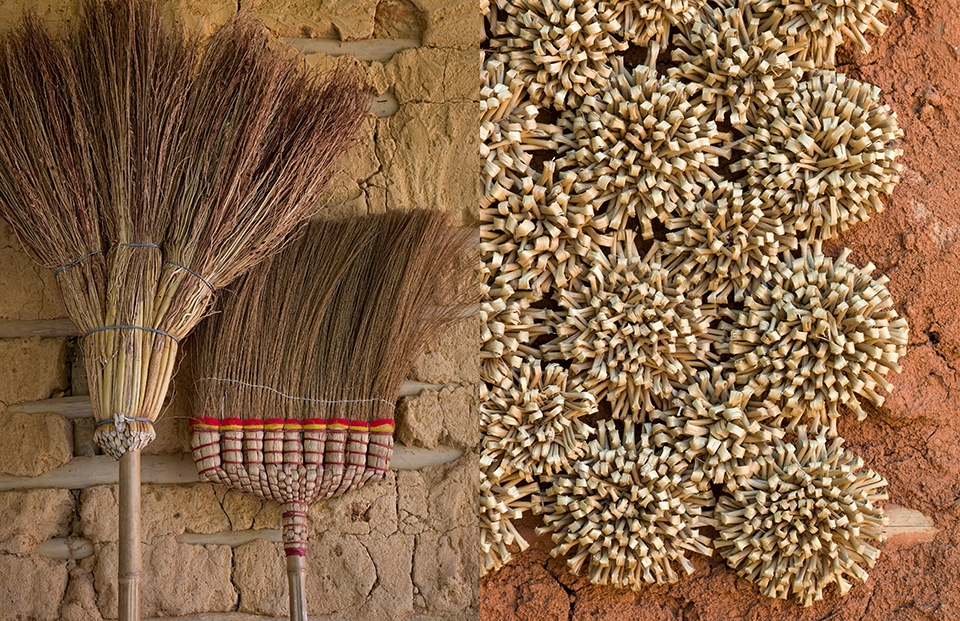
Left: straw brooms with bamboo handles, state of Minas Gerais from Oficina de Agost - Right: braided panel made from dyed Guinea grass, Juão de Fibra, artisan from Brasília by Arte Sol.
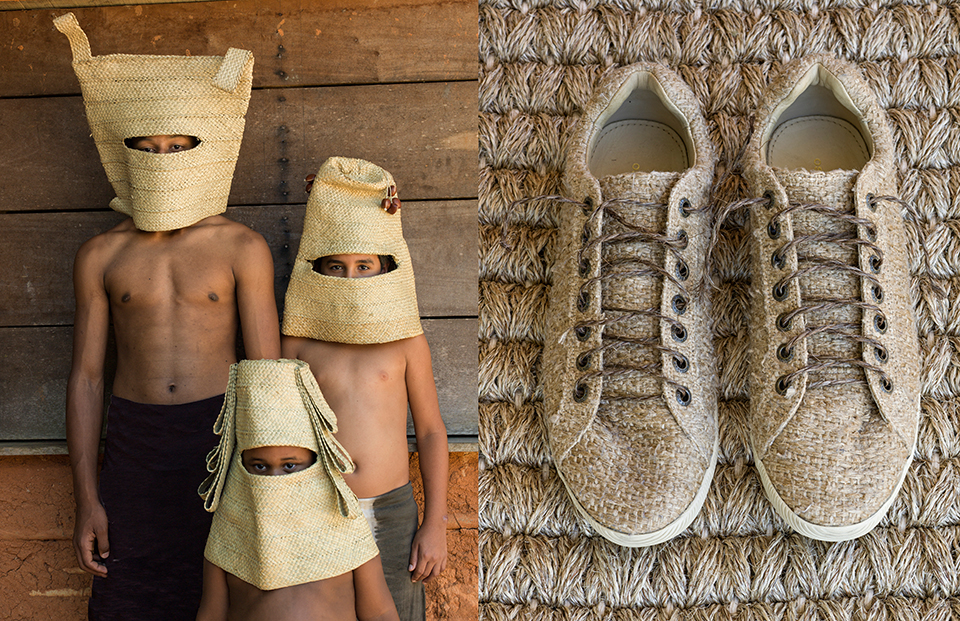
Left: indian boys play with woven straw masks at AGT Várzea Queimada, Piauí - Right:linen and straw footwear and sisal loom rug footwear by Osklen, rug from By Kami.
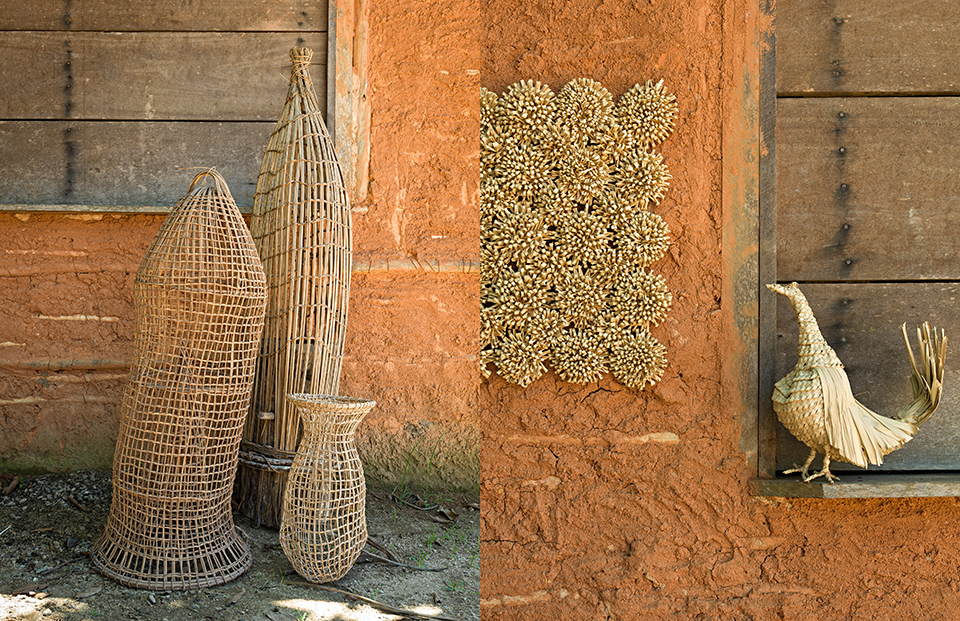
Left: fish traps made by the Enawenê-Namwê Indigenous group, from the region of Mato Grosso, and two fishing baskets from Xingu in Mato Grosso, as crafted by the Mehinako from Armazem, Paraty - Right: braided panel made from dyed Guinea grass, Juão de Fibra, artisan from Brasília and braided rooster made from carnauba straw, handcraft from Ilha Grande de Santa Isabel in the state of Piauí both from Arte Sol.
welcome
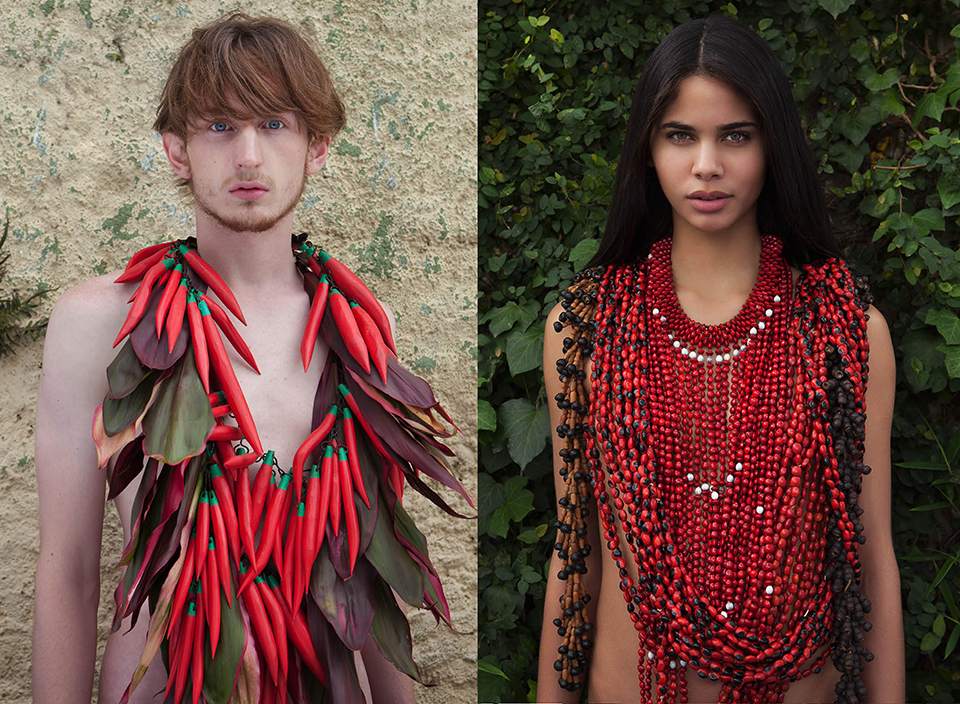
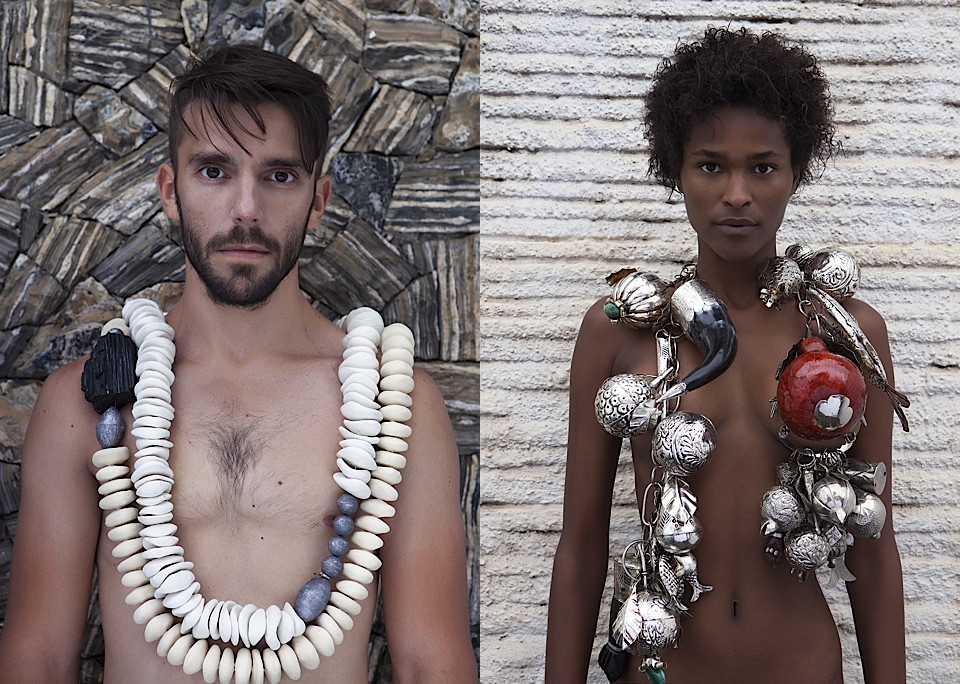
Succulent fat plants stand guard at the entrance to this garden of earthly delights; full of magnificent orchids, orchestrated with bustling hummingbirds and murmuring bumblebees hovering around. Exquisite flowers are growing wild, embracing lush floral trees like a necklace would a slender neck. They also appear on bits and pieces of adorable cloth, hardly clothing the sensual human frame. The grasses are waving in the breeze and attracting people of all sorts and colours to use them in rare and ornate artefacts, to cover roofs, floors and the body; the divine body with its piquant nudity and heavenly mass of hair that has become the trademark of Brazil, representing the roots of its culture.
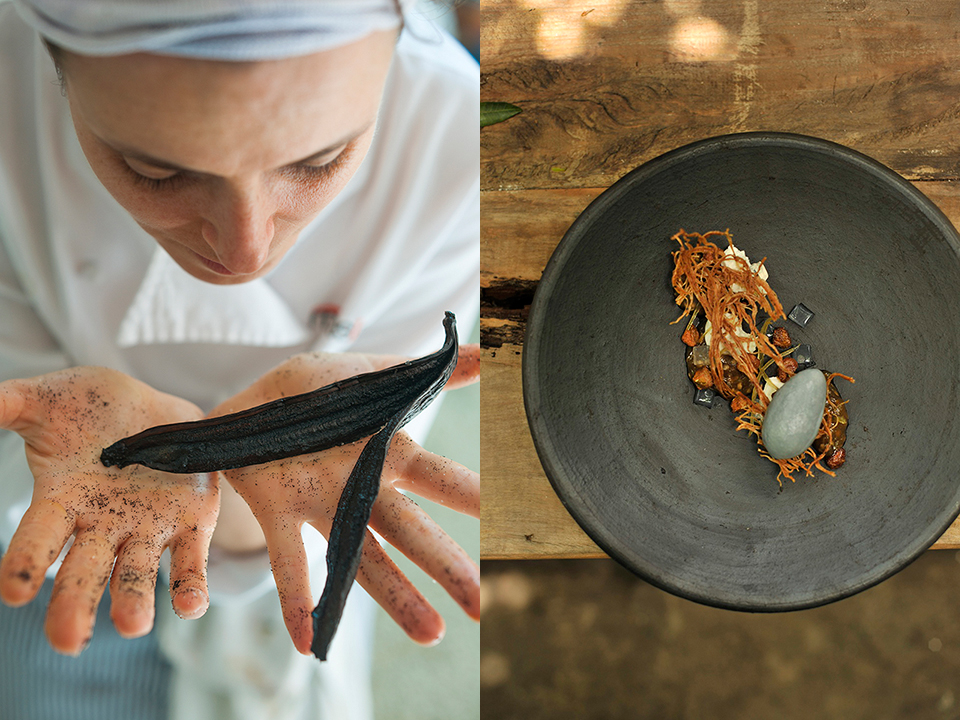
Roots have been discovered and retrieved to give food local colour and energy. The prolific palm tree shares its heart with all of us, delivering unbelievable savoury dishes straight off the grill, inspiring improvised ways of cooking for our lush future. Distinctive music is obtained from the forest also, with drums and flutes and shamanic voices, that with ambrosial sweetness narrate the origin of the planet and the birth of man.
Rare and opulent birds scant their own refrain, describing with loud fervour their mouth-watering environment. Nectarous fruits of all sorts and sizes are part of a daily ritual for appetizing lemonades and juices. The rainforest is known to host thousands of unknown plant species yet to be discovered for our health and pleasure. Rare golden monkeys can be seen as the icons of the golds found in this land: the rich oil, the sweet corn, the mellow pineapple, the syrupy honey and the rare metal itself, making this country a true land of milk and honey – now designing ice creams from it too.
Brazil is an inescapable destination, a destiny.
The flamboyant flowers that design the Brazilian landscape are embraced by palatable sea creatures that can be fished off the country’s seven and a half thousand kilometres of coastline. The beauty and the beast are brought together to imagine the luscious land of Amazonia; the boldness of its colour, the brazenness of its form, the thrill of its sumptuous embrace. Killing me softly.
text: Lidewij Edelkoort
photography: Rogerio Cavalcanti
art director: Sergio Machado
BLOOM Luscious is available for purchase:
English
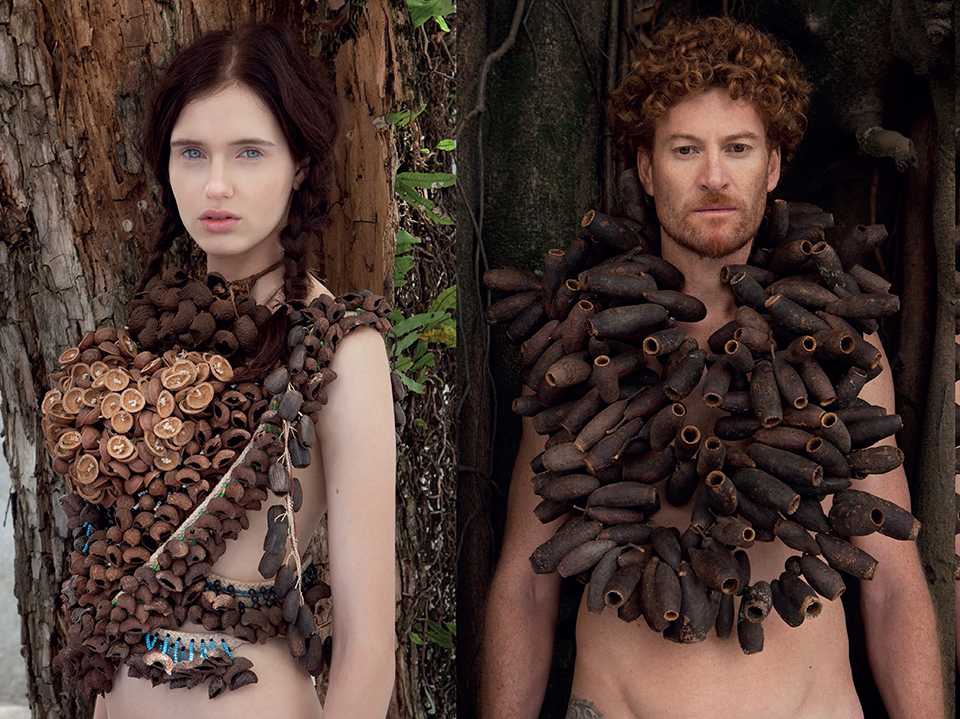
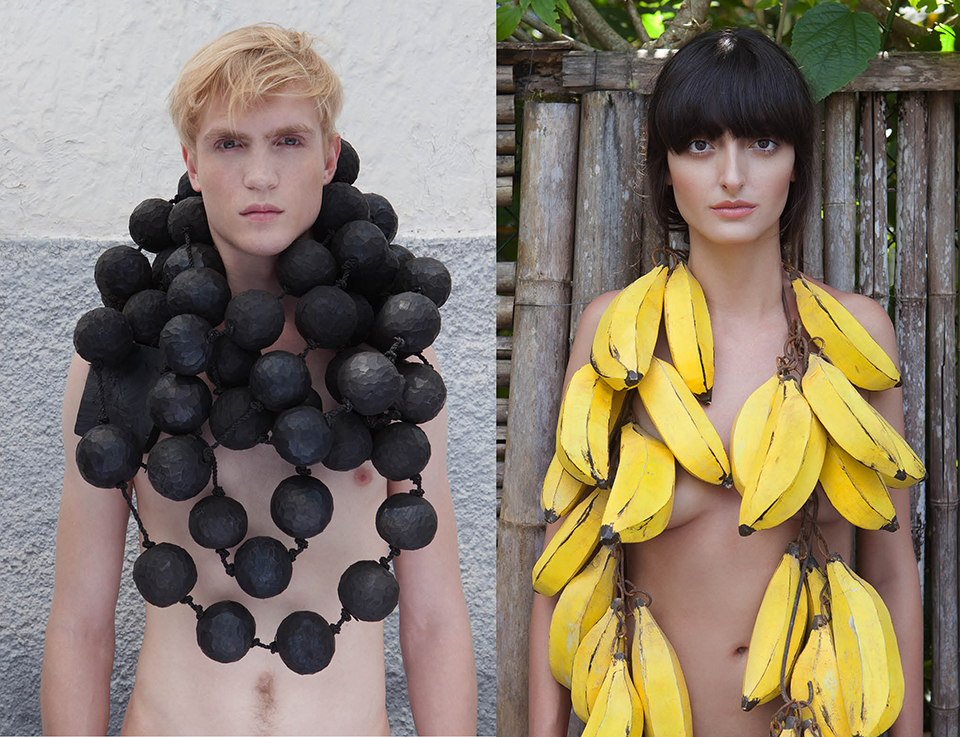
neo vanitas

Neo Vanitas photos by Kate Sears - styling Shane Powers Bloom issue 15
We enter a moment in existence when once again we turn to natural history for understanding, drawn to the vanitas in still life, to the collecting of natural wonders and strange relics for the cabinet of curiosities; to the bone and the shell,the fossil and the seed-pod, the tooth and the nail. We wield the power of objects, and the arrangement and display of objects, to tell a visceral story of life and death, to reconcile unknowns, to attempt a new to decipher for ourselves the astonishing mystery of the universe.
We are drawn to all that is reminiscent of the laboratory, the archaeological dig, the anthropological or botanical field expedition, the adventure story behind the museum display. Mineral,vegetable, and animal artefacts present themselves for cataloguing and classifying; systems and structures are secret worlds for us to decrypt and describe.
Like the explorers of earlier centuries, we are poised upon the precipice of a new world. Whether we perceive this as a new world of our own making, with consequences we only now begin to glimpse, or as a new world to colonize in space, or as the rapidly expanding nano-world of scientific investigation, or as all of these and more, we sense that all is about to change.
And because clues to our future are contained in the physical matter of the earth’s history and geography, we find resonance in all that speaks of life,death, the unknown, the strange, the secret, the microscopic,the macroscopic, the numinous souvenir of every type of exploration.
And in assembling such objects, in associating them, we find ourselves expressing the vanitas that is so deep a part of our human trajectory, going back at least as far as the Neanderthals, with their adornment of the dead with flowers and red ochre. At the point where bone meets blossom, time stands still.
Text / Michelle Anderson-Binczak

Neo Vanitas photos by Kate Sears - styling Shane Powers Bloom issue 15
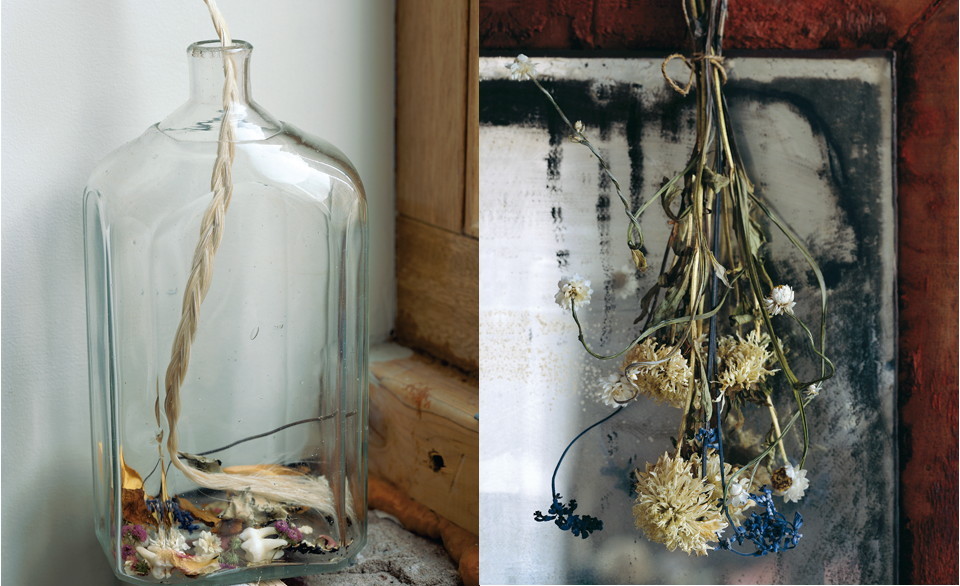
Neo Vanitas photos by Kate Sears - styling Shane Powers Bloom issue 15
mother nature
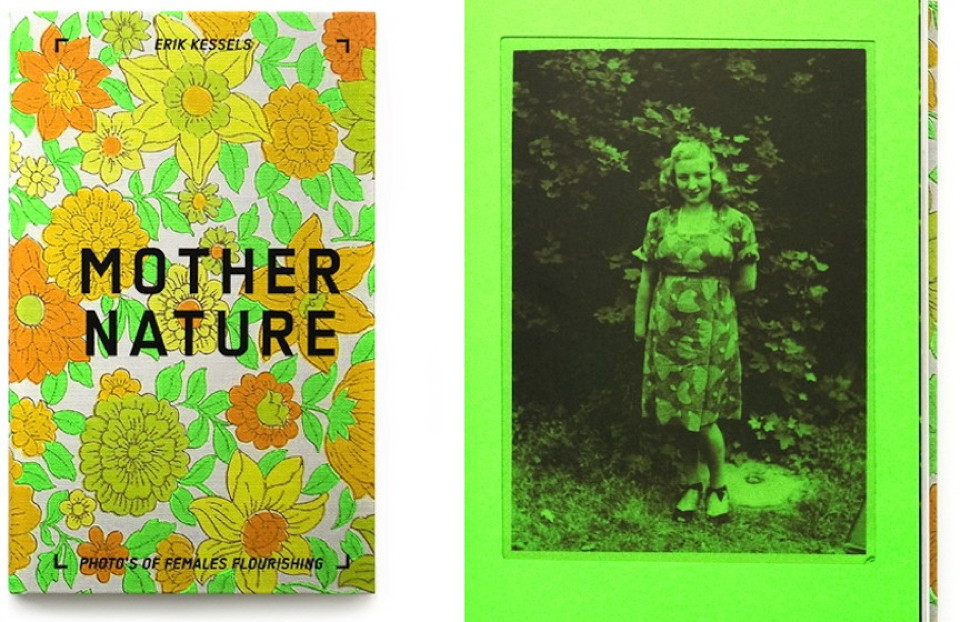
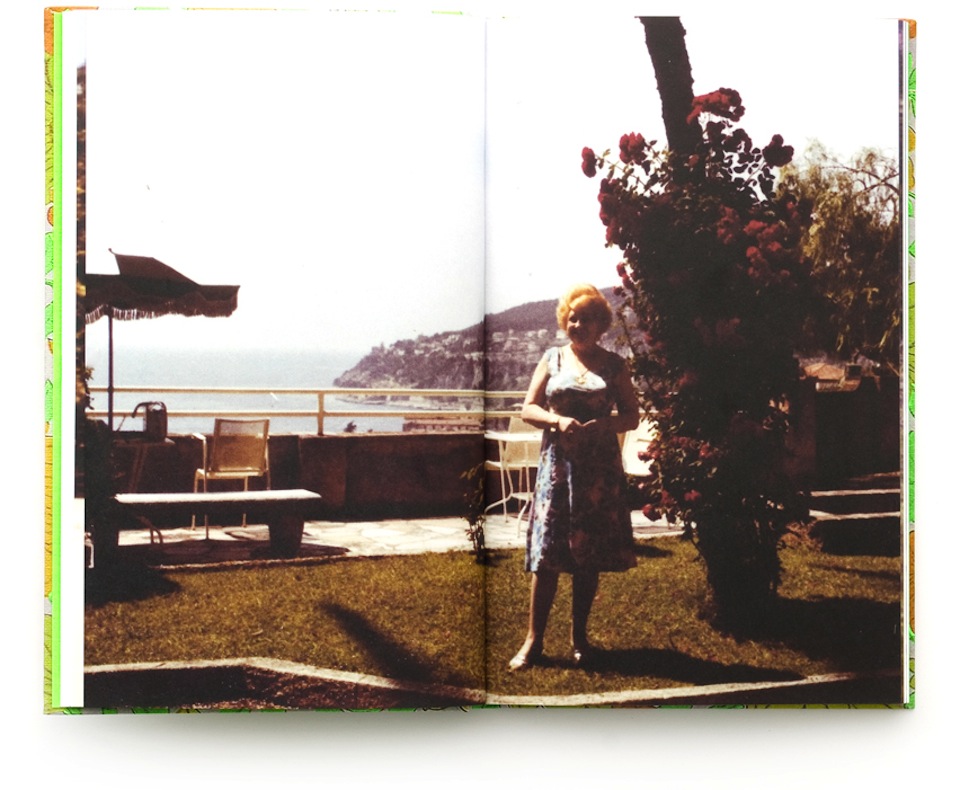
Dutch Art Director Erik Kessels changed the way we see photography. As a curator of photography, he elevated discarded amateur images to gallery status, finding beauty and insight in those pictures.
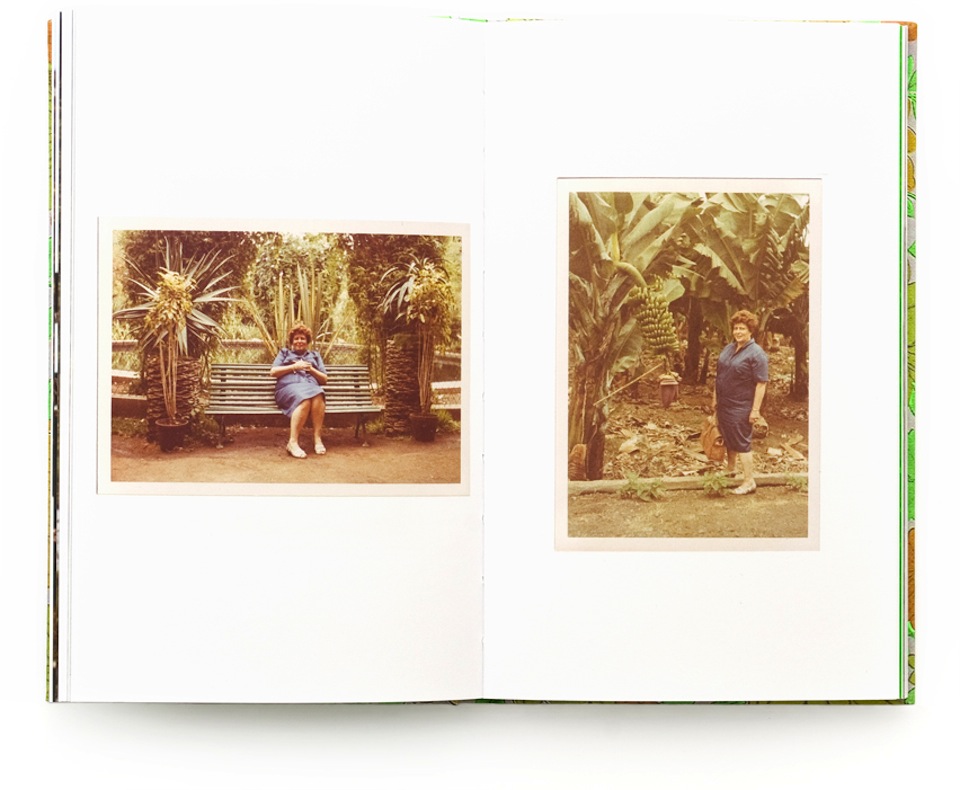
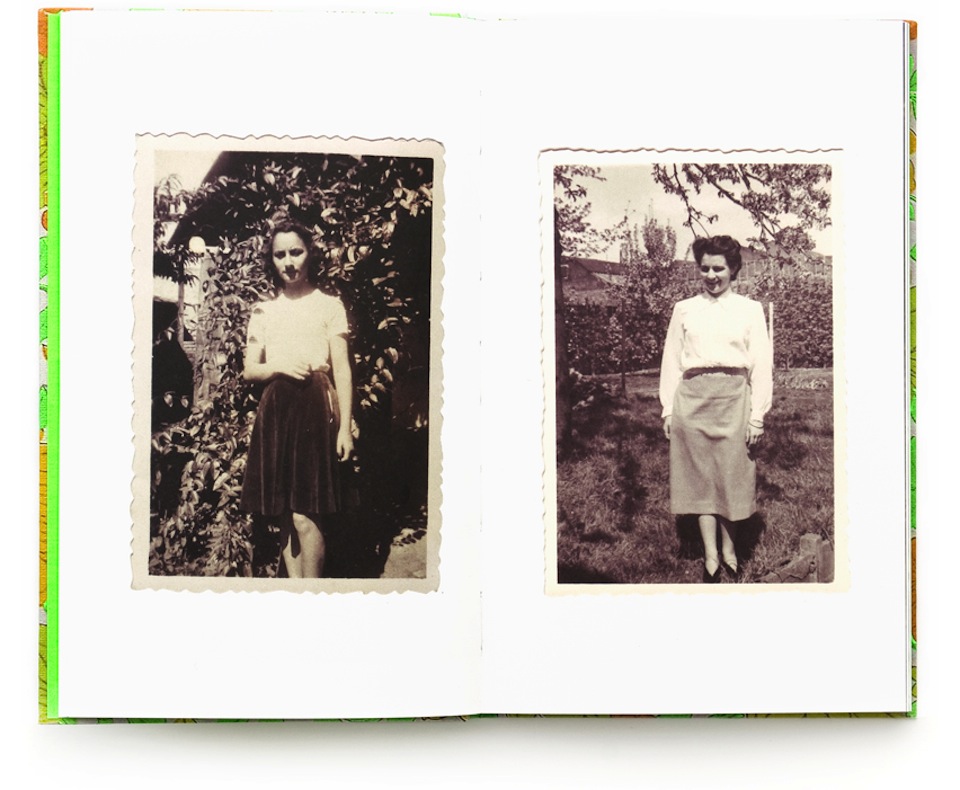
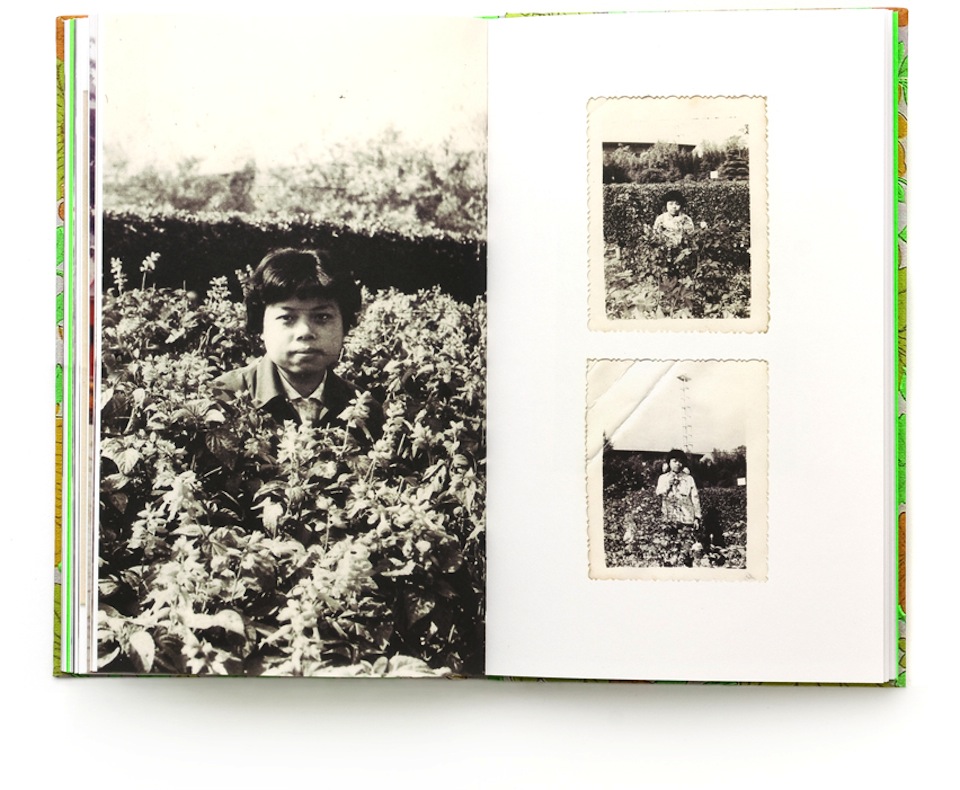
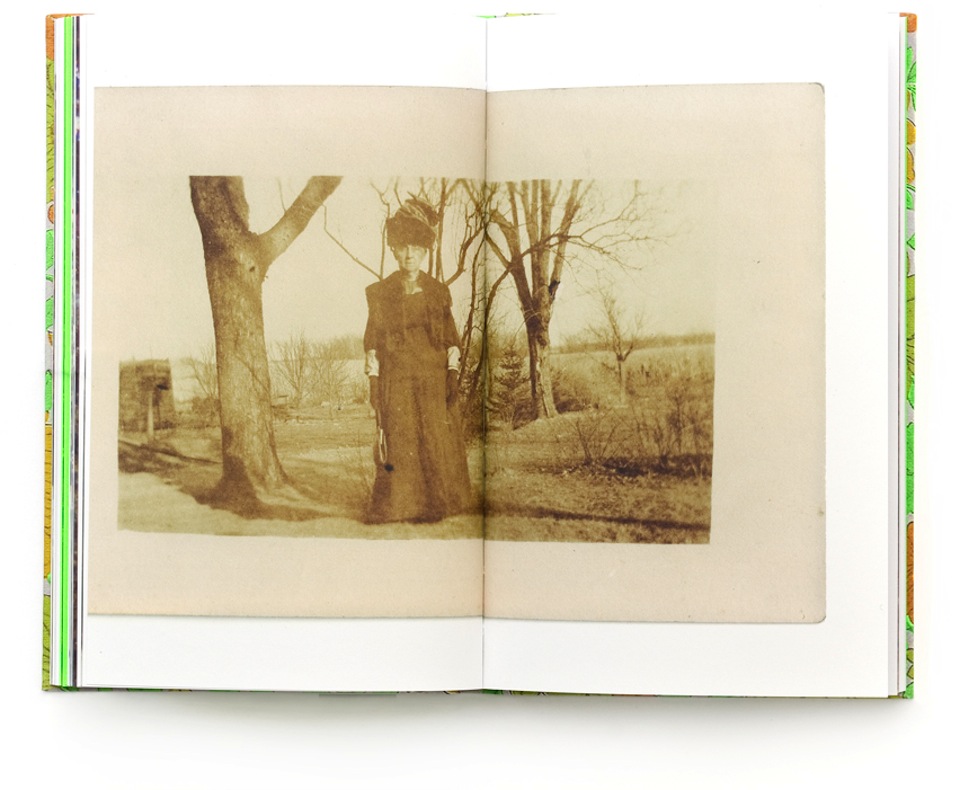
Erik Kessels brings us a new artwork, based on his own collection of photographs. In Mother Nature, he assembles photographs of women posing in front of flowered spaces, which include flowerbeds in public and private gardens, fields and beyond. This universal theme, which he identified within his own photo collection, allows us to observe repetition and difference, which weave through yielding a common narrative. The book gives us the opportunity to move between places, times, generations and cultures. The individual stories and the foreign faces create a whole within which we see our common and immutable practices.
What better description than the one given by Erik Kessels:
"Mother Nature, is an ode to found photographs made by amateurs that show females flourishing. It’s curious that a man often takes photograph of his wife in front of beautiful flowers or in nature. As if a woman needs to stand there. Or maybe she deserves it.
The photographs were collected from family albums. Once commonplace in every home, the family album has been replaced by the digital age where images are now jpegs and live online and in hard drives.
Mother Nature, is testament to the once universal appeal to document and display the mundane. Often a repository for family history, they usually represent a manufactured family as edited for display. Family Albums speak of birth, death, beauty, sexuality, pride, happiness, youth, competition, exploration, complicity and friendship.
We are all formed through our experiences, and what we witness is not always positive. Nevertheless, we usually commit only pleasant moments to our personal photos, and in particular to our family photographs.
Try flipping once through the average old-fashioned photo album. My bet is that every page will feature only laughing faces and endless images of “perfection and imperfection.”
Amateur photographers must think around corners. The lack of technical skills also makes their experimentation a necessity.
Family photographs are a form of propaganda. They try to show and sell the family in the best possible situation.»
Find the book
brasil beyond fashion
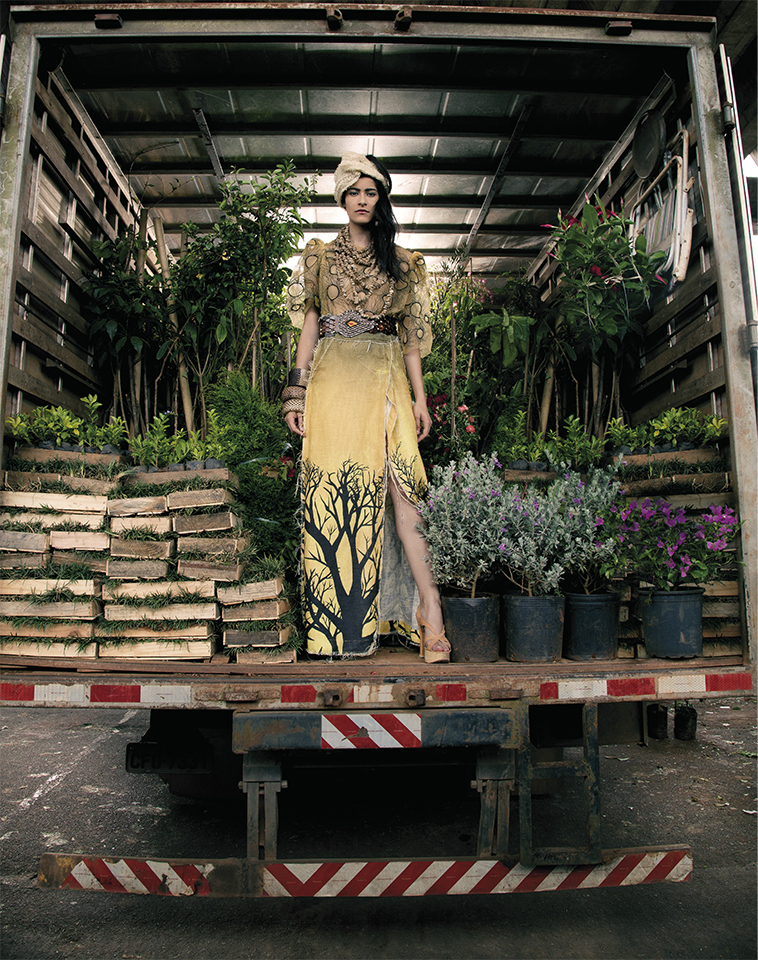
photo: Elle Dürst / fashion: Ronaldo Fraga / styling: Sergio Machado
In collaboration with Apex, Abit and Abest, the Brazilian Embassy in Paris is hosting a multi-dimensional installation for Apex brand Brasil Beyond that celebrates fashion, design, craft and creativity.
Conceived by Lidewij Edelkoort and art directed by Sergio Machado, the BRASIL BEYOND FASHION exhibition will open during Paris Fashion Week, showcasing more than twenty talented fashion designers from around Brazil.
Set amidst a gallery of large-scale photographs reflecting the true diversity and warmth of the Brazilian people, this inspirational presentation also features design, textiles, floral decorations and artisanal objects, including rare masks and head adornments from the Karajá, Rikibatsa and Tapirapé tribes. Crafts from Arte Sol, Brasil Arte, Galeria de Arte Brasileira and Deposito Kariri present collaborative sustainable projects that are produced in communities from across this vast and culturally-rich land. The exhibition is an extension of BLOOM LUSCIOUS, the new trend publication by Lidewij Edelkoort and edited by Lili Tedde.
TREND PRESENTATION & COCKTAIL WITH LIDEWIJ EDELKOORT
Friday, September 26, 2014 @ 18:00 (French)
EXHIBITION
Saturday & Sunday, September 27-28, 2014 @ Brazilian Consulate & Embassy, 34 Cours Albert 1er, 75008 Paris
TOKYO READERS!
Come experience a BLOOM: LUSCIOUS PARTY being hosted by Atsushi Taniguchi & Edelkoort East on Saturday, September 27 from 17:00 - 20:00 @ Jardin du I'llony ASHIYA in Aoyama
BLOOM LUSCIOUS Buy your copy of the new 280-page full colour trend publication.
welcome to a new bloom !
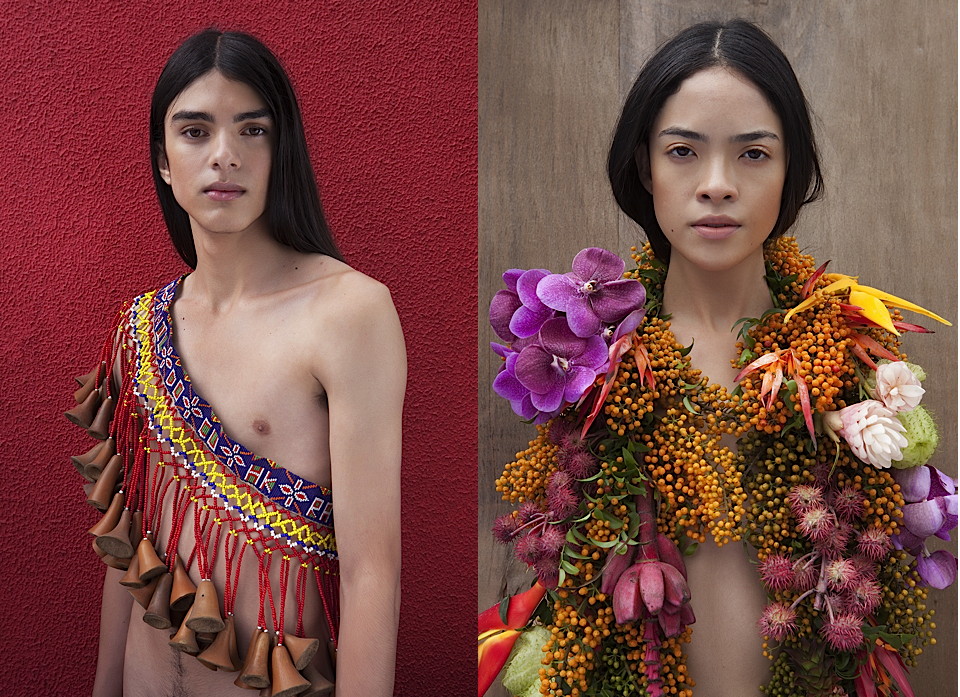
Art director : Sergio Machado - Photos: Rogerio Cavalcanti
We are pleased to announce that Bloom has become an annual trend book, evermore inspiring, with visually-stunning images to nourish all your creative work. The first in a series of journeys to countries around the planet takes us to Brazil. We are dedicated to bringing you the most unique local and outsider talent from each country to generate ideas for the years to come. Enjoy!
In this special triple issue (280 pages!), succulent fat plants stand guard at the entrance to this garden of earthly delights; full of magnificent orchids, orchestrated with bustling hummingbirds and murmuring bumblebees hovering around. Exquisite flowers are growing wild, embracing lush floral trees like a necklace would a slender neck. They also appear on bits and pieces of adorable cloth, hardly clothing the sensual human frame. The grasses are waving in the breeze and attracting people of all sorts and colours to use them in rare and ornate artefacts, to cover roofs, floors and the body in sustainable natural fibres; the divine body with its piquant nudity and heavenly mass of hair that has become the trademark of Brazil, representing the roots of its culture.
Brazil is an inescapable destination, a destiny. The flamboyant flowers that design the Brazilian landscape are embraced by palatable sea creatures that can be fished off the country’s seven and a half thousand kilometres of coastline. The beauty and the beast are brought together to imagine the luscious land of Amazonia; the boldness of its colour, the brazenness of its form, the thrill of its sumptuous embrace...
Lidewij Edelkoort
Art director: Sergio Machado - Editor-in-chief: Lili Tedde
A multitude of local ideas that are relevant for our global market. 280 visually-rich pages of trend information and creative inspiration for product design, art, fashion, cosmetics, food, architecture, interiors, textiles, communication and strategy.
A horti-cultural view of plants and nature.
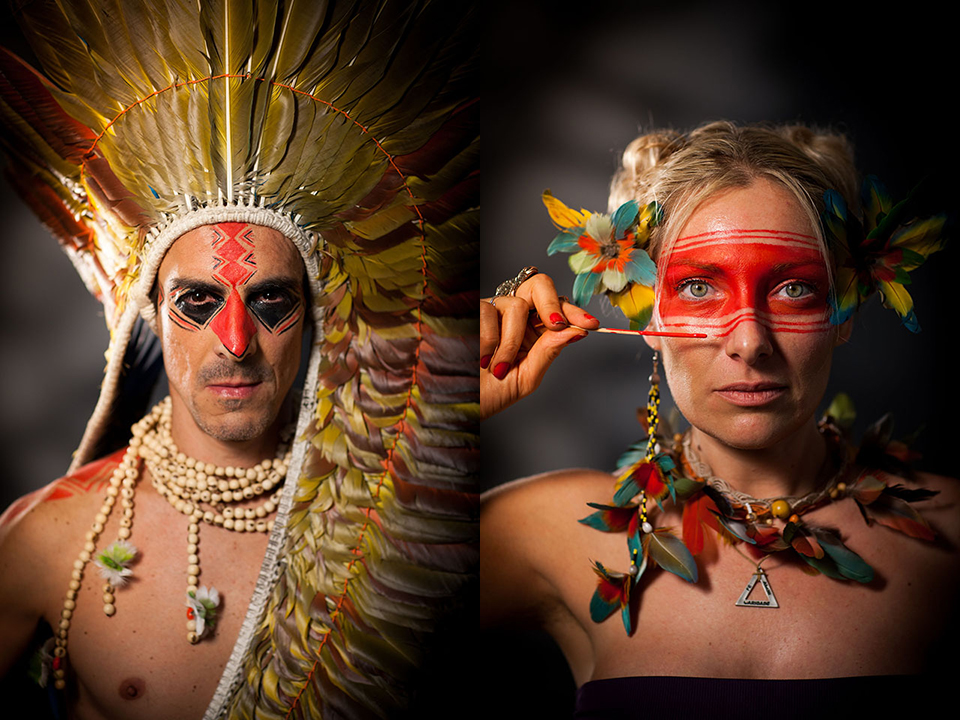
Art director Sergio Machado - Photos : Marcos Lopes
Art director: Sergio Machado - Photos: Ella Dürst
Art director : Sergio Machado - Photos: Rogerio Cavalcanti
photos Romulo Fialdini
aurore janon
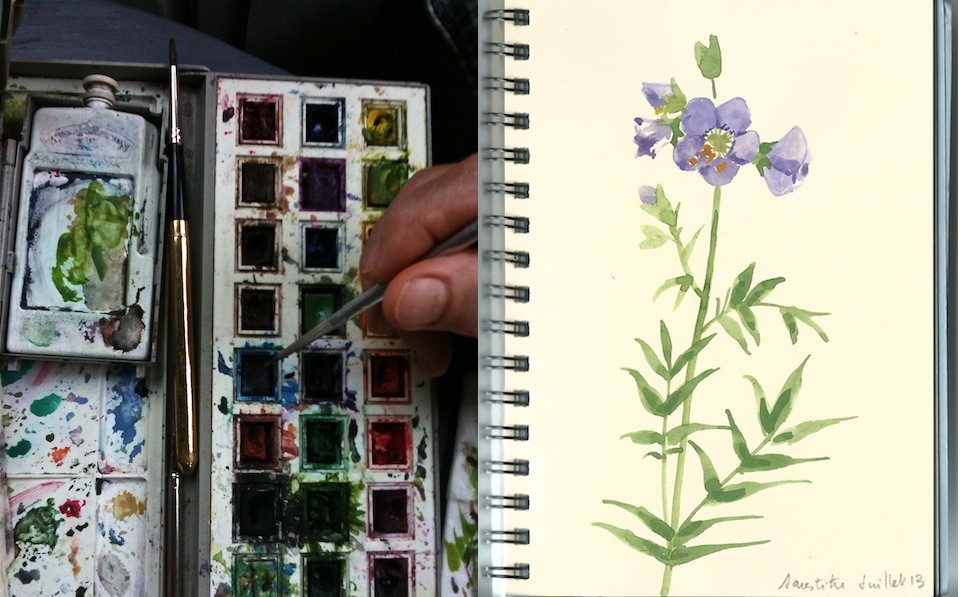
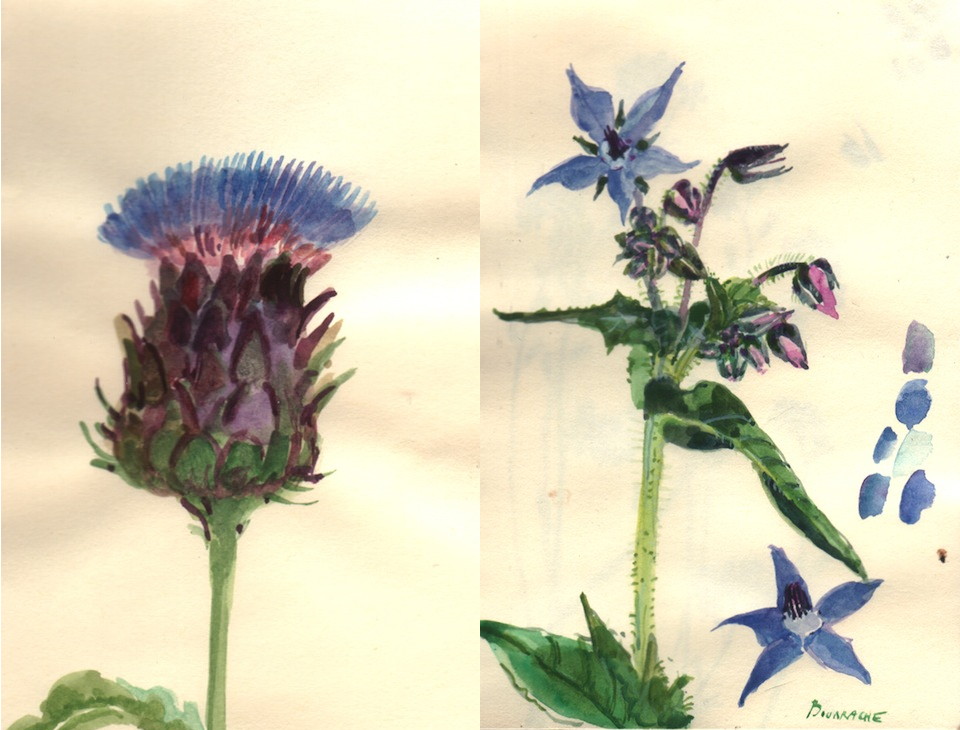
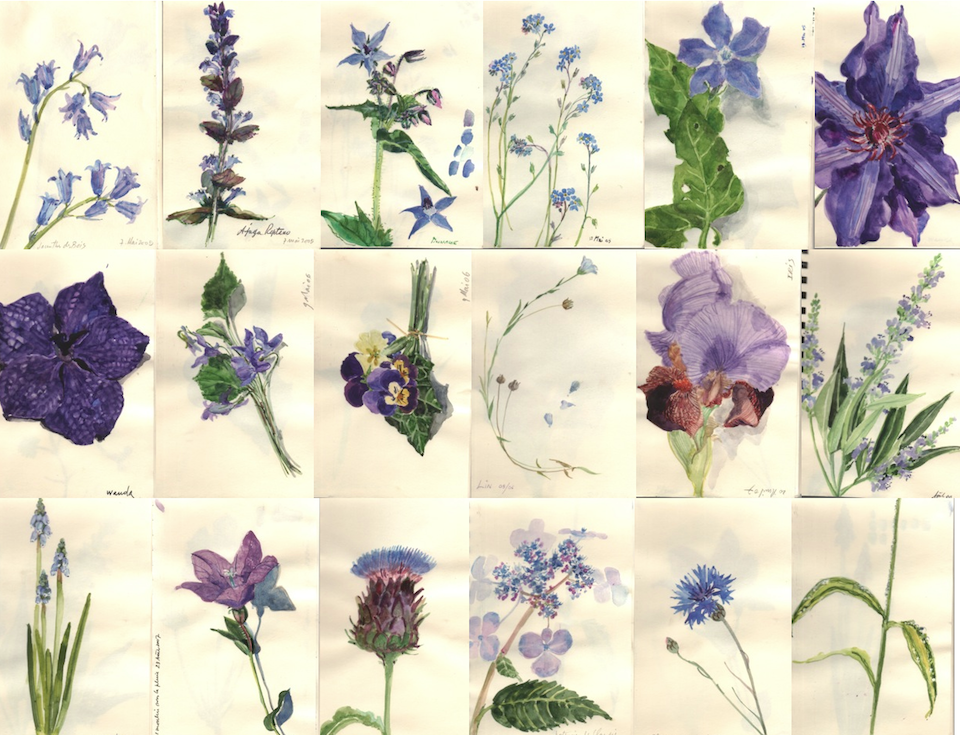
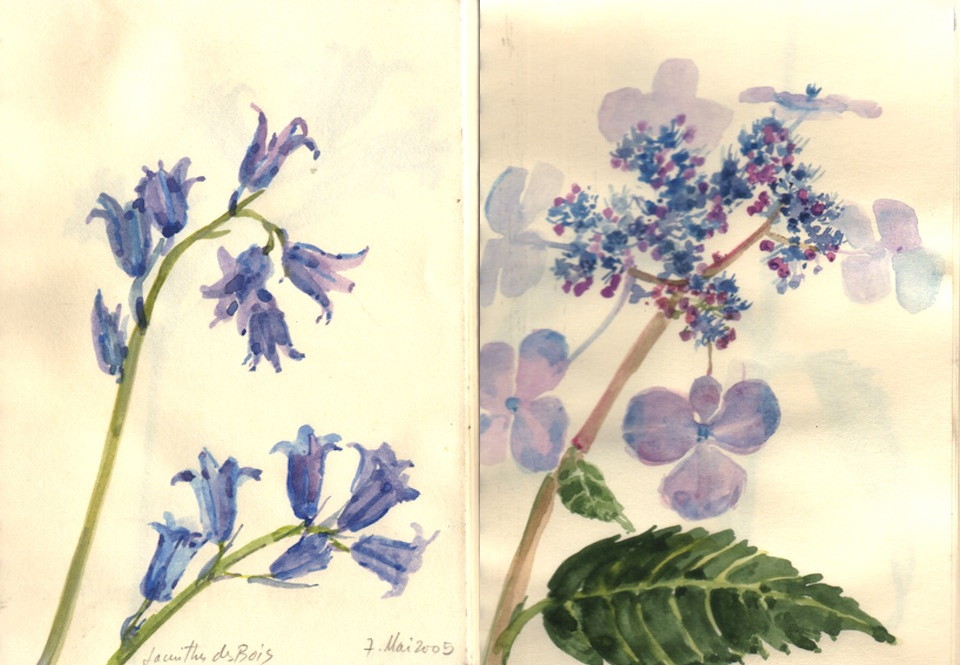
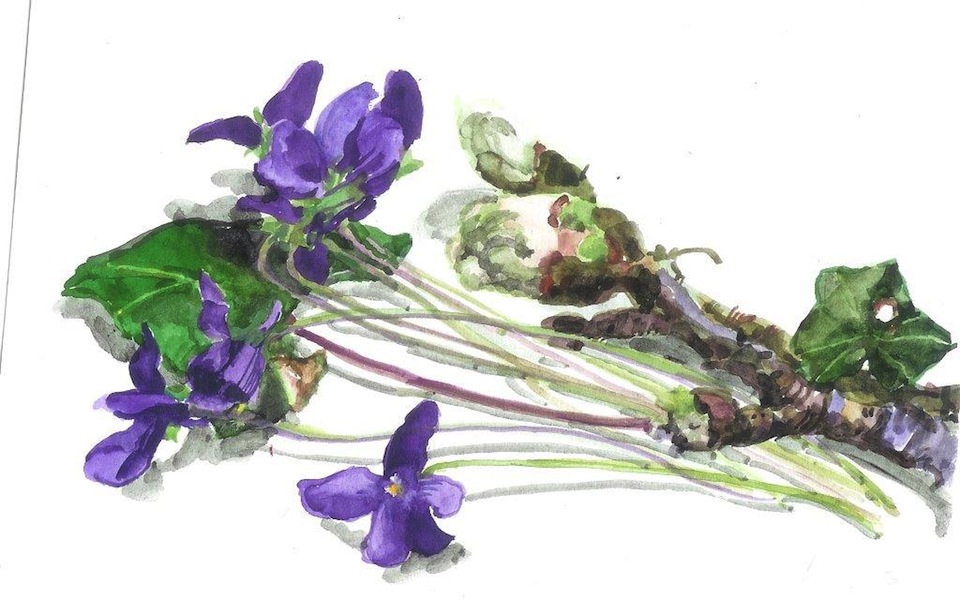
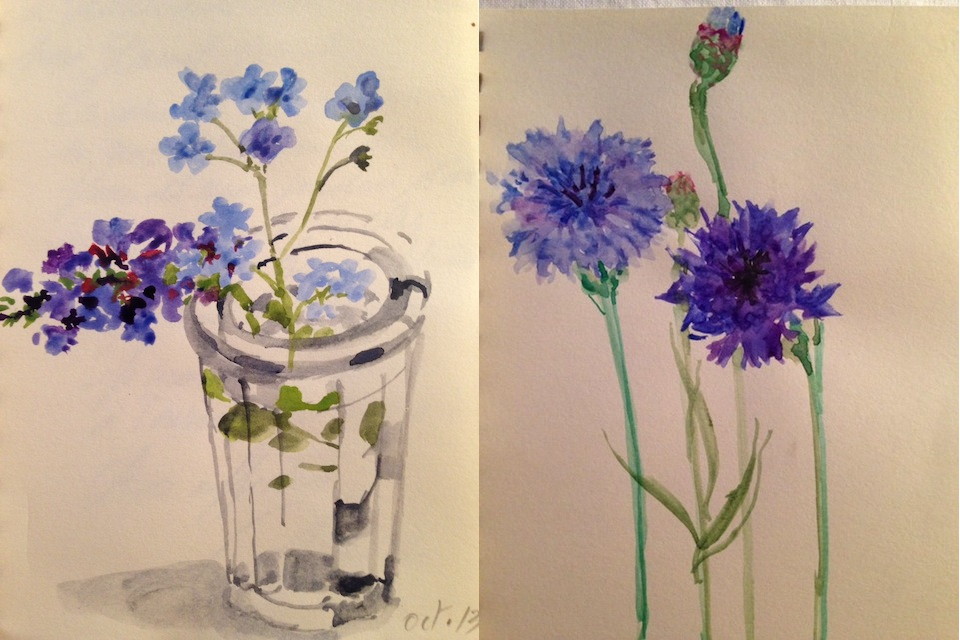
The poetry of Aurore Janon´s paintings is obvious. Beauty of colors, simplicity and elegance of shapes are the essence of her delicate work. Aurore lives in the north of France. She studied at Ecole des Beaux Arts de Paris and shared her passion of discovery with students in Textile Creation for many years. For you to get to know her better, we asked a few questions for Trend Tablet.
The main characteristic of your personality ? Perhaps optimism and tenacity.
What is your favorite occupation ? Take tea and make watercolor.
What's your idea of happiness ? Peace and simplicity in a garden.
Do you have a favorite color ? I do not have a favorite color, because what is a favorite ? It's a great adventure to find a color seen in nature. My favorite color for clothing might not my favorite color for food.
What is your favorite flower? I do not have a favorite one , each flower is so admirable in its composition, color, material, they remain for ever sources of wonder. By taste, I always prefer wild flowers.
Where would you like to live? At home, between my garden and in my library .
Your favorite dish? I really like to discover different flavors , soups are for me a source of great discoveries.
What is your current mood ? Serene.
tulip faces
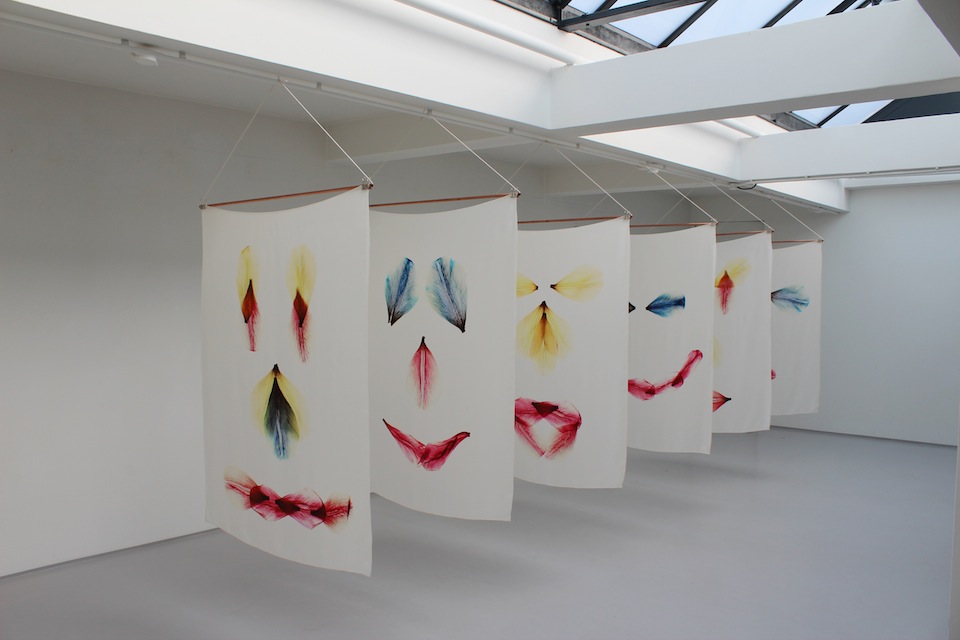
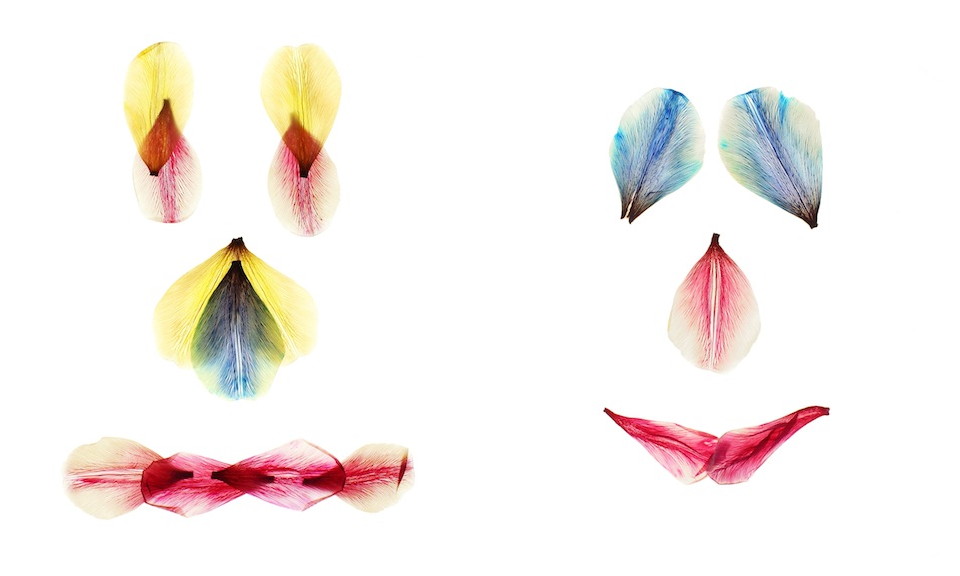
'Faces' is a new photographic series of natural-dyed tulip petals by Dutch designer Hilde Koenders. Digitally printed on silk, these abstract faces were presented during Dutch Design Week 2013 in the form of hanging banners to celebrate the 400th anniversary of the tulip in the canals of Amsterdam. The flower was introduced in Europe from Turkey and during the Golden Age, bulbs were traded at such excessively high speculative prices that "Tulip Mania" lead to what many refer to as the world's first burst economic bubble.
Koenders has returned to the symbolism of the tulip a second time. In 2005, graduated with 'Bleeding Til Death' at the Design Academy Eindhoven; an endearing installation in which the designer nursed cut blooms in hospital beds, their stems connected to a make-shift transfusions, poetically illustrating nature's transition from life to death.
all is flux
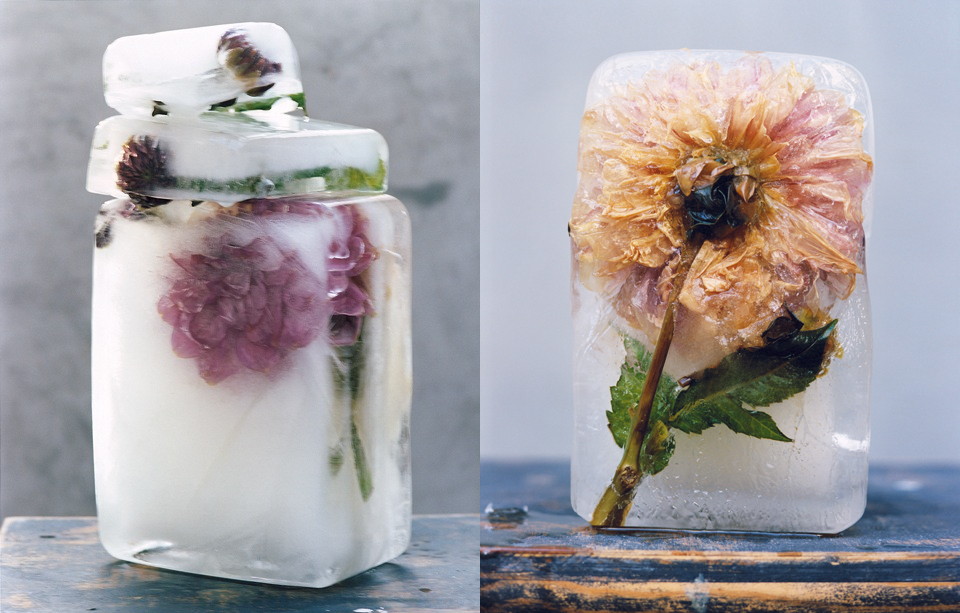
photos by emmanuelle hauguel, Bloom issue 21
Consider not only organic materials that will return to the earth, but pure and simple substances that disappear by changing state or property. Matter that becomes fog or water. Suspensions, saturations, freeze-formed or gelatinous compositions designed to disintegrate in time. The thing that becomes nothing is true minimalism. The laws of physics that enable suspended animation can guide us in creating mercurial, ice-like packages that please with their delicate temporality and playful shift between crystalline.
As we move further into the understanding that every package we create becomes yet another planetary presence that needs eventually to gracefully disappear, we find inspiration in the idea of packaging programmed to vanish.
Let us borrow a trick from nature, and wrap our products in the most ephemeral of forms: river-nature and cloud.
Can we create containers with the preservative power of glaciers? Wrappings
with a wont to evaporate? When our products are symbiotic with their wrappings, content and container one and the same and destined to die an easy death, then we will have achieved equilibrium based on a total embrace of the transient.
amira fritz
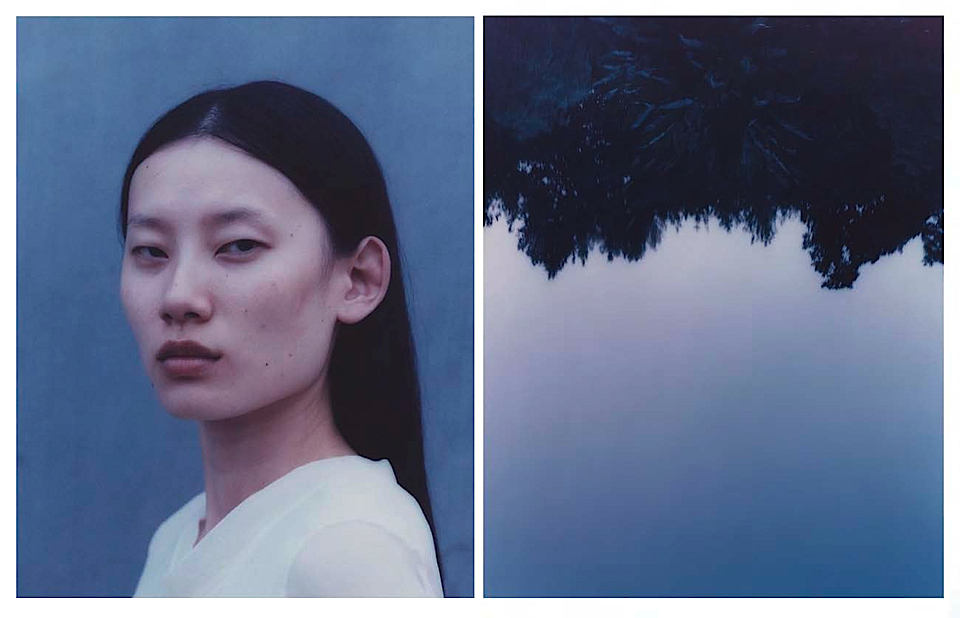
photos by amira fritz
Camilla Bo’ is an Italian freelance journalist and stylist. After two years of study in Paris she returned to her native Rome to study architecture. The art of critique proved more fruitful for Camilla and she began to write for the Association of Art and Critic about art and design and on her personal blog Choufouchouf. Focusing on the relation and communication between fashion and art, she decided to follow her creative nature not only giving a voice to the library she has on her laptop but also as inspiration for editorials. She’s now based in London, attending the course of «Art Direction for Fashion» at the Central Saint Martins College of Art.
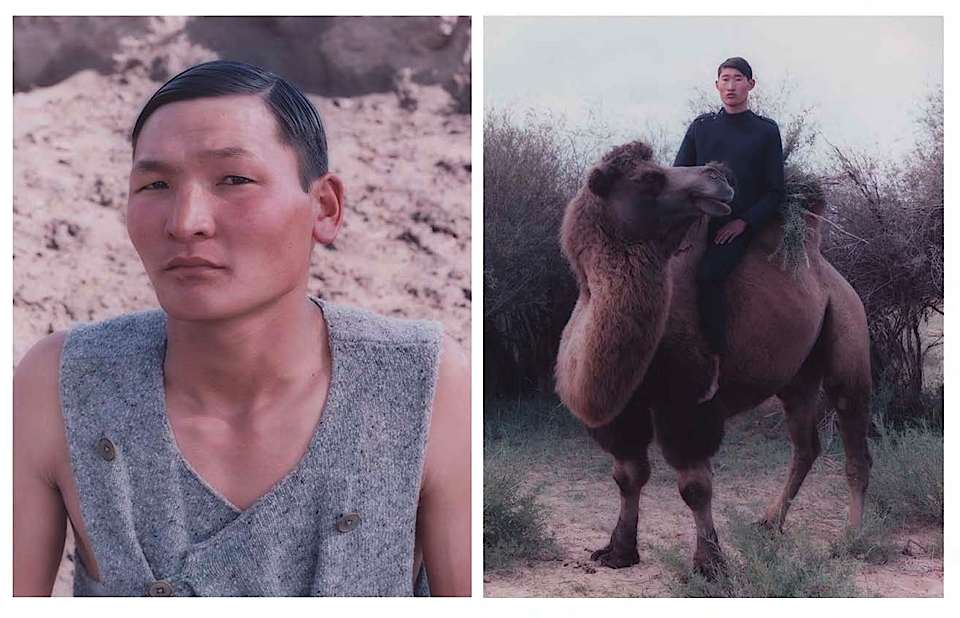
It’s a cold morning in London and Amira is here after a long long trip in China, Mongolia, Hungary, Germany and France. She has a silver suitcase with her, full of precious photographs from the trip.
When she gave me her heavy book and I started to look at her work I could feel her alert gaze upon me. She is so graceful, attentive and absent at the same time. I can recognize her in her pictures, so simple and powerful.
Nature is always present in her projects. So it's natural to think that it's where she likes to be the most.
She explains that is the primitive side of nature which fascinate her and it is actually what she captures in her pictures, but then she prefers to live in big cities.
Every time you see Amira’s pictures, you can find something different. You can hang them on the wall and I’m sure you’ll never be tired to look at them. There is a special harmony between colours, subjects and composition that makes you feel peaceful.
You're one of the few that still snaps in analog format. It 's easy to see why. Do you have any secrets to create a special atmosphere on the photos in the darkroom? Do you use particular types of paper or materials during the printing phase?
I think my biggest secret is to spend a lot of time with my pictures in the darkroom and to be open to experimentation. I sometimes play with the chemicals, use pre-flashed paper and move the paper while I am exposing the film, but these are all effects that could be done easily with photoshop. What makes my work improve is the time I put into it - you have to imagine, a colour darkroom is a total black space. There is no distraction possible. There are no calls, as the phone would lighten the paper, no computer, no internet, no one opening the door. You are totally alone and there is only darkness surrounding you. To put myself in this kind of restrictive situation somehow rubs off on the images and transforms them into objects. For me, it's like giving them a soul.
Your works are closer to paintings than to photographs. I mean there seems to be an influence of film sources or pictorial sources. Did you do any work in the past that has characterized so much your language?
While I studied in Vienna and part of my time in Berlin I worked as a movie projectionist. Always in little independent cinemas. So I have spent thousands of hours staring through a little window watching parts of movies. For sure, that influenced my work.
I ‘ve always been fascinated by your pictures with flowers covering faces… It reminds me to a vase. The men is the vase, the container of something alive. Why do you love cover people faces with the flower compositions?It is a choice dictated by aesthetic criteria or does it mean anything to you in particular?
I like to express feelings through my work. To make them visible for the viewer, I suppose a transformation into the surreal is sometimes necessary for this to happen. The idea to cover people's faces came from making portraits of my family. I have been familiar with these faces my whole life, so I responded to them in a different way than a stranger would. I put the flowers there to translate my perception into a visual format - to show the faces how I see them.
The flowers chosen for your set-up are often out of context, even if you're shooting in the woods or in a field you have the idea of a real set. And perhaps there lies the strength of your images. It 's always like that or there were some natural places you do not want them to change?
I am still looking for that place which looks exactly how it feels. I guess I would never leave if I found it.
Which artist you would like to collaborate with in the future?
Werner Herzog
Which are your next projects?
I recently traveled from Shanghai to Paris purely using transportation on land. Siberia was part of the trip, the landscape is just crazy there. It's so cold for most of the year and then in the short summer, people, animals and plants are blossoming in such an intense way. I think, I have to go back there.
Camilla Bo’
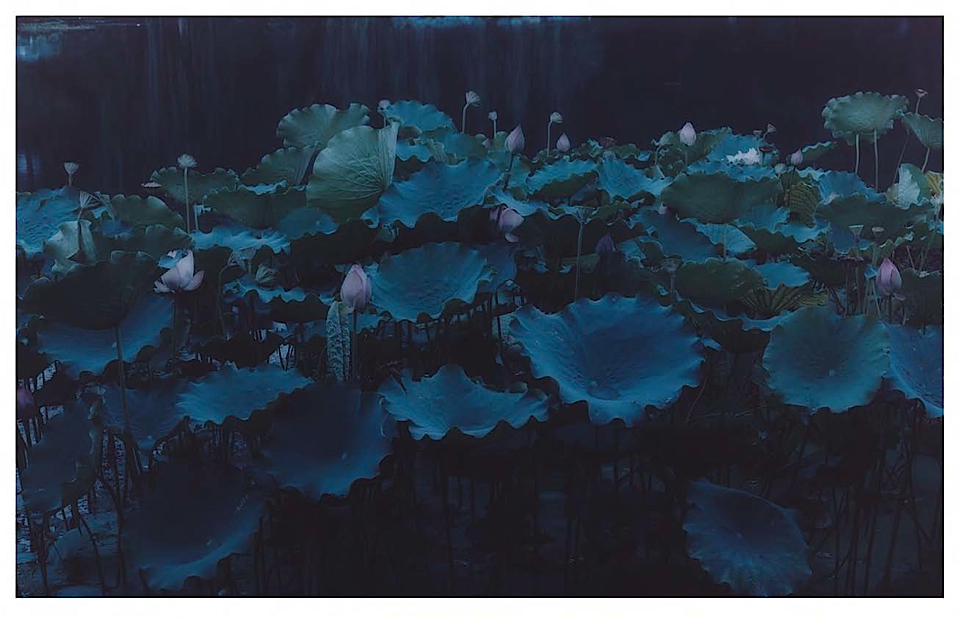
photo by amira fritz
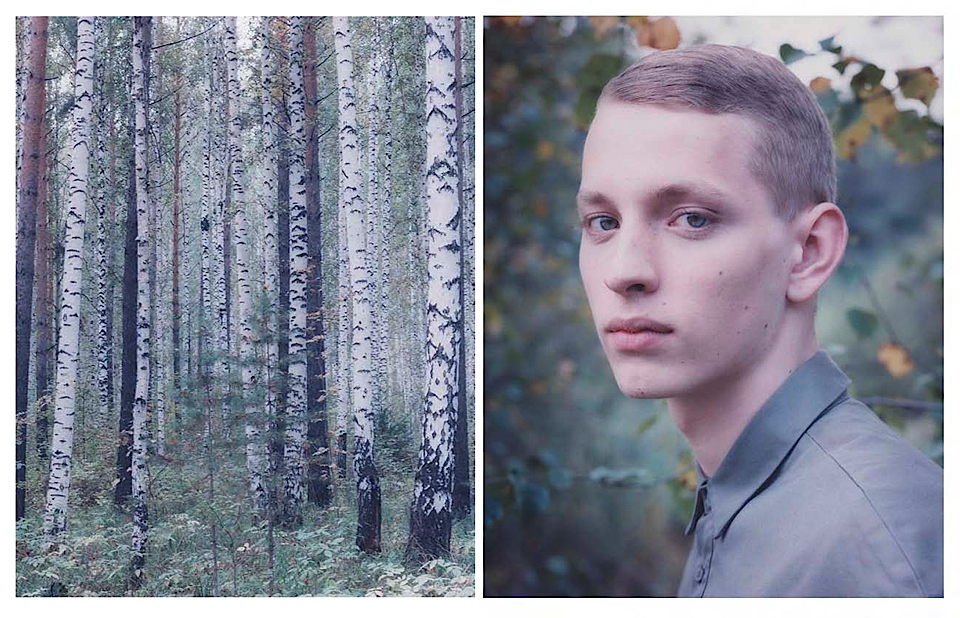
photos by amira fritz
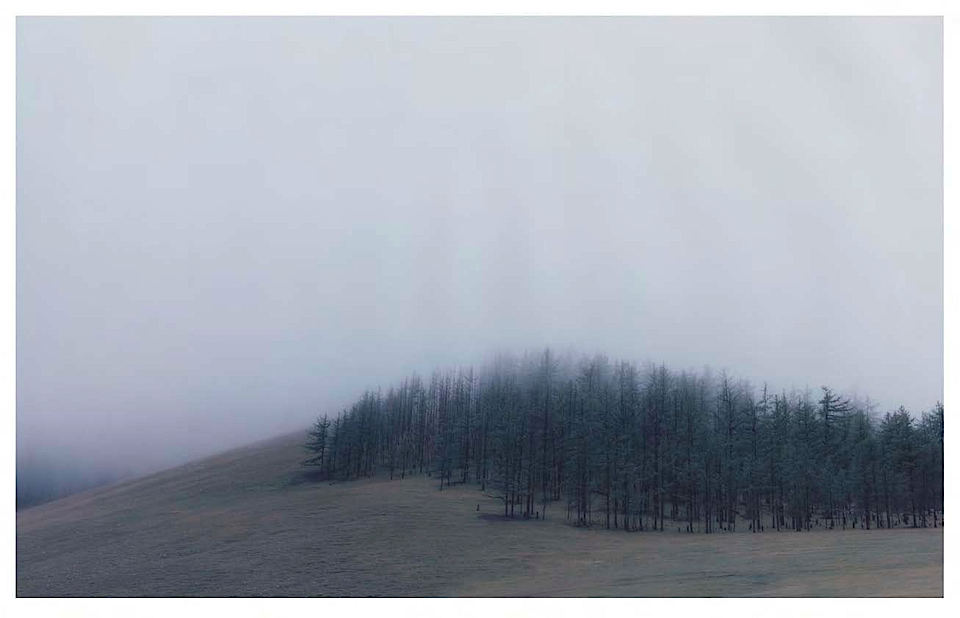
photo by amira fritz
photos by amira fritz
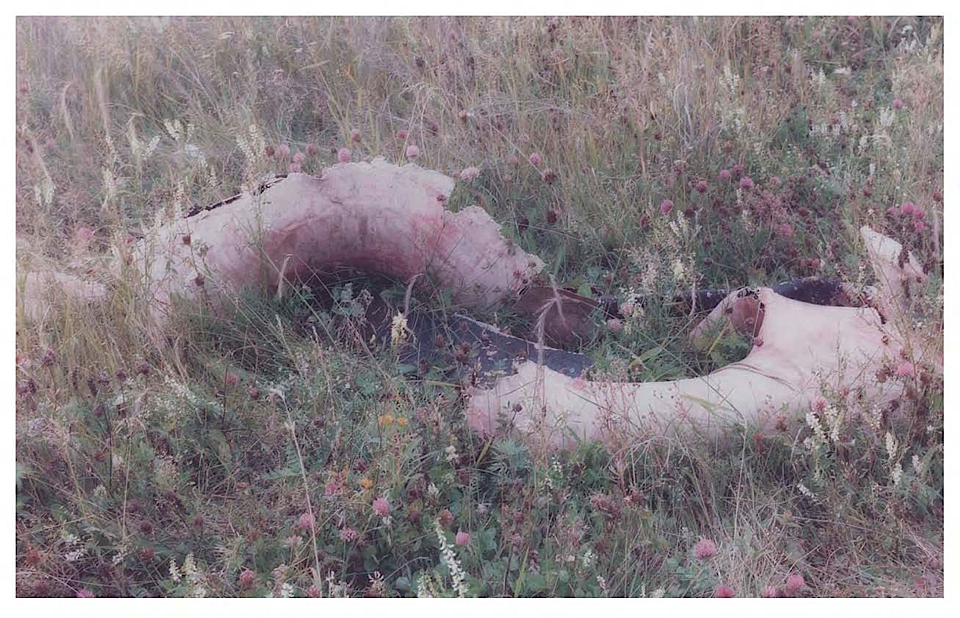
photo by amira fritz
bring the outdoors in
concept & styling by Shane Powers - Photo by Gentl & Hyers
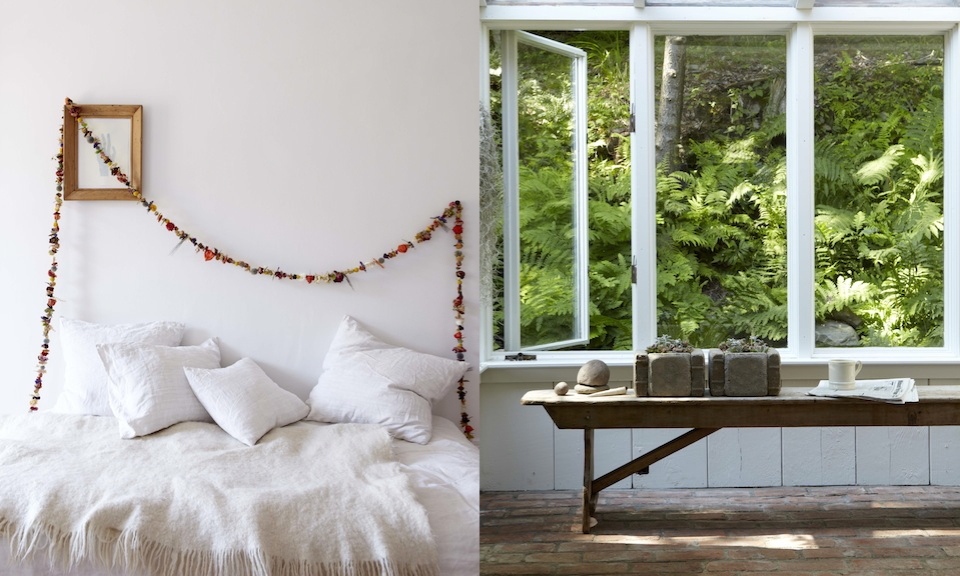
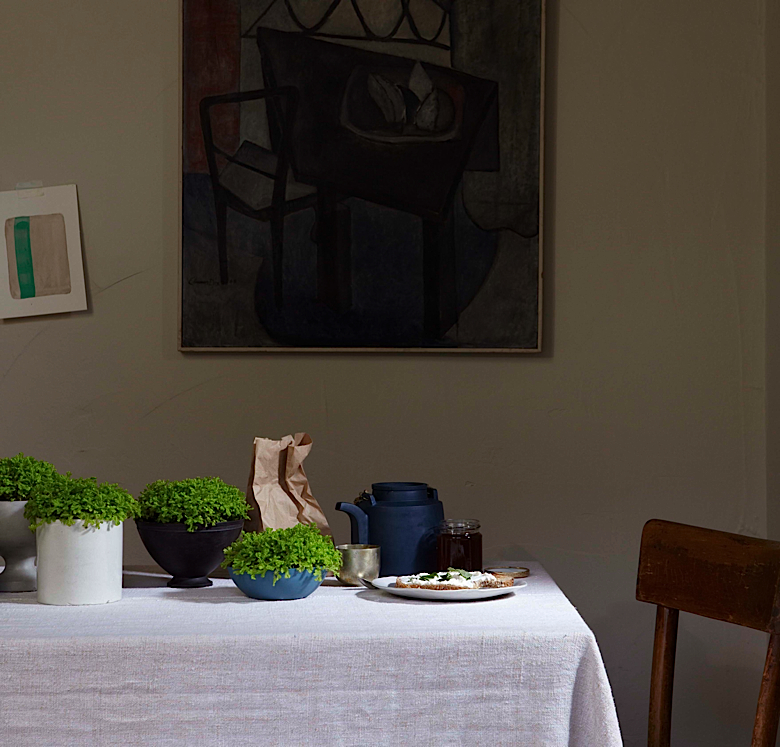
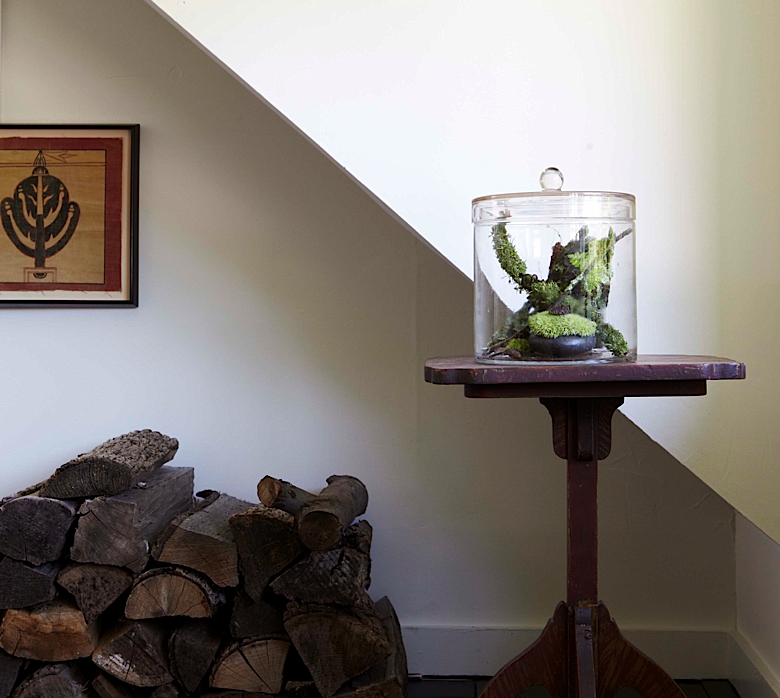
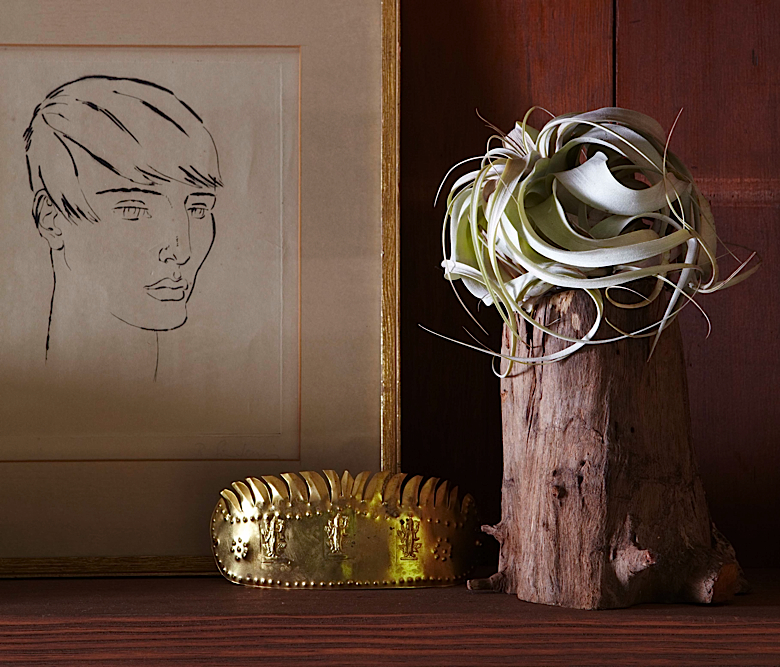
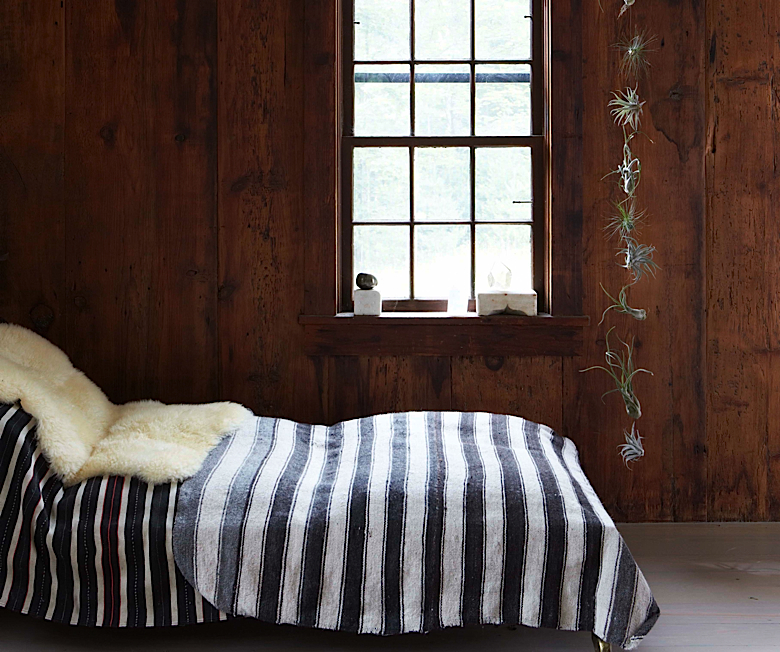
New York-based stylist and Bloom magazine contributor Shane Powers is pleased to release his first book, 'Bring The Outdoors In' (Chronicle, 2013). Photographed by Gentl & Hyers, this fresh and aesthetic lifestyle book offers original and creative ways to blur the boundaries between outside and inside.
Powers says that he's been fascinated by the natural world for as long as he can remember: "I didn't start working on botanicals until I got a job as a photo stylist for the groundbreaking publication Bloom. The founder, Lidewij Edelkoort, encouraged me to think beyond traditional uses, and focus on plants and flowers as more dynamic elements. I began to look at their shapes, colors, and textures with a new perspective… While trends in flowers and gardening may come and go, the ideas in this book have a timeless appeal to be enjoyed and referenced for years to come. The projects are not gardening projects; they are three-dimensional still lifes, miniature worlds designed to enhance your interiors.”
Edelkoort sees Shane Powers as a landscape designer of mental matter: "with the powers to transcend beauty with creative control and imagination, for you to grasp and make your own as an enlightening personal experience". Enjoy!
New York City readers will be able to attend the book launch from 6-8 PM on February 21 @ West Elm, 1870 Broadway (between 61st - 62nd Streets)
concept & styling by Shane Powers - Photo by Gentl & Hyers
concept & styling by Shane Powers - Photo by Gentl & Hyers
concept & styling by Shane Powers - Photo by Gentl & Hyers
concept & styling by Shane Powers - Photo by Gentl & Hyers
tools for peace
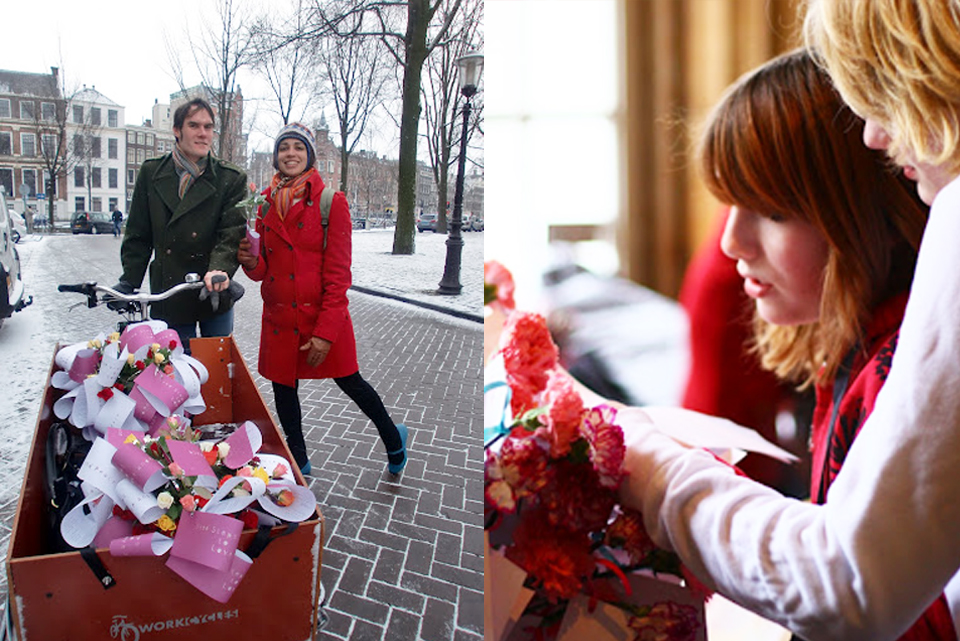
photo courtesy federico hewson
Federico Hewson, international performance artist, has turned social entrepreneur to market and brand flowers as tools for peace.
He started the "Valentine Peace Project" five years ago in the USA to generate a bigger hearted love for Valentine's Day. Federico collected dozens of love & peace poems in different languages from around the world - working with US flower companies, students in Los Angeles and volunteers.
Then, the "Valentine Peace Project" moved to Amsterdam and began working with Fairtrade . On February 14, through the streets and canals of Amsterdam, thousands of donated Fairtrade roses were given out with poems in a huge sweep! Federico is collaborating now with the Dutch Flower Industry to cultivate and market tulips dedicated to peace.They are both working with schools and communities to construct peace poetry gardens for the International Day of Peace in September.
For Federico, the Flower Industry could be more dynamic in flower design and more involve in fair-trade.
The "Valentine Peace Project" wants to connect our common global humanity through the appreciation of flowers and poems, which are reflections of inner peace. Flowers have also a political dimension since ever.They have been symbols for many revolutions up to the current Tunisian Jasmine revolution - part of the Arab Spring."
"Flowers continue to be symbols of enlightenment and revolution as well as means of urban regeneration, and now items of Fairtrade and global development." By branding flowers as tools for peace Federico plans to push forward this conversation.
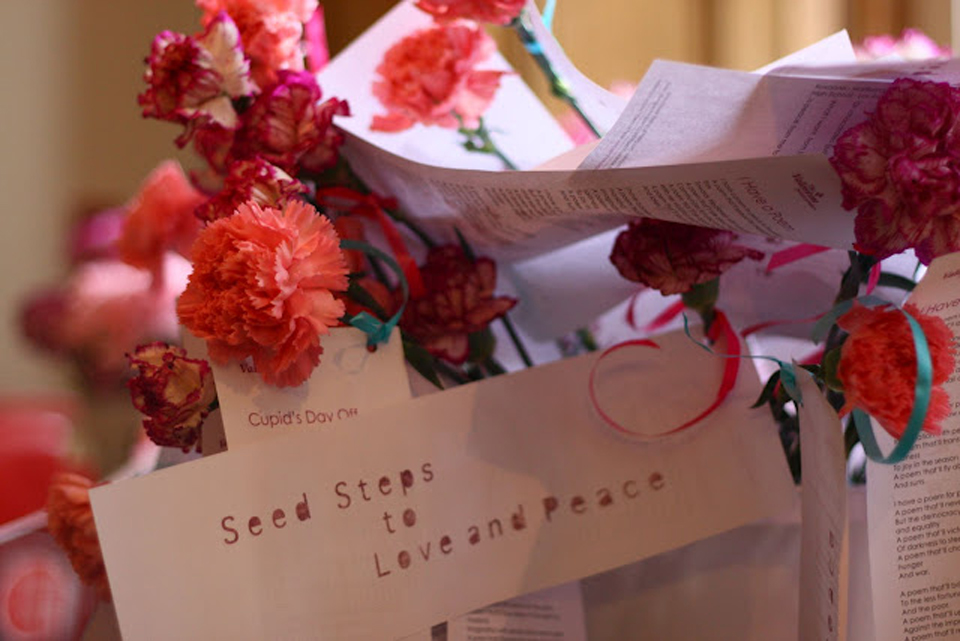
photo courtesy federico hewson

photo courtesy federico hewson
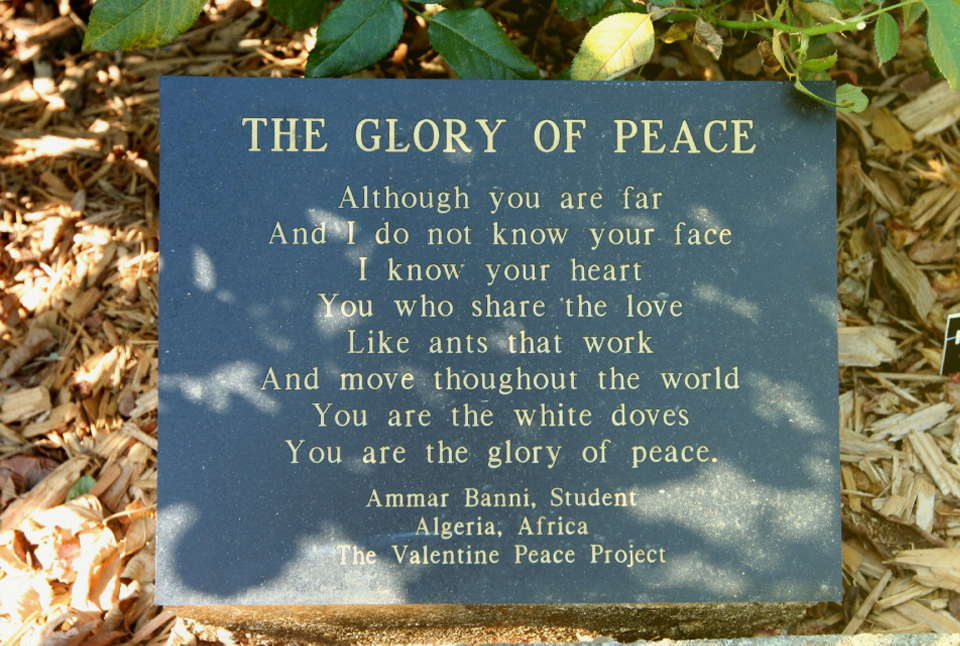
photo courtesy federico hewson
summer flowers
photos dietlind wolf
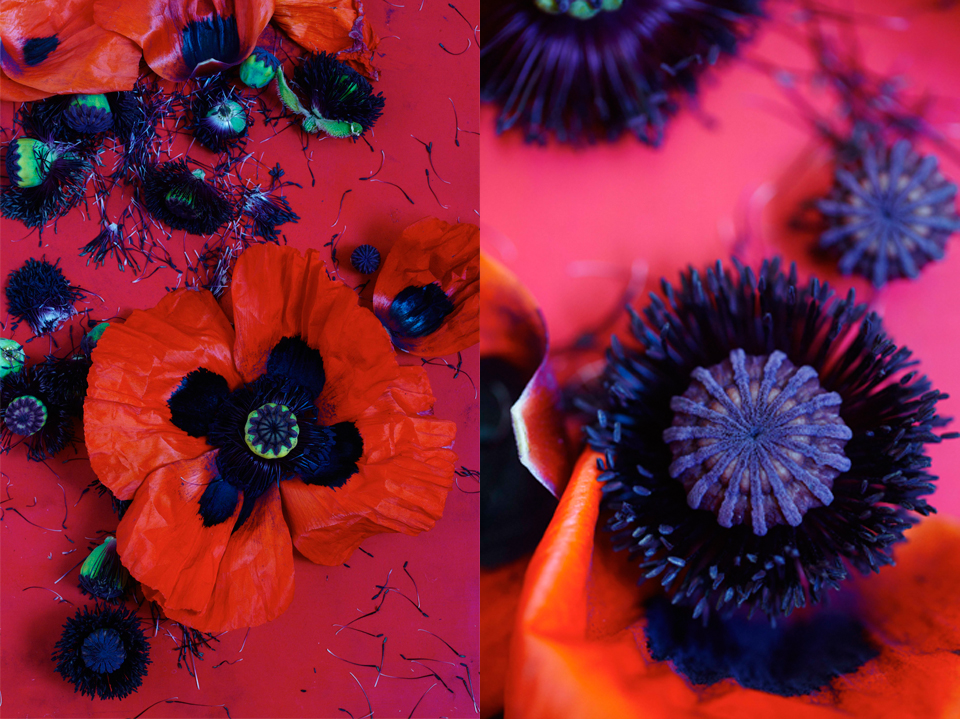
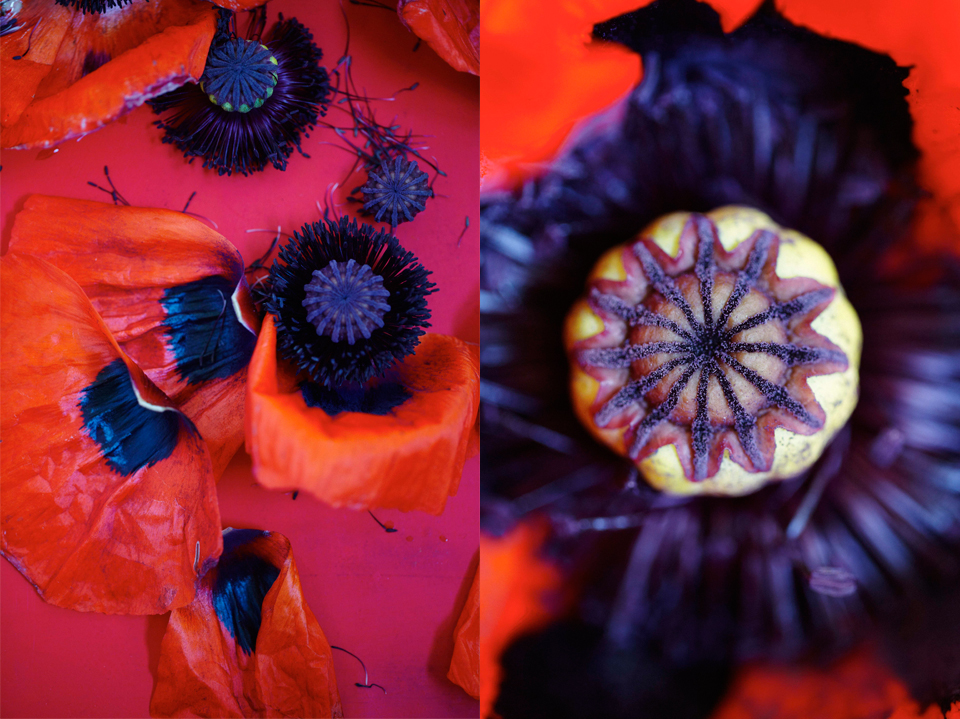
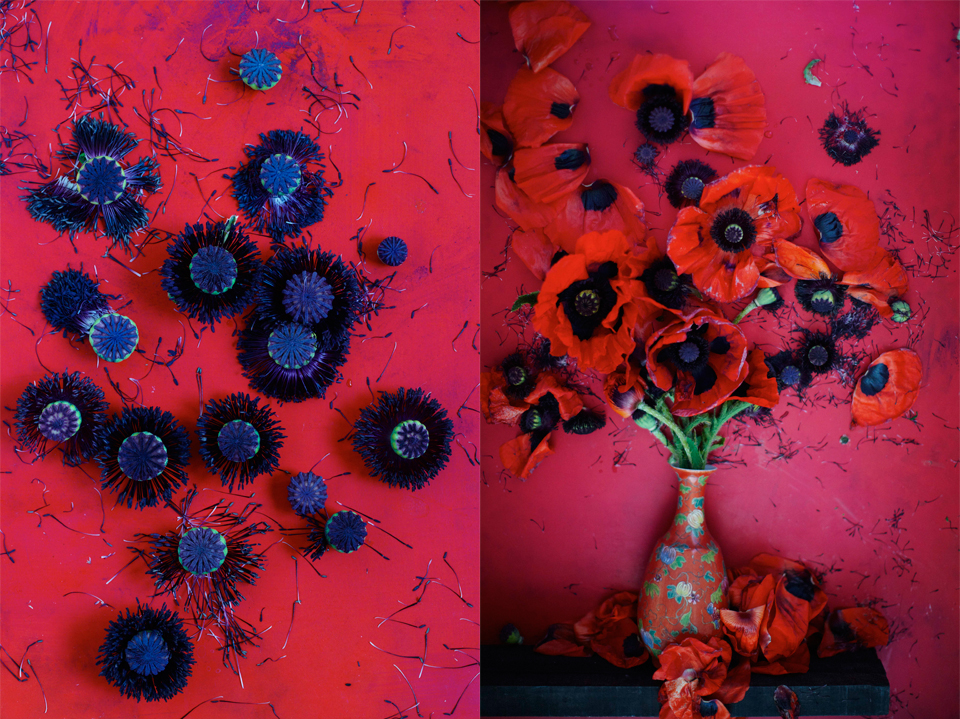
Dietlind Wolf's work is multiple: she is a propstylist, a photographer, an illustrator, a designer… exactly the kind of person we love at Trendtablet. We are happy to share with you one of her latest work on poppies with a personal and powerful expression of colour.
We asked Dietlind to give us some keys to better understand her work and personality.
"For my final examination I spend a month in India, to write and recreate the story of madras checks. It was the first time in my life I lived "inside" the colours I knew only from colour pigments before.
In the field of creating prêt-à-porter and Haute Couture textiles, I found the way to materialize colour into textile, to play with materials and to create new ones.
Those two experiences really shaped me.
I then had years of experience in styling for food and still-life photos. Digital photography allows me to play with real materials: with flowers or with my porcelains. As a stylist, I build a bouquet and focus on it, and after, I "ruin" it, or in other words, I use my finger and my hand as brushes. I transform the still life into something more textile, always with a need of balance between form, colour and contrast. At the end, it touches me when everything play well together."
photos dietlind wolf
photos dietlind wolf
botanical blueprints
Commelina communis - art by Makoto Murayama - courtesy of Frantic Gallery
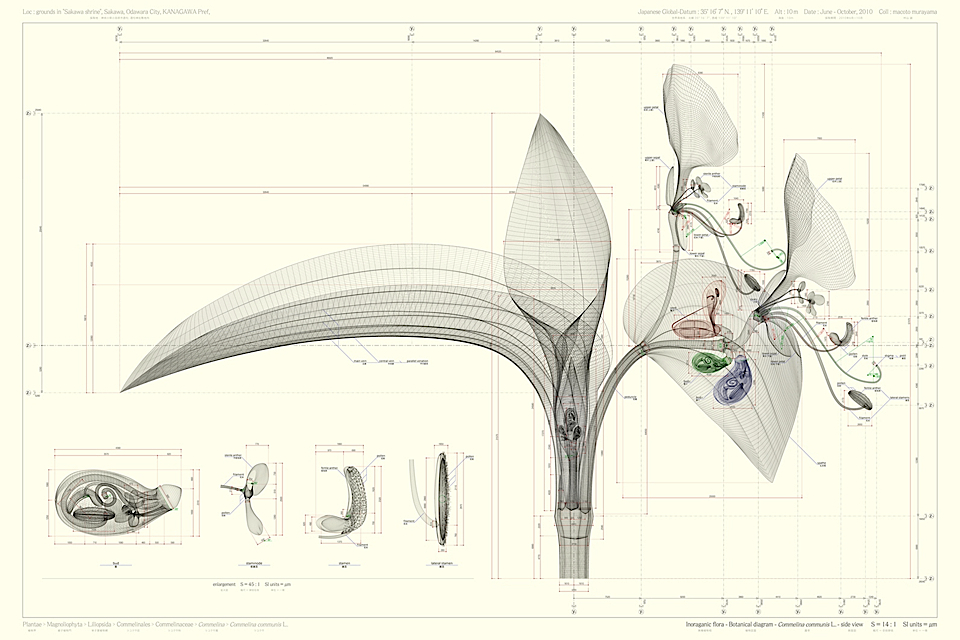
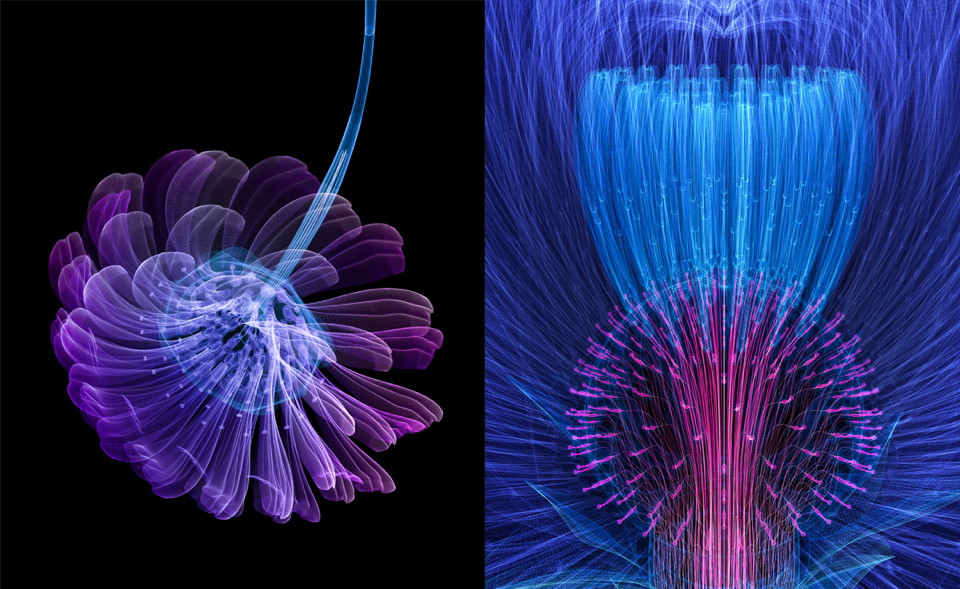
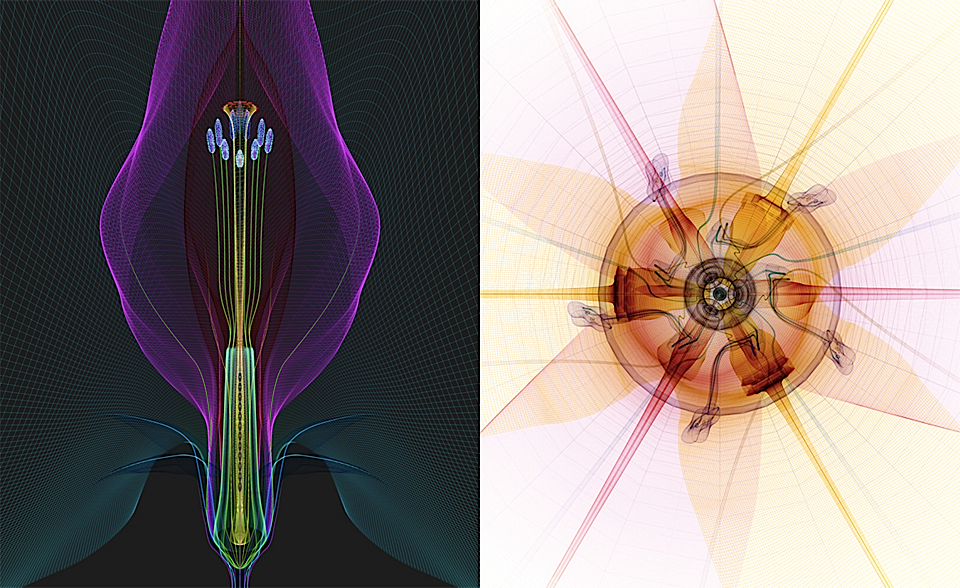
Makoto Murayama is a New Media artist, with a background in computer graphics illustration. His most recent exhibition, “Inorganic Flora,” was displayed at the Frantic Gallery in Tokyo. Using cutting-edge software and 3D modeling, Murayama creates synthetic images that reveal new possibilities for botanical illustration in the Digital Age. A meditation on the margins, Inorganic Flora merges the beauty of nature with the art of scientific progress.
Murayama’s exhibition stems from the botanical illustrations of Ancient Greece as well as the sketches of Tomitaro Makino (a pioneer in Japanese botanical illustration.) His work is also inspired by Yoshihiro Inomoto — a master of automobile illustration — as well as by the art of engineering configured during the age of the Industrial Revolution, and X-ray art of the late 20 th century.
Murayama begins by making a vivisection of a flower, takes multiple close-up photos and then sketches the inner cavity of each flower. Afterwards, he uses several different software programs: 3ds Max for form and structure; Adobe Photoshop for separate parts and composition; and Adobe Illustrator to add indications of elements, scale and scientific names.
Finally, Murayama makes large-scale digital c-prints, and frames each with transparent Plexiglas.
Text by Beth Lauck.

Southern star - 27685 - Pureblue - ˙A - art by Makoto Murayama - courtesy of Frantic Gallery
Transvaal daisy - Chrysanthemum-B - art by Makoto Murayama - courtesy of Frantic Gallery
Sweet pea-˙B-bc & Japanese lily-˙C-wc art by Makoto Murayama - courtesy of Frantic Gallery
une vision végétale
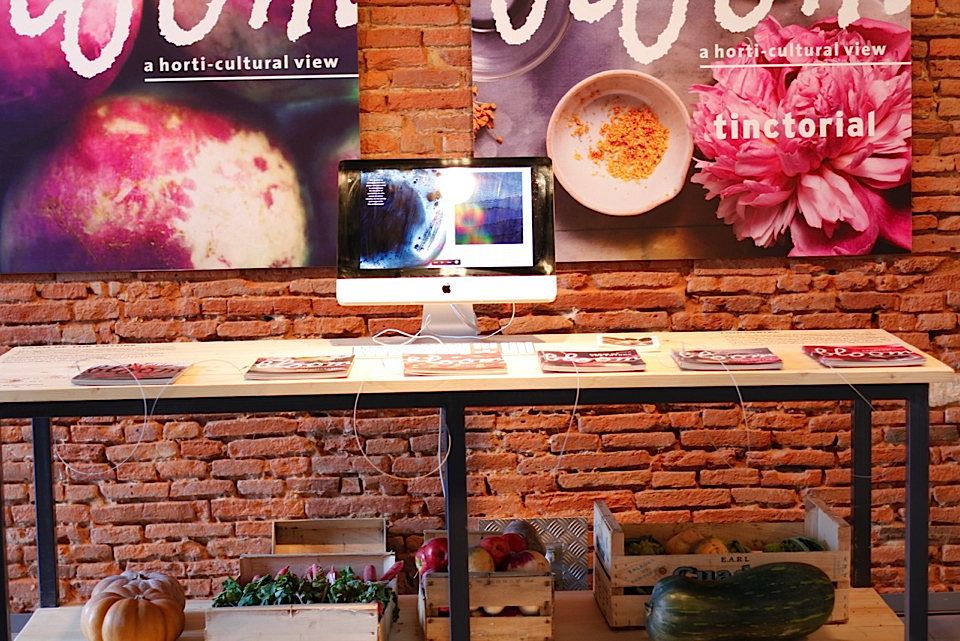
photo by Vanessa Batut
In Toulouse, France, at the Fondation pour l'Art Contemporain until the end of february you can visit the exhibition: Bloom, une vision végétale.
"A new romantic yet also realistic view of living in the country has emerged.The current financial crisis and our concerns about ecology have contributed to the rethinking of our existence in the challenging and stressful city, while advances in information technology have participated in setting humans free from a fixed location within the urban environment."
Lidewij Edelkoort
Some french press articles on the exhibition
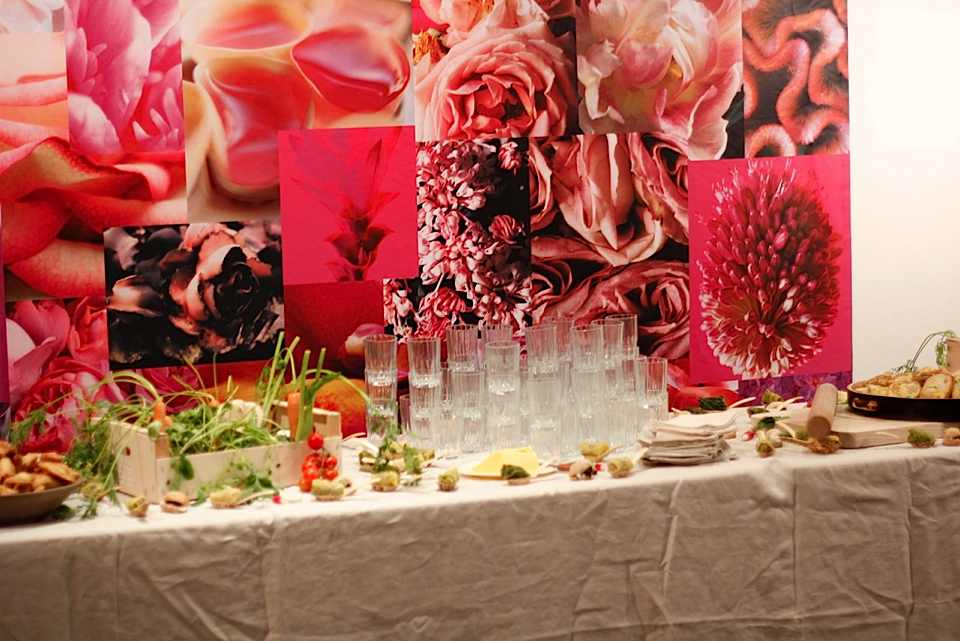
photo by Vanessa Batut
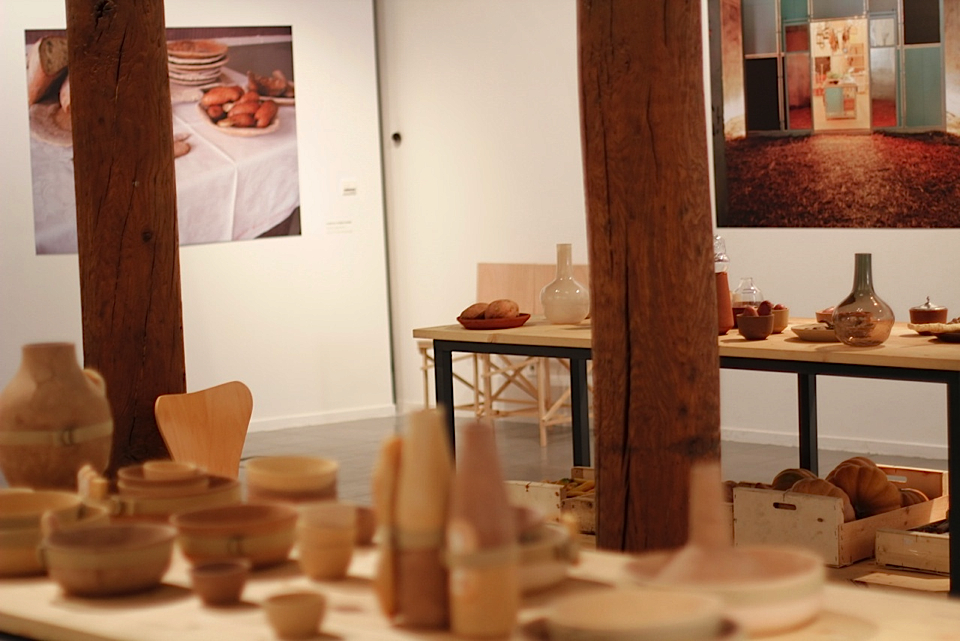
photo by Vanessa Batut
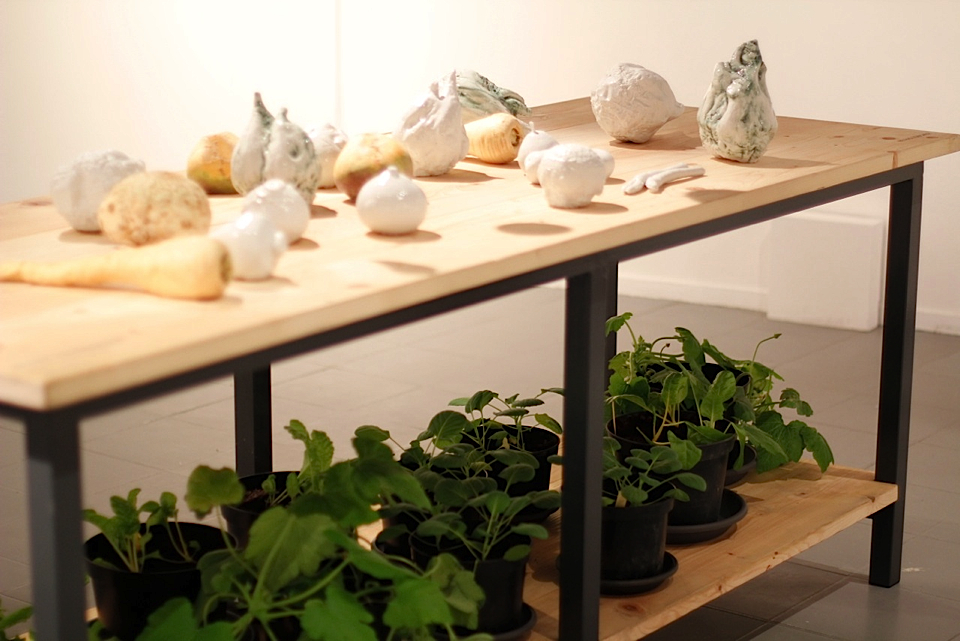
photo by Vanessa Batut
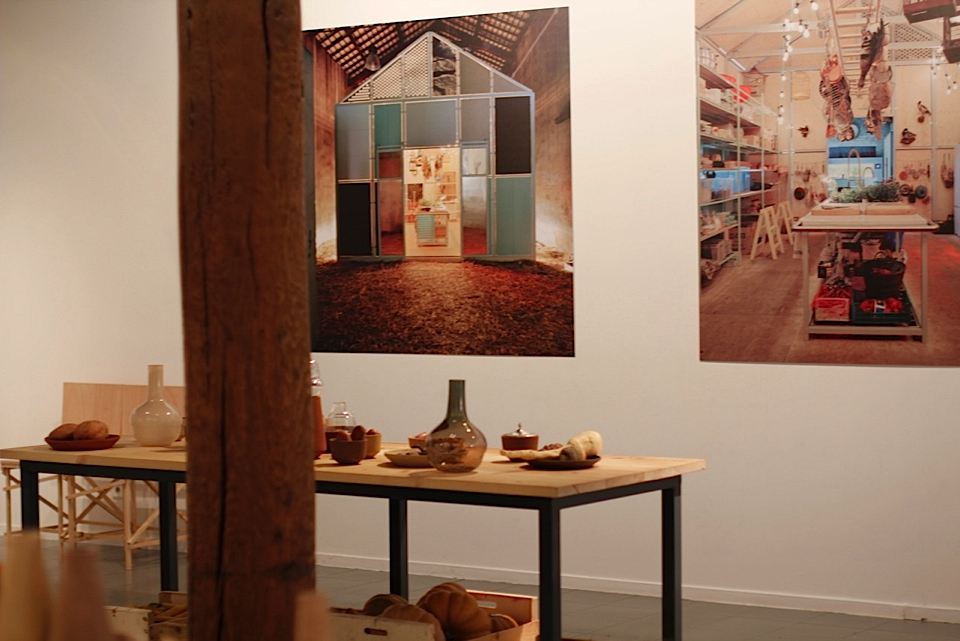
photo by Vanessa Batut
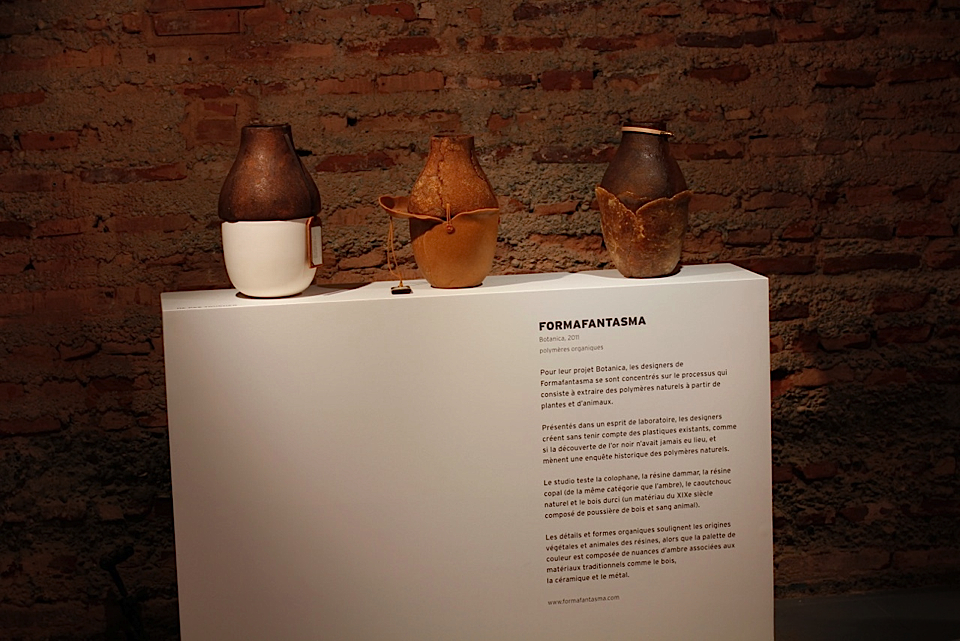
photo by Vanessa Batut
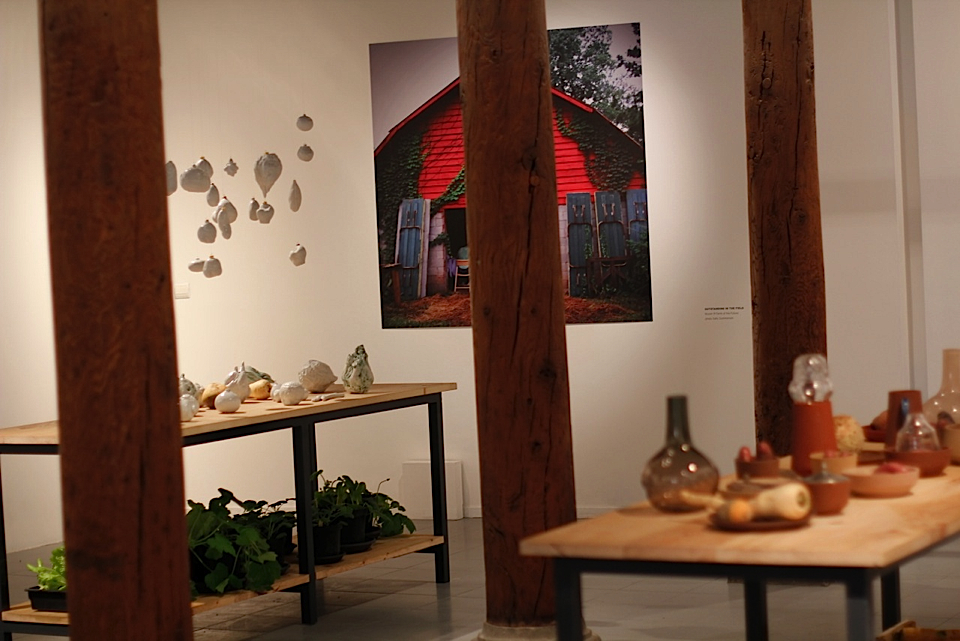
photo by Vanessa Batut
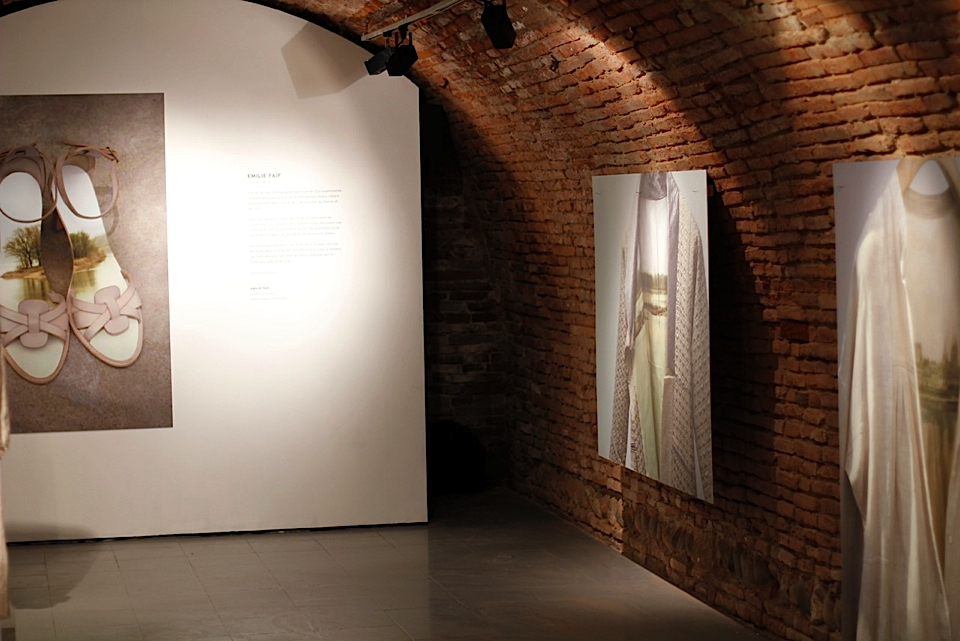
photo by Vanessa Batut
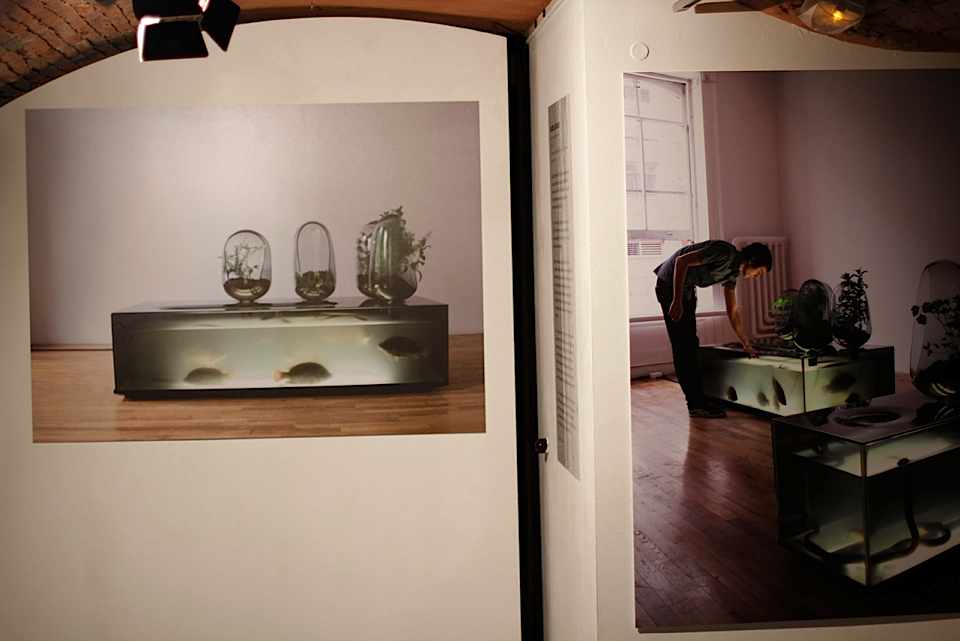
photo by Vanessa Batut
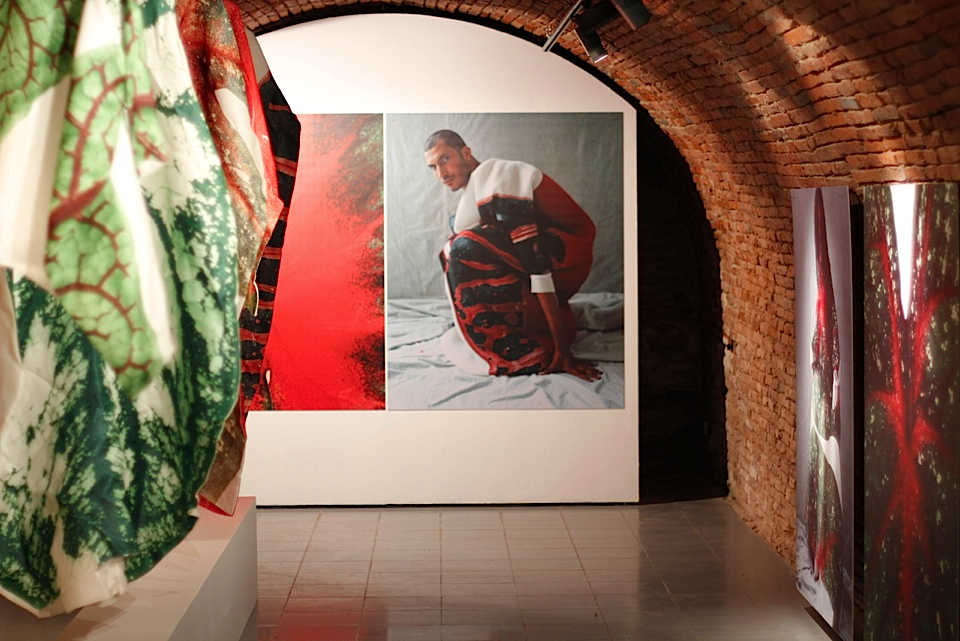
photo by Vanessa Batut
wild innocence
photos by vee speers
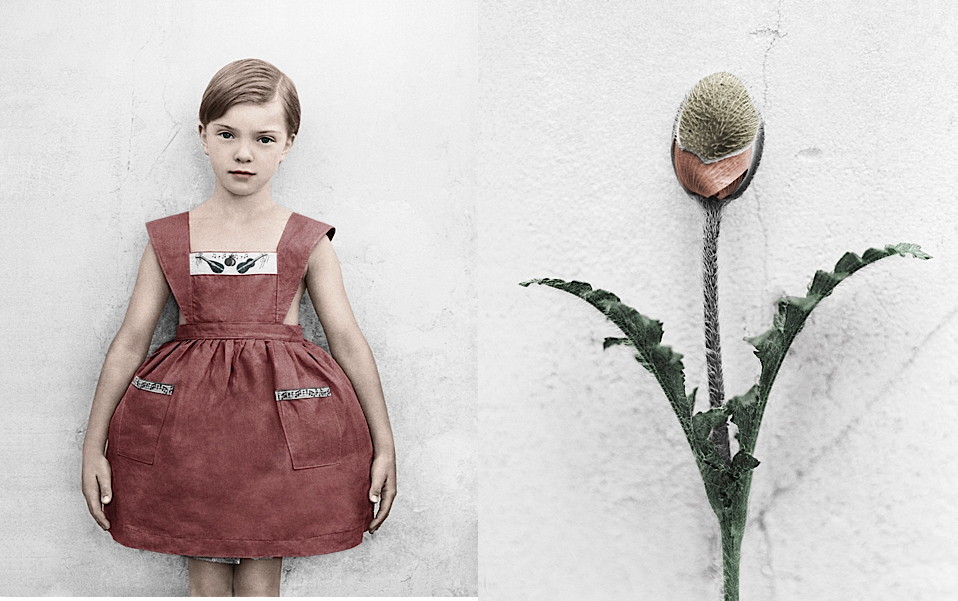
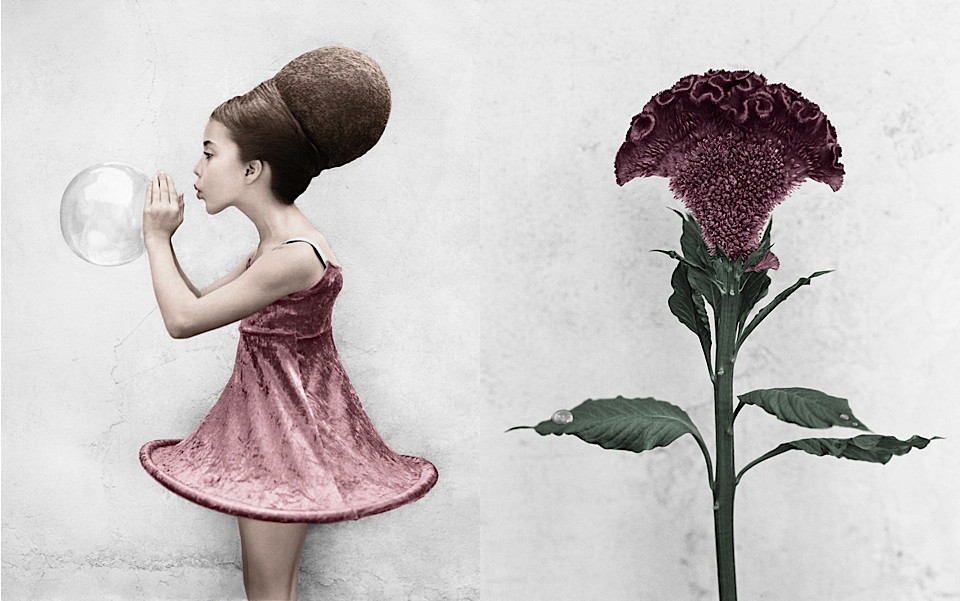
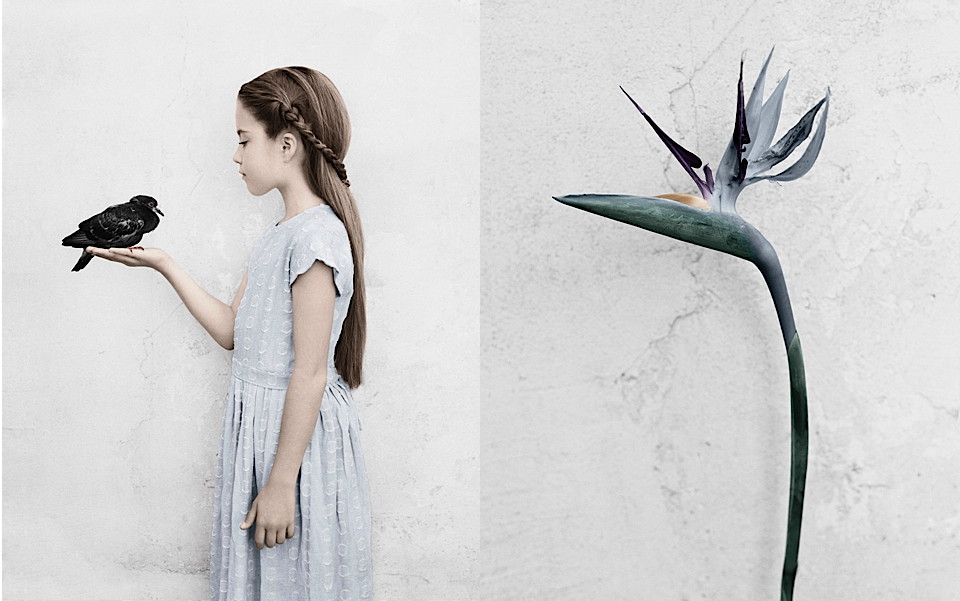
The expansive landscapes of children’s imaginations know no boundaries and have the power to transcend reasoning and logic. Dressing up, role-playing and telling stories sweeps us away to a magical alternative plane, where flora and fauna can provide mysterious props and where uncanny resemblances bring to life new floral friends.
Vee Speers’ hand-coloured photographic images transform childhood memories into haunting portraits of the future, inviting us to join an imaginative garden party and charming us with narrative masks, ballooning blooms, blown bubbles and fluttering birds of paradise.
Yet the arresting images in Speers’ œuvre reveal the unfettered dark side of the children, as we watch them turn into post-nuclear street fighters, sinister shamans adorned with dead animals, armed activists and bad-tempered fairies with the power to unleash their merciless ways.
Text by Philip Fimmano
photos by vee speers
photos by vee speers
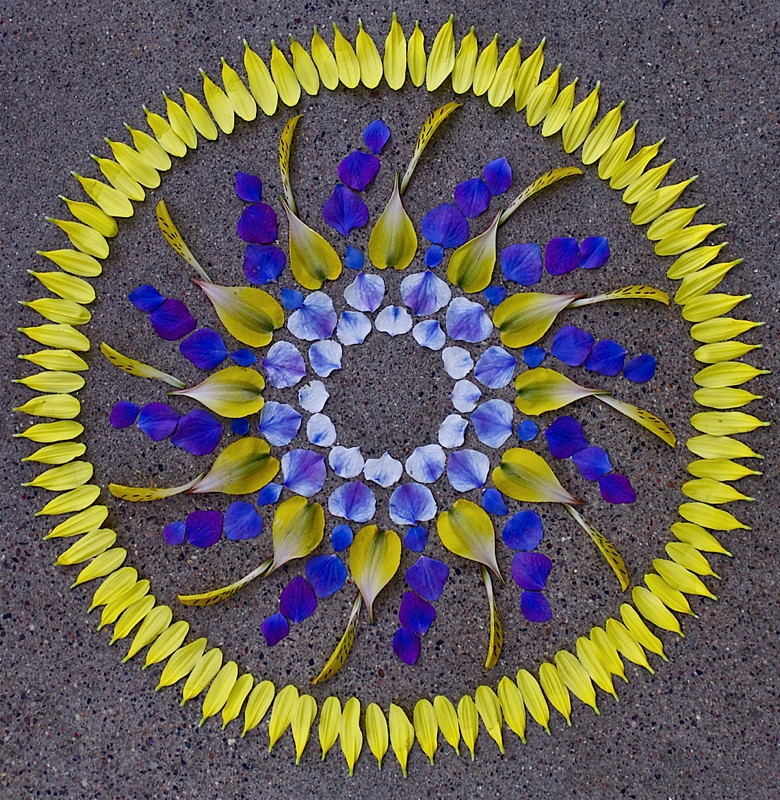
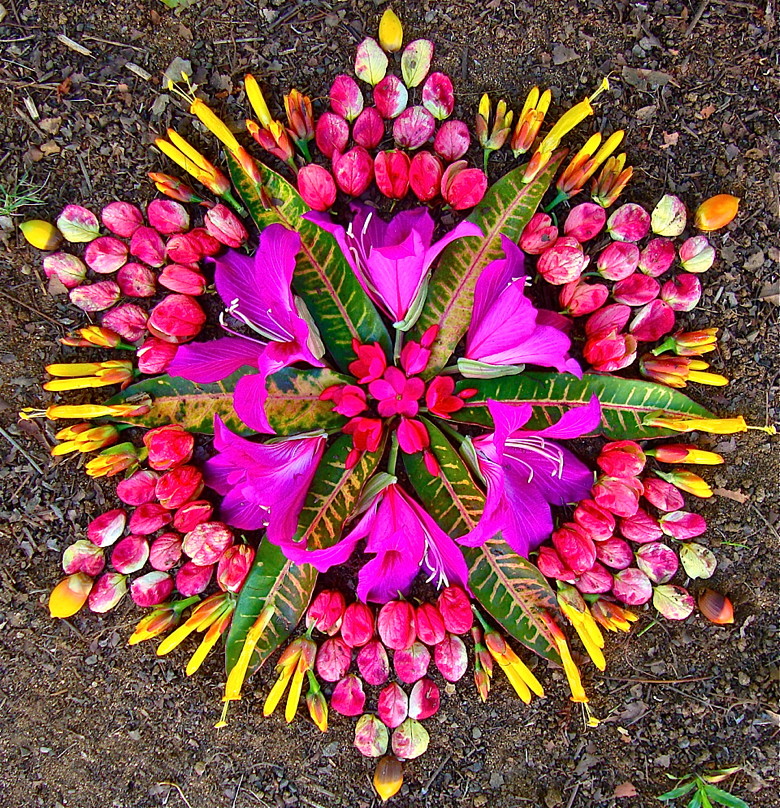
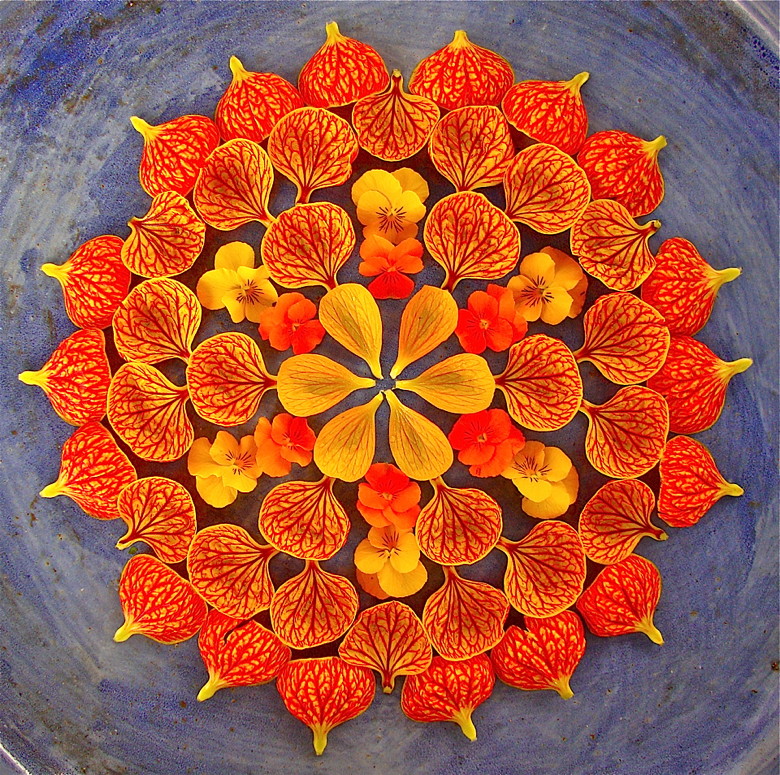
sacred flower circles
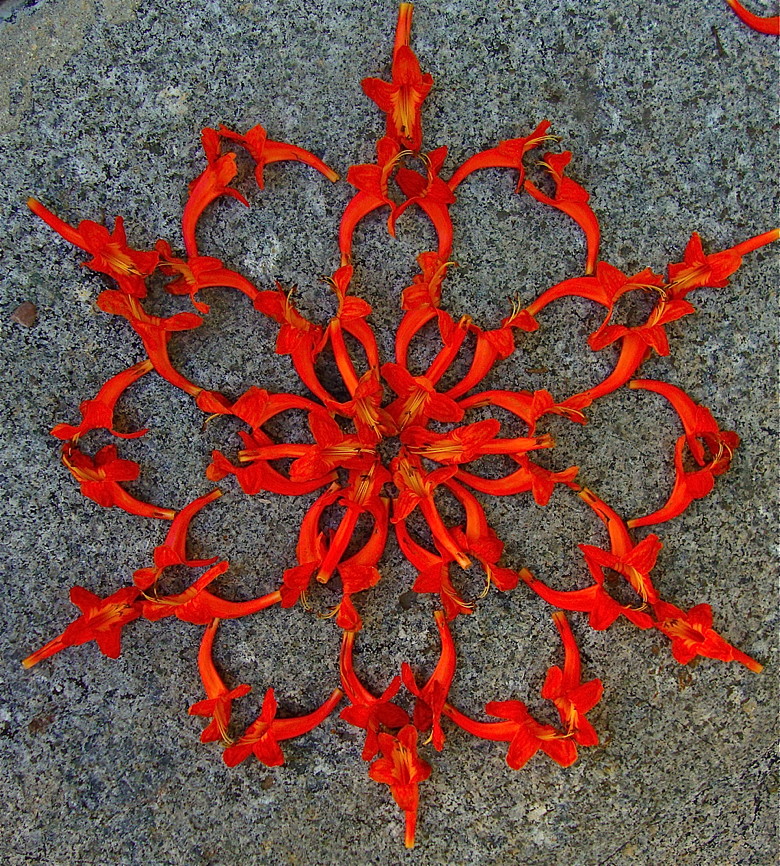
design and photo by kathy klein
The work of Kathy Klein offers a glimpse of the eternal. She creates danmalas, in vedic sanskrit dān: the giver, mālā: garland of flowers; the giving of flower circles. These spiritual offerings reflect the wisdom of nature and a sense of the sublime. Through guided meditation, Klein gathers flowers and other natural objects to generate a vivid spectrum of color, pattern and texture. Each design is unique, governed by the rhythms of the seasons and the innate beauty of the natural world. Her praxis is archetypal, her creations: enigmatic.
Klein’s danmalas illuminate a rare aesthetic. Relying solely on what she finds in any given environment, Klein reminds us of the importance of living and creating locally, without forgetting what it means to be a part of a global collective.
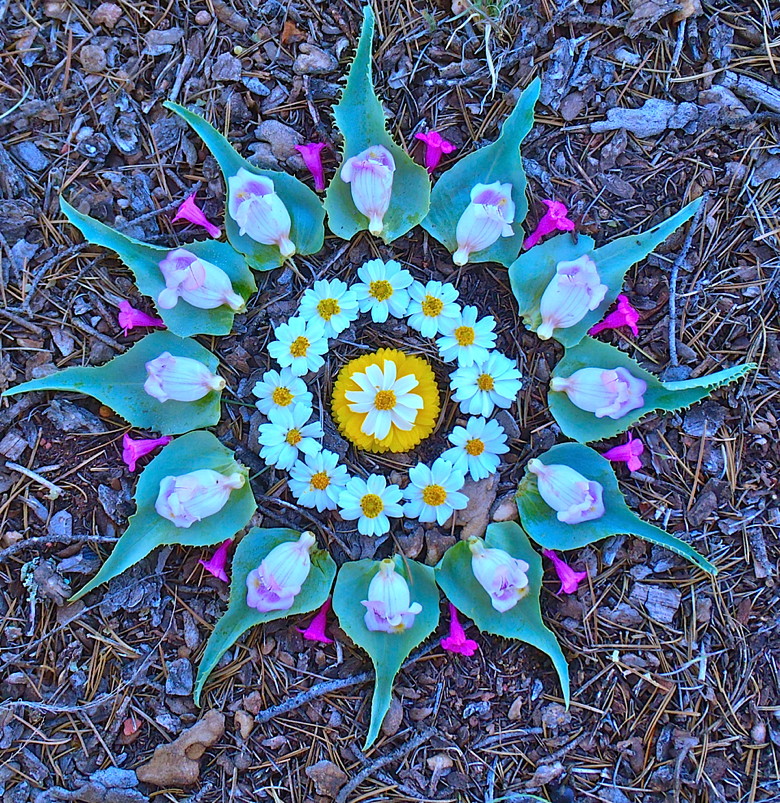
design and photo by kathy klein
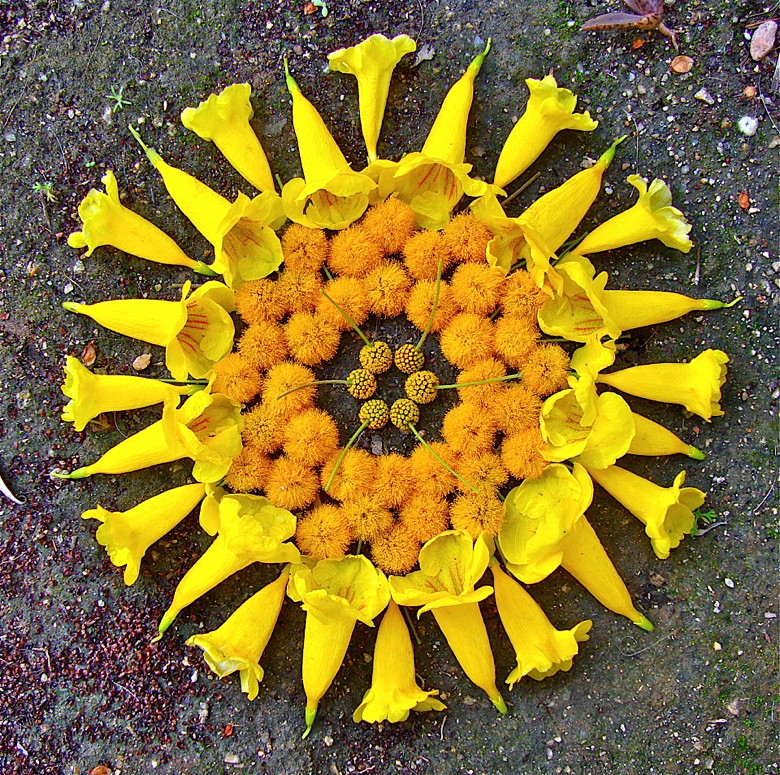
design and photo by kathy klein
design and photo by kathy klein
design and photo by kathy klein
design and photo by kathy klein
bewitched by the bel objet
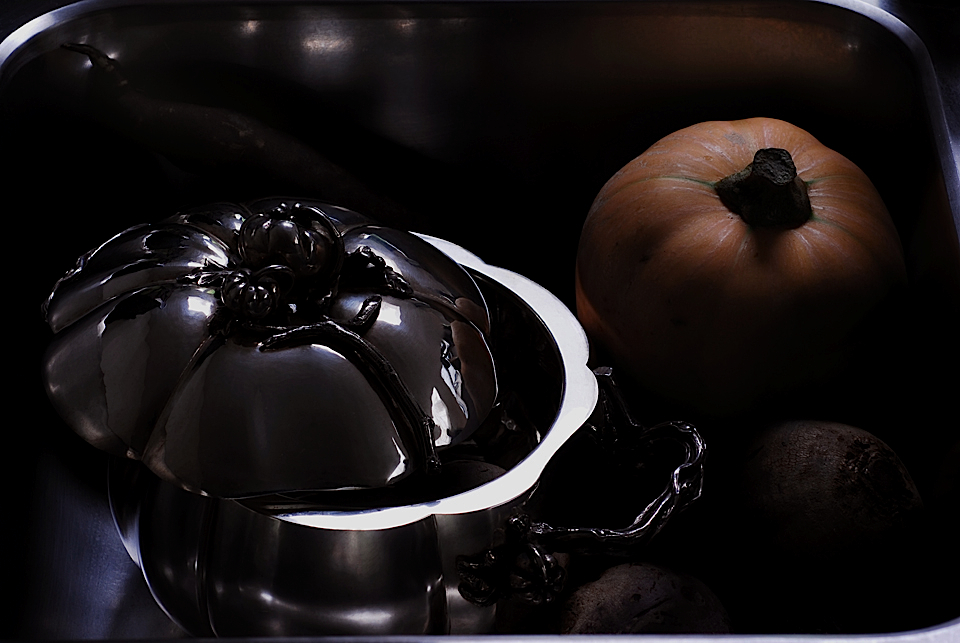
photo by sacha van dorssen - creative director nelson sepulveda
In search of fantasy and surprise, we seek new alliances between the decadence-twinged purely decorative and the lush down-to-earth generosity of the vegetable garden. We are inspired to forage for precious potager treasures among the many wonders at the traditional gold- and silversmith’s shop Lappara, working dreams into metal since 1893 in Paris’ Marais district. Where the utilitarian kitchen meets the ultimate hedonism, gleaming bunnies, gourds, and artichokes cast in gold, silver and gilded bronze nestle among green cabbages.
Where the ephemeral richness of the vegetable in its prime meets the eternal objet, metal glimmers nobly in the shadows of the night kitchen, suggesting the preparation of bounteous feasts and the ludic, erotic, mysteriously narrative decoration of the house. Text by Michelle Anderson-Binczak
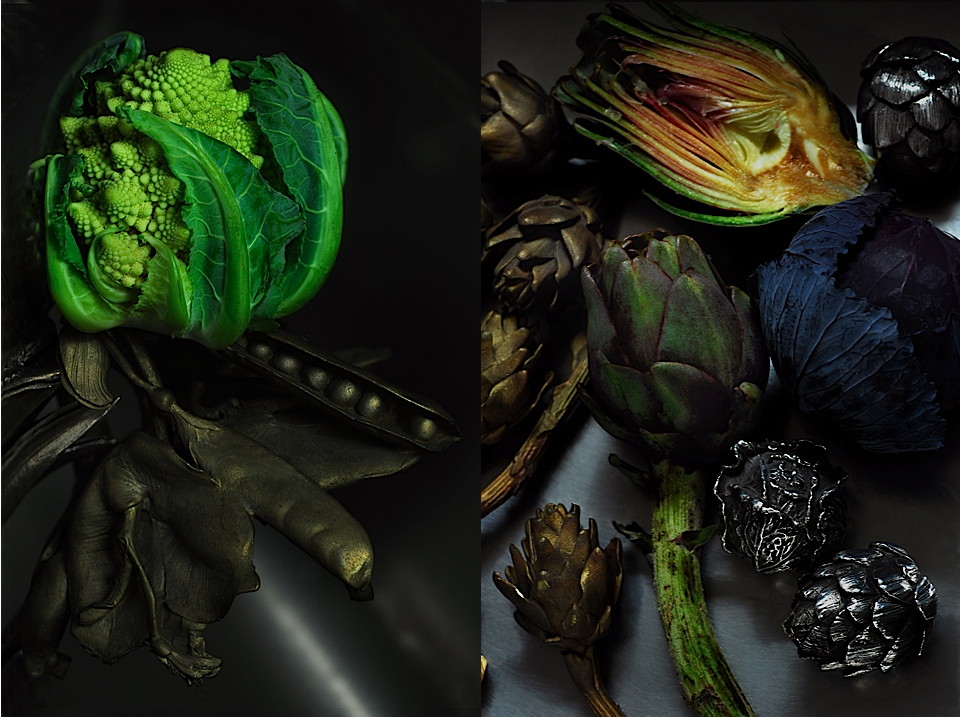
photo by sacha van dorssen - creative director nelson sepulveda
plantbombing
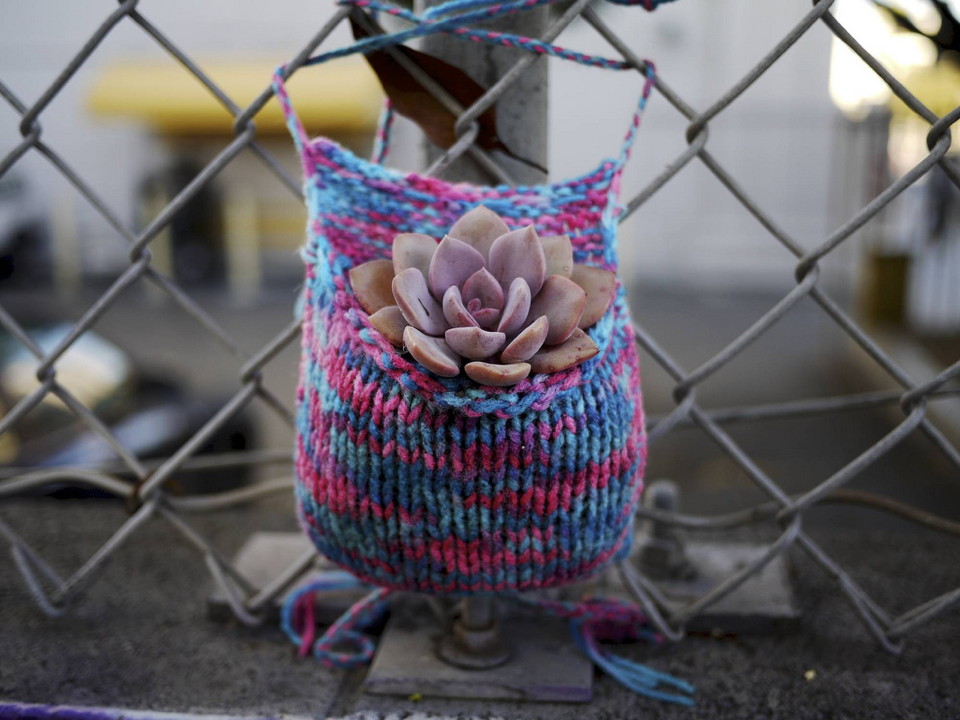
photo by derek powazek
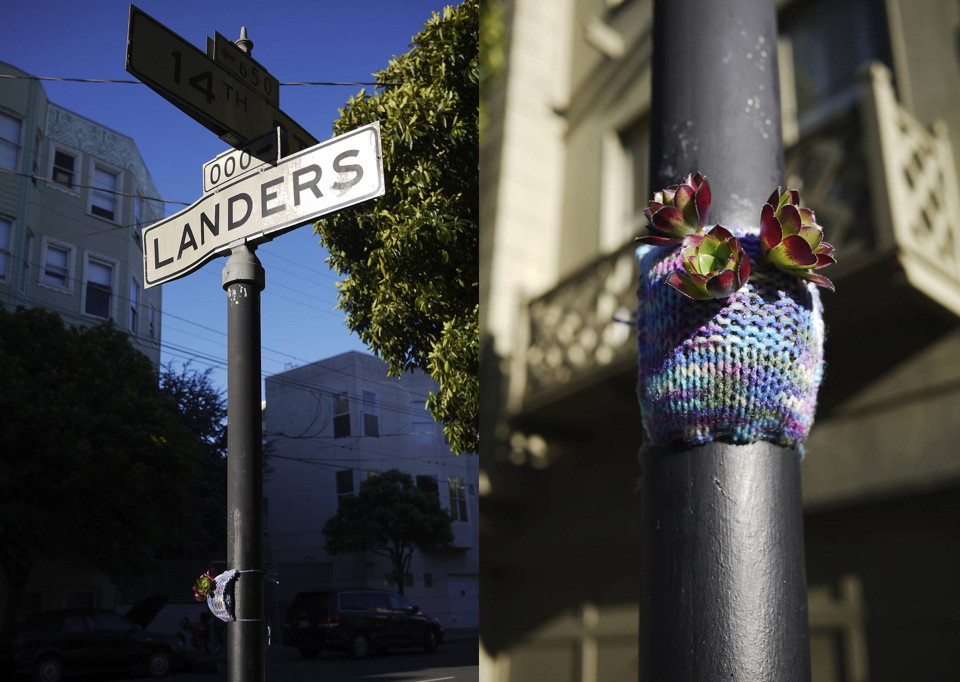
San Francisco-based urban knitter Heather Powazek Champ and guerrilla gardener Derek Powazek decided to combine their forces and came up with the the very best of both worlds. The couple started installing so-called ‘plant pockets’, low-maintenance species in beautifully hand-knitted yarn pockets, all over San Francisco. They call their project "Plantbombing," and it combines Heather's love of "urban knitting" and Derek's skill at gardening.
Using yarn, a bit of soil, and some hardy plants, the result is a hands-off, smile-inducing work of art. Derek gives some advice on selecting suitable species like Echeveria and Aeonium - two plants that do quite well in San Francisco climate. Do it yourself : all details are on their websites….
photos by derek powazek
living jewels
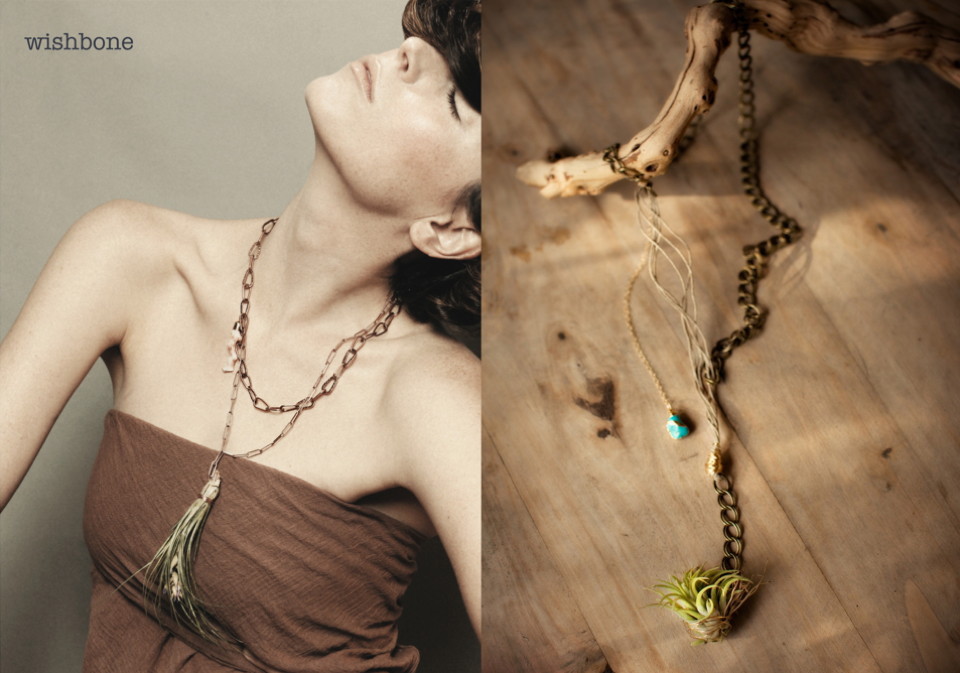 photo by nicol ragland
 photo by siouxzen kang
Jessica Viola is a botanical designer, she spent the past decade cultivating her design portfolio based on sustainability and artistic vision. She got a background in organic and botanical design and a strong passion for plants, ecology, culture and creative expression. So, Jessica is not only a garden designer, she also designs modern botanical jewels. Those living amulets act as a vehicle to inspire greater environmental consciousness by deepening our relationship to plants.
All jewelry is handmade and designed using sustainably harvested and ecologically responsible materials, including natural fibers and hemp, rare and inspired gems from friends around the globe, fine chains including 24K gold overlay, sterling silver, rose gold, copper, brass and recycled metals, and rare species of Tillandsias (air plants) that are grown organically and sustainably.
Air plants do not require soil, only indirect sun and occasional spritzing. With attention and a bit of care, like any garden, your living garden will bloom and blossom around your neck, next to your heart.
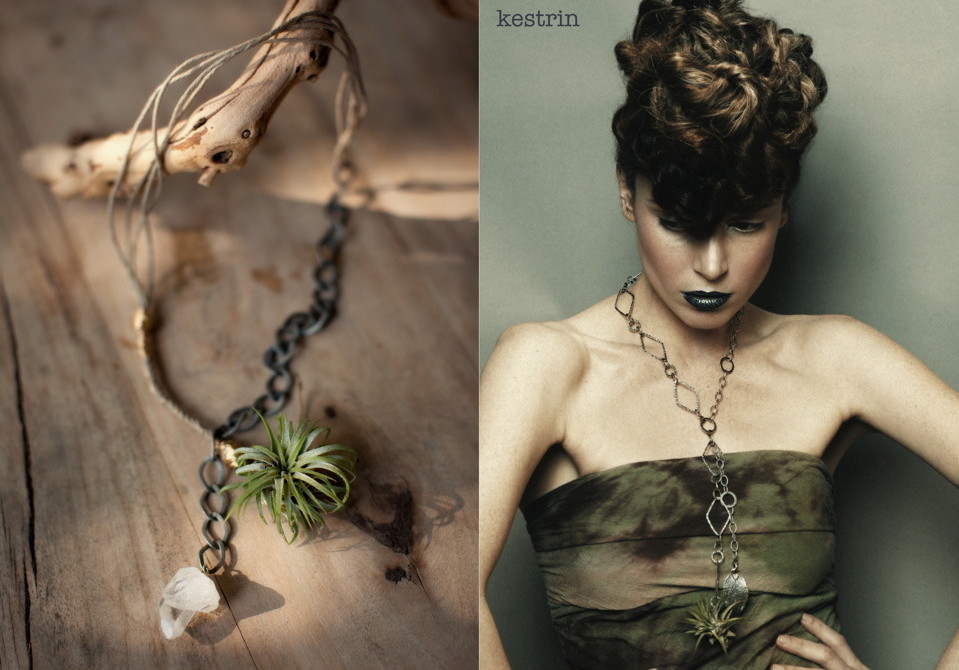 photo by siouxzen kang
 photo by nicol ragland
seminar in paris
In april, Lidewij Edelkoort hold a seminar in Paris at Galerie Végétale on Bloom.
Enjoy the mood of this lovely place and the arty setting of Bloom's photo's exhibition.
2011-06-21 14:20:04
introduction
Bloom was created in 1998, in response to the ever-growing lifestyles inspired by trends in flowers, plants and gardening. Bloom is the first magazine of its kind, analyzing with informative and inspirational photography and texts the major trends in this area, and how this relates to industries as varied as fashion, interiors, design, packaging, cosmetics, food and culture.
Bloom speaks to all levels of the industry, from hybrid creators to growers, from designers to individuals.
2011-04-26 00:27:48
homegrown talent
In 2003 two sisters, Kate and Laura Mulleavy had finished college and were sitting in their parents home in Pasadena, California both taking the year off to figure out what the next step in their lives should be.Kate had majored in Creative Writing and Laura studied both Biology and English. Having slightly hippie parents there wasn’t the traditional pressure to jump right into a career. Their mother was an artist and their father was botanist, giving their upbringing an equal balance between creative expression and the microscopic study of nature. Kate explains the impact of her childhood “ Because of that we have always had this connection to the idea of the land in terms of human and natural expression.” Their parents influence combined with fantastic natural beauty of the area, have always fueled their creative impulse, from the start nature was their muse. They grew up submerged in the vast beauty of Northern California in a home that was surrounded by an apple orchard, eucalyptus forest and a tiny rocky beach. Although out of all this rich landscape the most dramatic influence on them was by far the dynamic Redwood Forest.
Throughout their teen years the girls shared an obsession with fashion, but because of their location it remained an isolated interest, an industry that was happening elsewhere that they loved from a distance.The idea of approaching fashion in a straight forward way (design school and then apprentices in the industry) never appealed to them largely because this path was distinctly urban and not in sync with the laid back lifestyle and direct connection to nature they had grown to need. Their post college year off was spent watching horror movies to the point of total boredom, which pushed them to finally pursue what they had only dreamed of.Together they embarked on the completely improbable journey of launching a fashion label out of Pasadena California. Without any technical knowledge they designed a ten piece collection under the name Rodarte (there mothers maiden name). Armed with passion, and there love of nature the two sisters turned their lack of knowledge into an advantage, instead of being fearful of the unknown each step became an opportunity for invention.
What happened next is what fashion dreams are made of. They took their collection directly to New York setting up appointment that a New York fashion student would be far too intimidated to pursue. One out of the four that agreed to meet with the then unknown talents was Women’s Wear Daily. Their fresh perceptive and new starting place was immediately recognized and with in days they ended up on the cover of the industries weekly newsletter.
Soon followed the call from Ann Wintour at Vogue and within a season the improbable outsiders were swept into the fashion system and celebrated for attacking design with a distinct new mindset. Fast forward to 2011 and the sisters have had quite an amazing career. Even with the embrace of the industry they have remained radical still questioning every step of the process while making avant-guard collections with inspiration ranging from, Star Wars, the deconstructed buildings of GordonMatta Clark, what it means to be Frankenstein, poems about blood by Silvia Plath and the bondage photo’s of Nobuyoshi Araki. The originality of their work have made them favorites of both the media as well as women everywhere, even catching the attention of director Darren Aronfskys. His love of there work won Rodarte the ultimate commission designing the breathtaking costumes for Oscar contender Black Swan.
Here Bloom showcases Rodarte’s Spring 2011 collection.Which brings the women back around to their eternal muse, the redwood trees. Re-imaging the texture color and pattern of bark transforming it into would grain blouses and veneered cocktail dresses. They have taken the rawness of the wood creating fantasy textiles that are surprisingly elegant but capture the romance of the forest. Laura explains this collection has "every shade of brown you can imagine, seventies suburbia, wood paneling, gold, off colors like chartreuse—basically, a combination of all the things that represent the area to us."
by Michael Bullock
michaelj.bullock@gmail.com
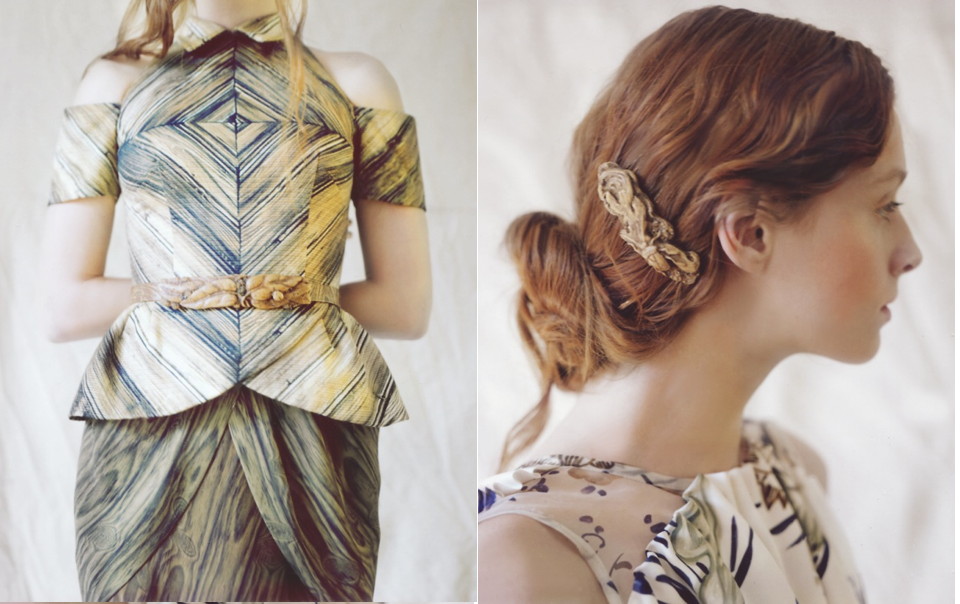
photo marie taillefer - styling shane powers
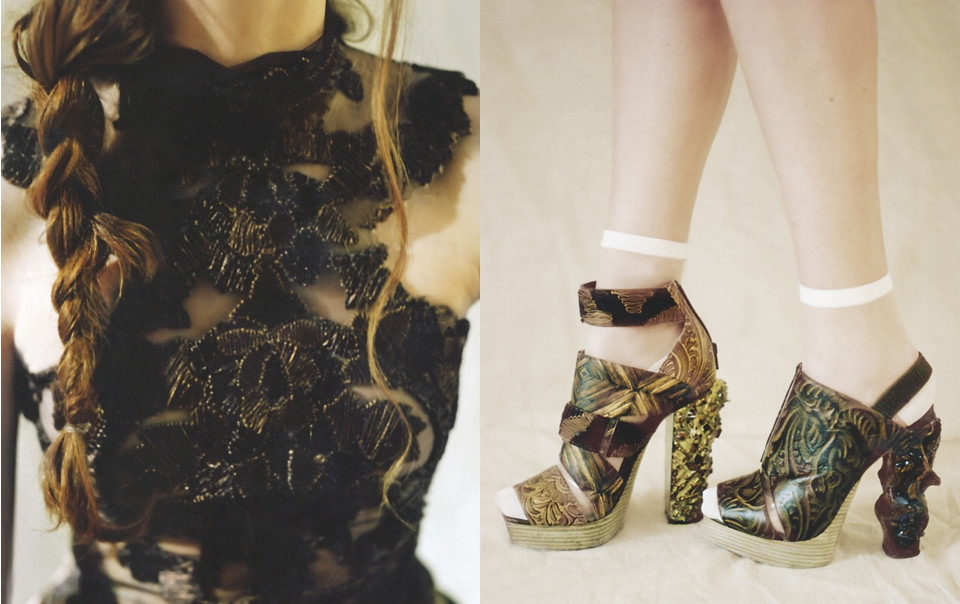
photo marie taillefer - styling shane powers
2011-06-08 09:46:08